Google ships four AI chip systems in one year: new TPUs encrypt data in use and double the memory wall
Google has stopped treating its chip as a component. On November 9 the company completed an eighth generation built like a product line — one system that keeps data encrypted while it computes, another that doubles the memory wall inside the same rack — and aimed both squarely at the workloads Nvidia's customers cannot easily move.
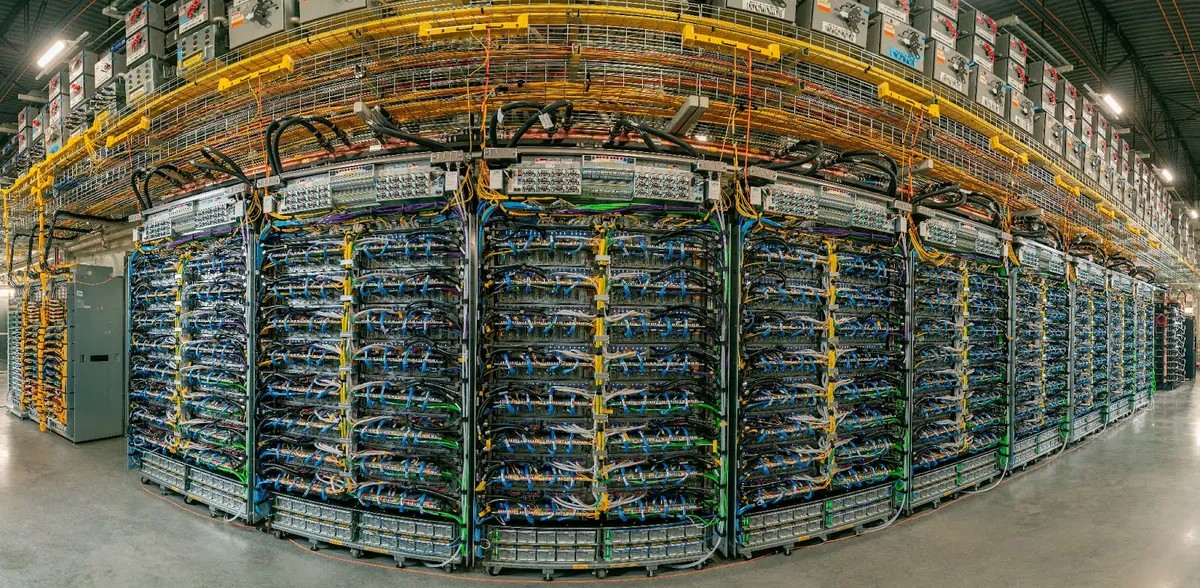
Photo: Google (official blog). The photograph shows an Ironwood (seventh-generation) superpod — Google's current TPU infrastructure; no eighth-generation installation exists yet to photograph.
Four systems, one year, no new silicon required
Google has done something it has never done before: shipped four AI chip systems in a single calendar year. On Monday, November 9, the company added the TPU 8tx and the TPU 8i Max to its eighth-generation line, completing a portfolio that began in April at Cloud Next with the TPU 8t for training and the TPU 8i for real-time reasoning. The two April systems set the generation's baseline — up to 2.7 times better training performance from the 8t and 80% better inference price-performance from the 8i, measured against the previous generation. The two November systems aim at narrower, more urgent problems: keeping secrets while a model is using them, and feeding agents that think across millions of tokens at once.
Notice what Google did not announce: two brand-new chips. The 8tx is built on the same silicon as the 8t; the 8i Max is two 8i chips fused into a single package. That is not a shortcut — it is the strategy, and the company says so out loud. A chip takes years of physics and fabrication; a system — the packaging, memory, networking, hosts and security wrapped around silicon — can be rebuilt in months. Google has been designing its TPUs as modular building blocks for the better part of a decade precisely so it could answer a market moving at agent speed, and four systems in twelve months is the receipt. The business behind it is no longer a science project: the TPU operation now counts nearly 100 customers, Google says — frontier AI labs, trading firms, retailers and universities — and Alphabet reported TPU system sales contributing to a September quarter in which Google Cloud revenue more than doubled year over year, to $30.71 billion.
TPU 8tx: the machine that keeps secrets while it works
Every encrypted system has the same hole in it. Data is protected while it sits on a disk and while it crosses a network — but the moment a computer actually processes it, the data is unlocked in memory, readable by whatever shares that machine. For a hospital network, a bank or a ministry, that moment is exactly where the compliance department says no, and it is why some of the most valuable AI workloads on earth — models run against medical records, financial data, citizens' files — have stayed off the most capable hardware.
The TPU 8tx is Google's answer, and it is built for regulated enterprises and governments by name. On the same silicon as the training-grade 8t, paired with fifth-generation AMD EPYC host processors, it moves security into the hardware layer itself: sensitive data and model weights stay protected and isolated even while in active use — encrypted not just at rest and in transit, but in the act of being computed on. Google pairs that with the low-latency Boardfly network from the 8i and claims up to 2x lower latency than the 8t at a near-zero performance penalty, so multi-step agents keep moving instead of waiting on the security layer. And because the same box carries training-grade compute, a team can fine-tune a model on private data, distill it into a smaller one and train agents against it — without ever migrating the sensitive data to a separate cluster, which is where leaks and audit findings usually happen.
TPU 8i Max: two chips, one package, twice the wall
The second new system attacks the other wall in AI infrastructure: memory. When dozens of agents work together across an entire software codebase or hours of video, the bottleneck is no longer raw compute — it is how fast the machine can feed context to the chips. Google's answer is disarmingly physical: take two low-latency 8i chips and combine them onto a single package. The 8i Max delivers double the compute, double the SRAM and double the high-bandwidth-memory bandwidth of a single 8i, and because it fits twice the silicon within the existing rack footprint, a data center gets significantly more computing power per square foot and per watt — the two currencies every operator is actually short of.
The absolute numbers, reported by Network World from Google Cloud's briefing, sketch the shape of the machine: 384 GB of high-bandwidth memory per package (about a third more than the 8i), 17.2 TB/s of memory bandwidth and 768 MB of on-chip SRAM. Around the hardware, Google is open-sourcing the model-state layer it calls TPU Sync, which tiers the giant key-value caches of long-context models off the chip and claims to cut their transfer latency — and time to first token — by more than 90%. The eighth generation, taken together, now reads like a menu written for the agentic era: the 8t for scale-up training, the 8i for low-latency reasoning, the 8tx for confidential computing, and the 8i Max for massive context windows and the highest compute density per rack.
The door opens: PyTorch, no rewrites
Hardware was never the only moat in AI chips; the software ecosystem was, and Google spent the same announcement attacking it. Last month the company open-sourced TorchTPU, so PyTorch code and Hugging Face models now run natively on TPUs — no code rewrites — alongside backends for the vLLM and SGLang inference engines that the open-source world actually uses. A new open-source agent suite plugs into coding tools to automate TPU onboarding and tuning in plain language, and Google says its native stack holds state-of-the-art price-performance marks on the InferenceX and AgentX benchmarks, which test realistic agentic coding and long-context work. The subtext is aimed at every engineering team that ever defaulted to the incumbent: the switching cost you were afraid of is the thing we just deleted.
The decision this sets
Strip away the launch language and two concrete decisions land on real desks. The first belongs to regulated industries: for years, the honest answer to “can we run frontier models on our most sensitive data?” was a workaround — smaller models, on-premise compromises, or a risk acceptance form nobody wanted to sign. A hardware-confidential accelerator changes that conversation in the next cloud renewal and in every AI RFP that touches health, finance or government data: the question is no longer whether encrypted-in-use AI exists, but what it costs and when it ships. The second decision is about the default itself. Staying entirely on the market's dominant GPUs has meant paying the scarcity premium and standing in the supply queue; Google is now offering a credible second source whose cloud business just doubled year over year, with an open software door. Both decisions, though, carry the same asterisk, and this magazine prints it in the same size as the claims: Google has published no prices, every performance figure in this story is the manufacturer's own, and no independent benchmark of either new system exists yet. Bloomberg reports both systems arriving in 2027 — reported, not promised. Evaluate now, by all means. Budget as if the brochure were true, not yet.
What is not in doubt is the velocity. A company that designs its own AI, trains it on its own silicon, and now reconfigures that silicon into four enterprise systems in a single year is telling the market something structural: in the AI era, the chip is not a component you buy. It is a strategy you operate. The rest of the industry — suppliers and buyers alike — now plans around that fact.
The numbers underneath
The eighth generation is not riding on novelty alone. Google says its native software stack holds leading price-performance marks on the InferenceX and AgentX benchmarks — the workloads that matter in the agentic era: inference at scale, coding agents with long context. Built with Supabase, the platform backend company, Google also reports its inference results in MLPerf, the industry measurement consortium. And under the floor, the numbers multiply: combined with the 8t and 8i, the 8i Max lifts a single pod’s HBM capacity and memory bandwidth by multiples of up to roughly five and ten times over the generation that came before it, generation over generation — again, the vendor’s own accounting, and again printed here as exactly that.
What thrills
- Speed as strategy: four enterprise systems in one year, because the computer is built around the chip, not after it.
- Security in the silicon: confidential computing removes the oldest excuse for keeping sensitive workloads off frontier AI.
- An open door: PyTorch runs natively via open-source TorchTPU — the switching cost drops toward zero.
What to watch
- Vendor numbers only: every performance figure is Google's; no independent benchmark exists yet.
- No prices, reported 2027: availability comes from Bloomberg's reporting, not a Google commitment.
- CUDA's gravity: the incumbent ecosystem still holds most tooling, talent and habit.
The clock problem
None of it is in a data center yet. Systems built on the 8tx and the 8i Max reach customers in 2027, Bloomberg reports — a two-year line between announcement and production while the incumbent ships today. Google’s answer to the timing gap is the software door it opened last month: TorchTPU is open source now, so a team can port its PyTorch stack, benchmark on today’s TPUs and walk into 2027 already running. Whether that is enough time to matter is the open question hanging over every enterprise AI roadmap written this quarter — and the reason the decision below has a date attached to it.
The data sheet
The eighth generation (Google, Nov 9, 2026)
| Field | Detail |
| TPU 8t (Apr 2026) | Training powerhouse for massive foundation models — up to 2.7x the previous generation's training performance |
| TPU 8i (Apr 2026) | Reasoning engine for real-time inference — 80% better inference price-performance vs. the previous generation |
| TPU 8tx (Nov 2026) | Confidential inference and small-scale training; 8t silicon + 5th-gen AMD EPYC hosts; hardware-enforced confidential computing; up to 2x lower latency than 8t |
| TPU 8i Max (Nov 2026) | Two 8i chips in one package; double compute, SRAM and HBM bandwidth; highest compute density per rack |
TPU 8i Max, as reported (Network World, from Google Cloud's briefing)
| Field | Detail |
| HBM capacity | 384 GB per package (about 33% more than TPU 8i) |
| Memory bandwidth | 17.2 TB/s (double the 8i) |
| On-chip SRAM | 768 MB (double the 8i) |
| Caveat | Reported figures from the vendor's briefing — not published in Google's announcement post |
The market context
| Field | Detail |
| TPU customers | Nearly 100 — frontier labs, trading firms, retailers, universities (Google) |
| Google Cloud, Q3 2026 | Revenue $30.71 billion, up 103% year over year; TPU system sales contributed materially (Reuters, from Alphabet's results) |
| Availability | Both new systems reported due in 2027 (Bloomberg); Google has published no prices |
| Photograph | Ironwood superpod (7th generation) — the current installed TPU infrastructure; Gen-8 systems are not yet installed anywhere |
Sources
- Google, official blog (Amin Vahdat, Nov 9, 2026): 'Introducing TPU 8tx and TPU 8i Max' — the four-system year, nearly 100 TPU customers, generation-8 performance, 8tx confidential computing with 5th-gen AMD EPYC hosts and up to 2x lower latency, 8i Max dual-chip package doubling compute, SRAM and HBM bandwidth, TorchTPU and TPU Sync.
- Reuters (Nov 9, 2026): Google Cloud revenue $30.71 billion in the September quarter, up 103% year over year, with TPU sales making a meaningful contribution; Bloomberg News first reported the new variants, including 2027 availability.
- Network World (Nov 9, 2026): TPU 8i Max specifications from Google Cloud's briefing — 384 GB HBM, 17.2 TB/s memory bandwidth, 768 MB SRAM.
- Photo: Google (official blog) — part of an Ironwood superpod, Google's seventh-generation TPU infrastructure. The eighth-generation systems announced November 9 are not yet installed; the announcement's own product art was not used.