
Nvidia's board investigates its founder: the Huang file, the market's $190 billion verdict and the retirement funds in the room
On Sunday, Jensen Huang confessed to his own employees. By Monday's close, his company's board was investigating him, Congress wanted him in a closed room, shareholders had sued, and some $190 billion of market value was gone. This is how a private relationship became a national-security file — and why the blow also landed on the retirement accounts of millions of people who never bought a single Nvidia share.
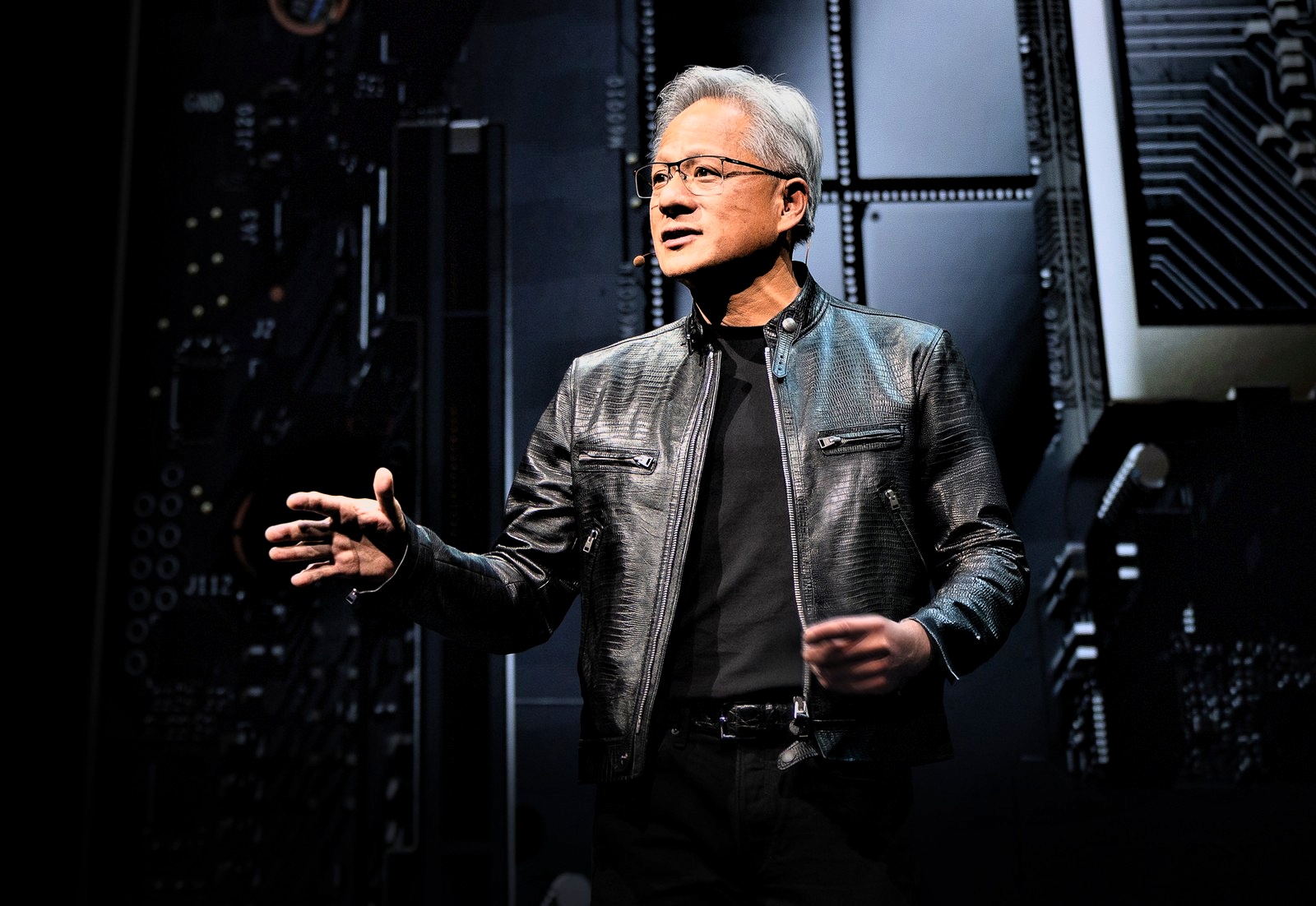
Photo: Nvidia (press photo, COMPUTEX 2025).
The most valuable company on earth is now investigating its own founder. On Sunday, November 8, Nvidia's board announced an independent investigation into the man who built it: Jensen Huang, the leather-jacketed chief executive who turned a video-game chip maker into the engine of the artificial intelligence age. The trigger was a report by The New York Times — published October 29 and deepening ever since — that U.S. intelligence officials believe Huang was the target of a foreign intelligence effort, and that the woman at the center of it, a former executive of an Nvidia customer named Alice Huang, was working for China's spy service. Hours before the board moved, Huang himself sent the message that made the story undeniable: an email to his own employees in which he admitted he had been unfaithful to his wife, took full responsibility, and promised to cooperate with whatever came next.
Nothing about this is a normal corporate scandal, and the market said so within hours. On Monday, Nvidia's shares closed down 4.3% — $178.67, against Friday's close of $186.64. That morning the damage ran deeper: in Frankfurt the stock fell more than 6%, putting some $270 billion of market value at risk, LSEG data via Reuters showed. By the closing bell, the loss had narrowed to roughly $190 billion — the 4.3% drop applied to a market capitalization of about $4.5 trillion — on a day when the broader market rose. Five minutes after the closing bell, shareholders sued. And behind the stock move sits a quieter, larger exposure: Nvidia makes up roughly 8% of the S&P 500, which means the savings of millions of people who have never bought a share of it — in 401(k)s, IRAs and pension funds — rode the same fall. This is the story of how a relationship became a national-security file, and what it means for everyone holding the index.
The email
Corporate crises usually begin with a denial. This one began with a confession. On Sunday, Jensen Huang wrote to Nvidia's employees and told them, in his own words, that he had been unfaithful to his wife — Lori Huang, whom he met while studying engineering and to whom he has been married for decades — and that he took full responsibility for his actions. Reuters, which reported the message, noted what it did not contain: any detail about the alleged relationship itself. It did not name Alice Huang. It did not mention Megaspeed, the Singapore company where she worked, or intelligence, or China.
But everyone reading it knew. The confession landed ten days after the Times first reported the relationship, and its function was precise: it converted a story the company had been treating as an ordinary business matter into a governance event that the board could no longer wave away. Within hours, the board announced its investigation, and Huang — through the company's statement — said he fully supports the review and has committed to cooperating with it. He remains chief executive, without interruption. The founder who co-created Nvidia in 1993 with Chris Malachowsky and Curtis Priem, and who has led it ever since, is now the subject of the most serious inquiry in the company's history — opened, in effect, by his own hand.
The other Huang
Alice Huang is not related to Jensen Huang. The shared surname is coincidence; nearly everything else about her, as reported, is not. She is a Chinese citizen and a former executive of Megaspeed International, a Singapore-based cloud computing company that buys Nvidia's most advanced AI chips — by the New York Post's account, billions of dollars' worth — and rents out GPU computing capacity from data centers across Southeast Asia. Megaspeed is an Nvidia Cloud Partner in the Asia-Pacific region; its website offers Nvidia's GB200 NVL72 and HGX H100 systems. She also appears in Singapore corporate documents under the name Huang Le.
But Alice Huang's story did not begin with Sunday's confession — it had been building for months. Back last spring, according to the reporting of the Times — echoed by the Financial Times on November 7 — a memo was already circulating among senior Trump administration policymakers that assessed that Alice Huang had been recruited by China's Ministry of State Security, the country's top intelligence agency, to collect information about American AI chips, and described her relationship with Jensen Huang as romantic. U.S. authorities investigated Megaspeed and concluded it was a Chinese intelligence asset, the Times reported; separately, the U.S. Commerce Department has inquired into whether the company diverted restricted AI chips to China. She did not respond to the Times when it first reported the relationship last month, and Reuters could not determine her location to seek comment on Monday. It deserves to be said plainly, because the board itself said it: the public reporting does not establish that any sensitive information was actually obtained. What exists today is suspicion at the highest level of the U.S. government — aimed at the one man who knows Nvidia's roadmap better than anyone alive.
The investigation
The board's answer came Sunday, in the form governance lawyers recognize: a committee of independent directors, assisted by outside independent counsel, will oversee the investigation and review all available information. And the board paired the machinery with a verdict-in-waiting: it said it has 'no reason to believe that either national security or Nvidia secrets were compromised.' Read carefully, that sentence does two jobs at once. It reassures customers, governments and investors that the crown jewels are — as far as anyone can currently say — intact. And it frames the inquiry around national security, a frame that points outward, at a foreign operation, rather than inward, at the judgment of the chief executive.
And until that weekend, the outward frame was the only position the company had: Nvidia had characterized Huang's interactions with Alice Huang as ordinary customer engagements, and noted that customers do not receive classified information or trade secrets. The investigation changes the posture without conceding the point: the question is no longer whether the board believes there is a problem, but whether an independent process, run by directors with outside lawyers, reaches the same conclusion the statement already announced. Huang, for his part, has said through the company that he supports the review and will cooperate fully. The board has expressed confidence in him and his leadership team, and he continues as CEO. What the investigation will actually examine — and whether it will address executive conduct alongside the security question — has not been detailed. Investors will be reading for exactly that.
Washington moves
The political system, for its part, did not wait for the board — it had already moved the week before. On Wednesday, November 4, three Republican chairs of House committees wrote to Huang asking for a closed-door briefing on November 18, citing national security concerns. The next day, Thursday, November 5, the House Select Committee on China said in a statement that Alice Huang was an 'openly reported Chinese intelligence asset' and joined the request. The date is not an accident of scheduling — November 18 is the day after Nvidia reports its quarterly earnings. Senator Chris Coons has pledged a Senate inquiry as well, which means the founder of the world's most valuable chip company faces Congress on two tracks while his own board investigates him on a third.
President Trump, for his part, confirmed he was briefed on the spying allegation earlier this year and took no action, calling Huang 'an honorable guy,' as USA Today reported. That makes the White House the one institution in Washington that has publicly declined to escalate. China, for its part, answered on Monday, at its regular press briefing in Beijing, and rejected the reporting outright: the allegations, Beijing said, were groundless speculation and a smear — the same posture it takes toward the export-control regime, in place since 2022, that bars Nvidia's most advanced AI chips from shipment to China and sits at the center of this entire affair. Nvidia exists inside that rivalry: the company whose products Washington treats as strategic assets now has its chief executive inside an intelligence file. Every government customer, export license and data-center approval the company touches will be read through that fact until the investigation closes.
The market's verdict
Wall Street delivered its own finding on Monday, and it was not ambiguous. The selling started Monday morning, before the opening bell: in U.S. premarket trading the stock was down about 5%, and in Frankfurt it fell more than 6%, putting some $270 billion of market value at risk (LSEG data via Reuters). The regular session stayed rough — Finnhub's record shows a low of $170.24 — until buyers stepped in, and Nvidia closed at $178.67, down $7.97 — 4.3% — from Friday's $186.64 close. That closing drop, applied to a market capitalization of about $4.5 trillion, works out to a loss of roughly $190 billion for the session. The decline is more telling for its company: it happened on one of the strongest days of the year for the broader market, with chip rivals rising — a split that says investors were not fleeing AI. They were repricing one company and one man.
Then came the lawyers. Five minutes after the market closed, Nvidia shareholders led by Mark Kistenmacher filed a proposed class action in federal court in San Jose, accusing the company and Huang of defrauding shareholders by concealing his ties to a suspected Chinese spy and failing to disclose that the matter raised national-security concerns threatening Nvidia's reputation and business prospects, Reuters reported. The suit seeks unspecified damages; Nvidia did not immediately respond to a request for comment. Such suits commonly follow sharp declines, and this one now runs in parallel with everything else: the board's investigation, the congressional requests, the Senate pledge — and, on November 17, an earnings report that was supposed to be the main event of Nvidia's autumn.
Why your retirement fund was in the room
Here is the part of this story that reaches people who have never followed a chip stock. Nvidia is not just a large company; at roughly 8% of the S&P 500 — the SPY fund's holdings put it at 7.77% as of October 29 — it is a structural piece of the American retirement system. Index funds are the default home of 401(k) contributions, IRA savings and pension portfolios, and every one of them holds Nvidia in almost exactly that proportion, whether the saver chose it or not. When the stock falls 4.3% in a day, that slice of those accounts falls with it, automatically, silently, in the background of millions of statements nobody opens until January.
This magazine will not invent a loss figure for those savers, because none exists in the reporting: what a given fund felt depends on its own construction, and Monday's rise in the broader market offset much of the single-stock damage at the index level. The verified fact is the mechanism, and the mechanism is the story: the governance of one company in Santa Clara is now a line item in the retirement math of people who could not pick Jensen Huang out of a lineup. Concentration is the price of the index era's simplicity — the same weight that lifted those accounts on Nvidia's rise transmits its shocks on the way down. Monday was the demonstration.
The decision this sets
For anyone who runs a company, a fund or a data center, the lessons are already operational. Key-person risk is no longer a succession-planning abstraction: when one executive is synonymous with a company — its product launches, its customer relationships, its political standing — his personal exposure becomes enterprise exposure, and boards that have not rehearsed that scenario are now reading about one. Vendor concentration has a new dimension, too: the world's AI build-out runs overwhelmingly through one supplier whose leadership is under simultaneous investigation by its board and scrutiny by two houses of Congress, eight days before its earnings. None of that changes a single purchase order this week. It changes the risk register, the questions in the next supplier review, and the premium on having a second source — the same week, not coincidentally, that Google put four TPU systems on the table in a single year.
What happens next is dated. Earnings on November 17 will test whether the business story can out-shout the governance story for one news cycle. The congressional briefing is requested for November 18. And somewhere in Santa Clara, a committee of independent directors and outside counsel is beginning the review that will decide whether Sunday's sentence — no reason to believe anything was compromised — becomes the company's conclusion or its first draft. This magazine will follow all three dates. The founder remains in the chair. The questions are now larger than the chair.
What is established
- The machinery is real: independent directors plus outside counsel, with the founder's stated full cooperation.
- No compromise found: the board says it has no reason to believe national security or Nvidia's secrets were compromised — the public reporting establishes no leak.
- Continuity: Huang remains CEO without interruption, with the board's expressed confidence, into the Nov 17 earnings.
What to watch
- Nov 17–18: earnings, then the requested congressional briefing — two stages in 48 hours.
- Scope unknown: the board has not said whether the review covers executive conduct, or only national security.
- The stock's split: Nvidia fell on a rising market — repricing of key-person risk, not of AI demand.
The file
The chronology
| Field | Detail |
| Oct 29, 2026 | The New York Times reports U.S. intelligence concerns over Huang's relationship with Alice Huang of Megaspeed |
| Spring 2025 (as reported) | A memo circulates among senior U.S. policymakers assessing Alice Huang was recruited by China's Ministry of State Security (NYT; FT, Nov 7) |
| Nov 4, 2026 | Three Republican House committee chairs request a closed-door briefing from Huang for Nov 18 |
| Nov 5, 2026 | House Select Committee on China calls Alice Huang an 'openly reported Chinese intelligence asset' |
| Nov 8, 2026 | Huang admits the affair to employees; the board announces an independent investigation, saying it has no reason to believe national security or Nvidia secrets were compromised |
| Nov 9, 2026 | NVDA closes −4.3% at $178.67; ≈$190B of market value lost by the close (≈$270B at risk intraday in Frankfurt, LSEG via Reuters); a shareholder class action is filed five minutes after the close |
| Nov 17–18, 2026 | Nvidia earnings (Nov 17); requested congressional briefing (Nov 18) |
The people
| Field | Detail |
| Jensen Huang, 63 | Co-founded Nvidia in 1993; CEO ever since; admitted being unfaithful, took full responsibility, pledged cooperation; remains CEO |
| Alice Huang (Huang Le) | Chinese citizen; former Megaspeed executive; U.S. authorities concluded she was recruited by China's Ministry of State Security, per the NYT; not related to the CEO; has not commented |
| Megaspeed International | Singapore-based cloud company and Nvidia customer/Cloud Partner (GB200 NVL72, HGX H100 on offer); investigated by U.S. authorities; a Commerce Department inquiry examined possible diversion of restricted chips to China |
The exposure
| Field | Detail |
| Market value | ~$4.5 trillion as of Nov 6 (Reuters) — the world's most valuable chipmaker |
| S&P 500 weight | Roughly 8%; SPY holdings 7.77% as of Oct 29, 2026 (State Street) |
| Retirement channel | 401(k), IRA and pension savings held through index funds carry Nvidia at index weight, chosen or not (mechanism; no saver loss figure is reported) |
Sources
- Reuters (Nov 9, 2026), 'What we know about Nvidia's probe into CEO Jensen Huang': the board probe, Huang's message to employees ('unfaithful', 'full responsibility'), Megaspeed scrutiny, the board's 'no reason to believe' statement, independent committee with outside counsel, Huang's support and cooperation.
- Reuters (Nov 9, 2026), 'Nvidia, CEO Huang sued over disclosures': shares closed down 4.3% on Monday — a closing market-value loss of approximately $190 billion, with ≈$270 billion at risk intraday (LSEG via Reuters); proposed class action (lead plaintiff Mark Kistenmacher) filed in federal court in San Jose five minutes after the close, seeking unspecified damages; Nvidia did not immediately respond.
- The New York Times (Oct 29, 2026; coverage Nov 8): U.S. intelligence assessment that Alice Huang was recruited by China's Ministry of State Security to collect information on American AI chips; the spring memo among policymakers; China rejected the reporting as groundless.
- Financial Times (Nov 7, 2026): the memo describing the relationship as romantic, as reported. USA Today (Nov 9, 2026): Trump confirmed he was briefed earlier this year, took no action, called Huang 'an honorable guy'. House committees' letter (Nov 4) and House Select Committee on China statement (Nov 5) requesting the Nov 18 briefing; Senator Coons' pledged Senate inquiry.
- Finnhub session data (Nov 9, 2026): NVDA open $173.07, high $179.92, low $170.24, close $178.67, previous close $186.64 (−4.27%). SPY holdings, State Street (Oct 29, 2026): Nvidia 7.77% of the fund.
- Photo: Jensen Huang on stage during his COMPUTEX 2025 keynote — Nvidia press photo distributed for Computex 2025.