The chip that is the model: AMD pays up to $2.9 billion for Taalas and its etched-in-silicon inference
The blue board in the photograph does not run an AI model. In a very literal sense, it is one. The chip at its center carries a model's weights etched into its own metal — no loading, no fetching, nowhere else for the knowledge to live. In August, AMD agreed to buy the Toronto company that builds it, Taalas, and said nothing about the price. It took a quarterly filing in November to reveal what the silence was worth: about US$2.9 billion, with almost half of it not yet promised to anyone.
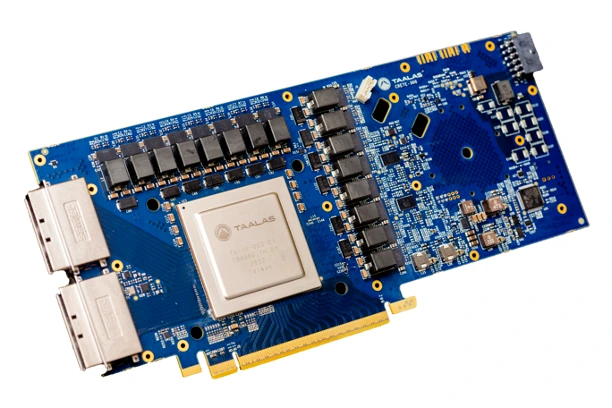
Photo: Taalas (official product image, HC1 technology demonstrator). Served at the size the official master allows — see the production note in Sources.
Every AI system your company uses runs on a simple, expensive loop. A model is a vast list of numbers — its weights — and every time the machine answers a question, those numbers have to be hauled from memory to the processors, multiplied, and put back, billions of times a second. The hauling is the cost. It is why inference, the business of actually answering, burns power and money long after training is over, and why the general-purpose GPU — a magnificent machine built to run any model at all — spends so much of its life waiting on its own memory.
Taalas looked at that loop and asked the rudest question in the industry: what if the weights never moved? What if they were not loaded into the chip, but built into it — printed into the silicon at the factory, the way a book is printed on paper? The result is a chip that can run exactly one model, the model it was born with, and run it with a speed and efficiency that a generalist cannot match, precisely because it refuses to be anything else. AMD decided that refusal was worth buying. The question the whole industry has been asking since August — worth how much? — finally has a number attached to it, and the number comes with an asterisk the size of a billion dollars.
A model, printed in metal
Taalas calls its approach model-specific silicon. A conventional accelerator treats a model as software: interchangeable, updatable, portable. A Taalas chip treats it as hardware. The weights of a single model are etched directly into the silicon during manufacturing, so the knowledge and the machine that uses it become the same physical object. The company's first demonstrator, the HC1, was built around Meta's Llama family of models — one model, cast in metal, doing one job at a speed its makers describe in terms no GPU datasheet uses.
The trade is written into the physics, and the company has never hidden it. A chip whose model is etched cannot be reprogrammed when a better model arrives next quarter; it sacrifices the flexibility that made GPUs the default tool of the AI era. What it buys with that sacrifice is the elimination of the memory traffic that dominates the cost of inference: no weights to fetch means no fleet of memory chips feeding them, less power burned per answer, and a machine that can be far simpler than a flagship accelerator. Whether that trade is genius or a trap depends entirely on how long a model stays worth running — and on volume. Etching makes sense only when the same model will answer the same kind of question millions of times.
That is a narrower market than the GPU's, and a very large one. The models that sit behind translation, summarization, customer support, code completion and content filtering do not change every week; they change on a calendar, and between changes they answer at industrial scale. For a workload like that, paying for flexibility you never use is its own kind of waste. This is the bet AMD just bought: that a meaningful slice of the world's inference is stable enough to be printed.
The price was in the fine print
When AMD announced the definitive agreement in August, the release did what acquisition releases do when a buyer would rather talk about strategy: it talked about strategy. Roadmaps, platforms, ecosystems — and no number. The number surfaced the way these numbers usually do, not in a headline but in a note. Note 5 of the Form 10-Q AMD filed with the SEC on November 4, for the quarter that closed on September 26, puts the consideration at approximately US$2.9 billion in cash and stock — including up to approximately US$1.4 billion of contingent consideration.
Read that structure the way an accountant would. Roughly US$1.5 billion of the price is the firm part. The other roughly US$1.4 billion — close to half the headline figure — is contingent: money that moves only if conditions AMD has not detailed in the filing are met. The filing does not break the total down between cash and stock, and it does not spell out what the contingent portion is contingent on. So the honest headline is not that AMD paid US$2.9 billion for Taalas. It is that AMD agreed to pay about that much, with nearly half of it riding on a future nobody outside the deal has seen written down.
Even the firm part makes this one of the largest technology acquisitions in Canadian history — and it buys a company that, by venture standards, was still young. Taalas was founded in August 2023 in Toronto and raised about US$219 million of venture capital before AMD arrived. Three years from founding to a near-three-billion-dollar exit, for a team of chip designers whose product is a demonstrator and whose idea the industry is still arguing about: whatever else the deal is, it is a measure of how expensive the inference problem has become, and how few teams on Earth are credibly attacking it from first principles.
The founders came from inside the house
There is a familiarity to this acquisition that the filing does not mention and the industry press in Canada did. Taalas was founded by Ljubisa Bajic, Lejla Bajic and Drago Ignjatovic — engineers with long careers at AMD itself, who left, built the thing AMD did not have, and have now sold it back to AMD at a price that says the detour was worth it. It is a pattern the semiconductor industry knows well: the big company's roadmap moves at the speed of its installed base, and the radical idea needs a small room of its own before the big company can afford to believe in it.
AMD says the Taalas team joins its Canadian workforce and that the technology will be integrated into its future inference chips, aimed squarely at NVIDIA. That integration is the real acquisition. A demonstrator chip is a proof; a roadmap is a business. What AMD is buying is the option to offer, inside its own platform, the one thing its GPU line cannot be: silicon that gives up generality on purpose. For customers, the practical question arrives later — which models, at what volume, on what terms — but the strategic shape is already clear. NVIDIA's dominance in inference rests on the GPU being the answer to every question. AMD just paid to make one of the questions have a different answer.
What this means if you run the bills
Strip the romance away and the deal is about the line item that now dominates AI budgets. Training a model is a project; running it is a utility bill, and it scales with every user, every query, every month. The cost of inference per answer — per token, per document, per conversation — is where AI programs either earn their return or quietly bleed. A technology that cuts that unit cost, even for a subset of workloads, changes the arithmetic of deployments that today are rationed precisely because each answer costs too much to give freely.
The decision it puts in front of technology leaders is a portfolio decision, not a purchase order. Nothing changes this quarter: the agreement has not closed, and no Taalas-powered AMD product is on a price list. The work worth doing now is the audit — which of your AI workloads run the same model, at high volume, on a change calendar measured in quarters rather than weeks? Those are the workloads for which etched silicon will one day be a line in a vendor comparison. Everything that changes fast, experiments, or spans many models stays on general-purpose hardware, where flexibility is not waste but insurance. And a caution that applies to every claim in this story: Taalas' performance figures are the company's own, with no independent benchmark at production scale published to date. The etched-chip idea is proven as a demonstrator. As a business, it is a filing, a team and a promise.
What still has to happen
The deal is signed, not done. AMD expects it to close by the end of 2026, subject to regulatory approval, and until then Taalas remains an independent company and every figure in the 10-Q remains a plan rather than a payment. The contingent half of the price will be decided by conditions that have not been made public; if they are not met, the final cost of this acquisition will be materially lower than the headline — which is, of course, exactly why the structure exists. AMD bought the future tense at a discount for uncertainty, and sold the founders a share of it back as an incentive to make it present.
That is the right way to read the whole transaction. In August, AMD bought an idea at an undisclosed price. In November, the fine print priced the idea: up to US$2.9 billion, half of it payable only if the idea works. The blue board in the photograph is what the idea looks like before it becomes a product line — one model, cast in metal, betting that in a world drowning in inference bills, the fastest chip is the one that refuses to do anything else.
What works for the buyer
- Inference is the recurring bill: a working etched-silicon line attacks unit cost where it actually accumulates — per answer, at volume.
- Half the price is contingent: AMD pays the full figure only if undisclosed conditions are met, which prices the uncertainty instead of ignoring it.
- The team is the asset: founders with long AMD careers return with a technology the roadmap did not have, and join the Canadian workforce.
What to watch
- The agreement has not closed: it remains subject to regulatory approval, expected by the end of 2026.
- The price is not firm: up to ~US$1.4 billion is contingent, with conditions and the cash/stock split undisclosed.
- Taalas' performance claims are the company's own, with no independent benchmark at production scale — and an etched model cannot be updated when models move on.
The file
The deal
| Field | Detail |
| Buyer | AMD (Advanced Micro Devices) |
| Target | Taalas Inc., Toronto, Canada — specialized AI inference silicon |
| Agreement | Definitive agreement signed August 2026; price undisclosed at announcement |
| Price revealed | Form 10-Q filed November 4, 2026 (quarter ended September 26, 2026), Note 5: ≈US$2.9 billion in cash and stock, including up to ≈US$1.4 billion contingent |
| Status | Not closed — expected by end of 2026, subject to regulatory approval |
The technology
| Field | Detail |
| Approach | Model-specific silicon: a single model's weights etched directly into the chip |
| Demonstrator | HC1, built around Meta's Llama model family |
| Trade-off | Flexibility surrendered for inference speed and efficiency; an etched model cannot be reprogrammed |
| Plan | AMD to integrate the technology into its future inference chips, against NVIDIA; Taalas team joins AMD's Canadian workforce |
The company
| Field | Detail |
| Founded | August 2023, Toronto |
| Founders | Ljubisa Bajic, Lejla Bajic and Drago Ignjatovic — long AMD careers before founding Taalas |
| Funding | ≈US$219 million of venture capital raised |
| Context | Among the largest technology acquisitions in Canadian history |
Sources
- AMD — Form 10-Q, quarter ended September 26, 2026, filed with the SEC on November 4, 2026 (Note 5: acquisition consideration of ≈US$2.9 billion in cash and stock, including up to ≈US$1.4 billion contingent).
- AMD — press release, August 6, 2026: definitive agreement to acquire Taalas; integration into AMD's AI platform and inference roadmap; closing subject to regulatory approvals. ir.amd.com
- BetaKit — coverage of the August 6, 2026 announcement (terms undisclosed at announcement).
- The Globe and Mail — on the founders' long AMD careers and the deal's place among Canada's largest technology acquisitions.
- Photo: Taalas — official HC1 product image (taalas.com/products). Production note: the official master is 612 × 408 px; it is served inside the article at a width the master supports without upscaling, per the house rule that a photo is judged at its served size.