
Tesla winds down the Cybertruck line as Giga Texas turns to the Cybercab
The most polarizing vehicle of the decade is being shown the door — by its own maker, in its own factory. Elon Musk said on X on November 6 that Tesla will gradually reduce Cybertruck production at Giga Texas toward mid-2027 to make room for the Cybercab, closing the arc of a truck that sold some 71,000 units in three years against a forecast of 250,000 a year.
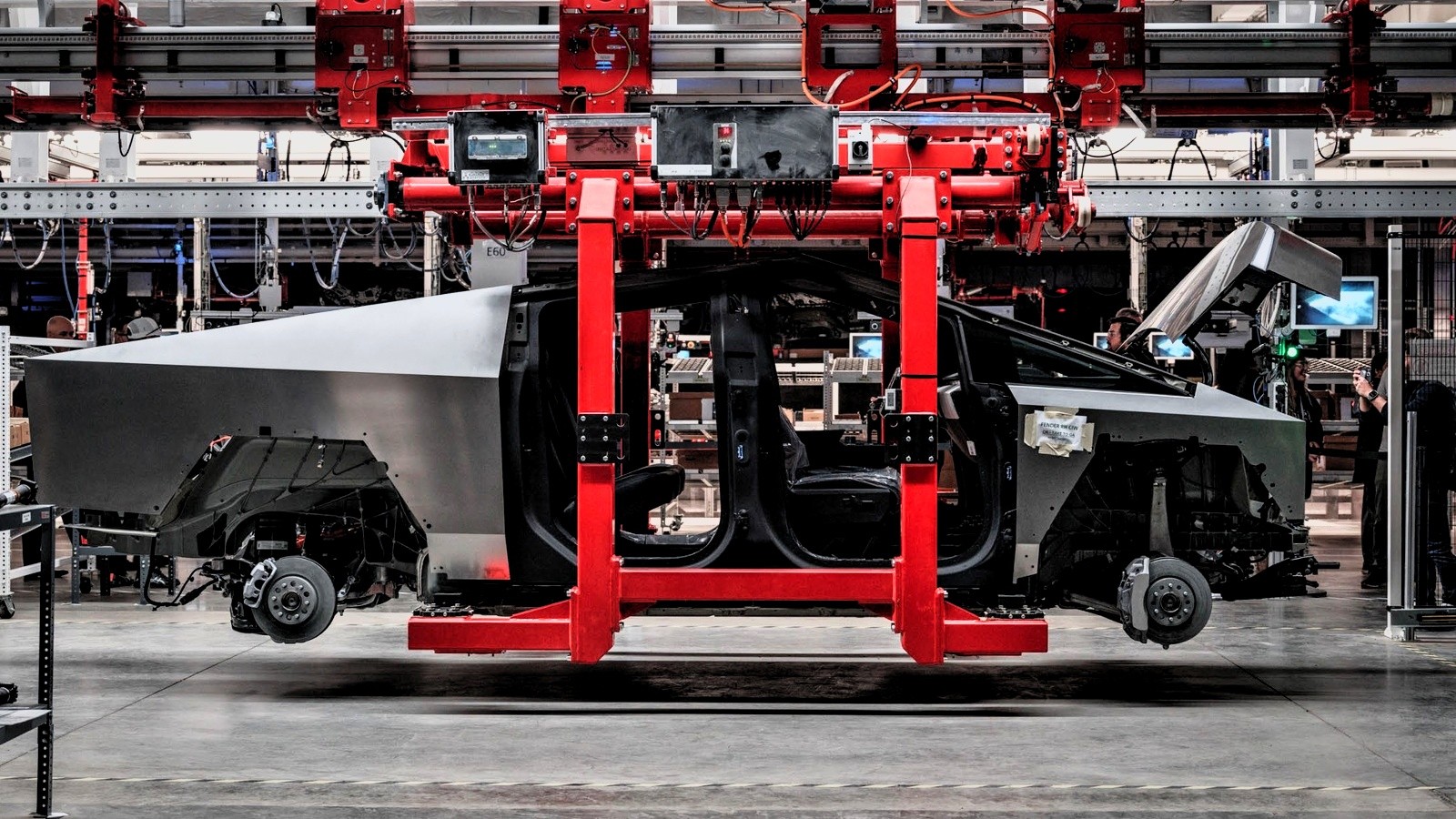
Photo: Tesla (official press material).
The announcement, and the arithmetic behind it
Musk’s post was brief and final in tone: Cybertruck production at Giga Texas will wind down gradually toward mid-2027, freeing the line for the Cybercab, Tesla’s purpose-built robotaxi. The sales record explains why the decision was available to make. Per Cox Automotive / Kelley Blue Book figures, the Cybertruck sold 38,965 units in 2024 and 20,237 in 2025 — a 48% drop — with 11,586 more from January to September 2026: roughly 71,000 trucks in three years, against the 250,000-per-year volume once projected for it. A vehicle designed as a phenomenon performed as a niche.
It is also the third Tesla model to end in 2026: the Model S and Model X already ceded their space to Optimus, the humanoid robot. Read together, the pattern is not retreat but rotation — the factory floor is being reassigned from the products that built Tesla’s legend to the machines Tesla believes are its future: robotaxis and robots. Wes Morrill, the Cybertruck’s lead engineer, put the epitaph in one line: the truck “lives on through Cybercab” — its steer-by-wire, 48-volt architecture and stainless lessons migrate into the vehicle that replaces it.
An enthusiast’s farewell, with respect
Whatever the sales chart says, the Cybertruck mattered. It proved a manufacturer could ship a concept car unfiltered — exoskeleton, yoke-era minimalism, drive-by-wire — and force every rival’s design studio to answer it. Trucks got weirder and more interesting because it existed. That its line now yields to an autonomous pod is the most Tesla ending imaginable: the future kept outbidding the present inside its own plant.
Why the truck’s ideas outlive the truck
To see what actually survives the wind-down, look at the two technologies Morrill’s epitaph names. Steer-by-wire deletes one of the oldest parts in the automobile: the mechanical column that physically ties the steering wheel to the front wheels. In its place, sensors read the driver’s input and send it as data to electric motors that move the steering rack. The wheel in your hands becomes a controller, not a crank. That is more than a novelty. Software can make the steering quick and light in a parking lot and calm at highway speed, the system no longer has to package a steel shaft through the structure of the vehicle, and the same design serves markets that drive on either side of the road. It also raises the engineering bar in a healthy way: when the link is electronic, the system must be designed so that no single failure can take the steering with it — redundancy stops being a luxury and becomes the architecture itself.
The 48-volt architecture is quieter and, for the industry, possibly more consequential. The physics is plain arithmetic: electrical power is voltage multiplied by current, so delivering the same power at four times the voltage takes a quarter of the current. Less current means thinner, lighter copper wiring, less heat wasted along the harness and smaller connectors throughout the vehicle — multiplied across every motor, light and actuator a modern vehicle carries. The wider industry stayed on low-voltage electrics for generations largely because every supplier, tool and component was built around them; moving a whole supply chain is far harder than moving one specification. A manufacturer willing to redesign the electrical foundation at once — and to drag its suppliers with it — buys weight and efficiency advantages that rivals cannot copy with a mid-cycle refresh. That is the kind of lesson that migrates: it lives in the wiring, not in the styling.
A gradual wind-down, rather than a hard stop, is also a manufacturing decision with its own logic. A production line is not a light switch; it is tooling, supplier contracts, trained crews and a flow of parts that has to be tapered in sequence. Drawing production down toward a dated horizon lets suppliers plan their own exits, lets the plant retool in stages instead of in one expensive convulsion, and lets the successor product inherit floor space, people and know-how progressively. The stainless exoskeleton taught its own expensive lessons — about forming and finishing an unforgiving material at production speed — and lessons paid for at that scale do not vanish when a nameplate does. They go into the institutional memory of the factory, and from there into whatever the factory builds next.
This is how a manager should read a low-volume halo product. Judged purely on units, the wedge was a niche. Judged as a technology carrier — a rolling program that forced steer-by-wire, a new electrical architecture and hard lessons in materials into production, where they can be inherited by the vehicle that replaces it — the return calculation changes completely. The right question about a flagship is not only how many it sold, but what it leaves behind on the shelf for the next product to use.
The decision this sets
For the industry, the lesson is capacity discipline: a halo product earns its line only while it pulls the brand forward, and Tesla just demonstrated it will reassign flagship space to autonomy without sentimentality. For suppliers and fleet buyers, the wind-down window to mid-2027 defines the planning horizon for parts, service and residual values. And for competitors in electric trucks, the wedge’s exit reopens the segment’s strangest question: whether the market rejected the truck’s form, or simply its price of admission.
What thrills
- The ideas migrate: steer-by-wire and the 48-volt architecture live on in the Cybercab.
- Concept cars can ship: the Cybertruck proved an unfiltered design can reach production.
- Factory honesty: Tesla reallocates its floor to the future without nostalgia.
What to watch
- Residual values: a dated wind-down reprices every used Cybertruck.
- Parts and service horizon: owners will plan around the mid-2027 endpoint.
- Volume reality: 71,000 in three years against 250,000 a year promised — the gap is the story.
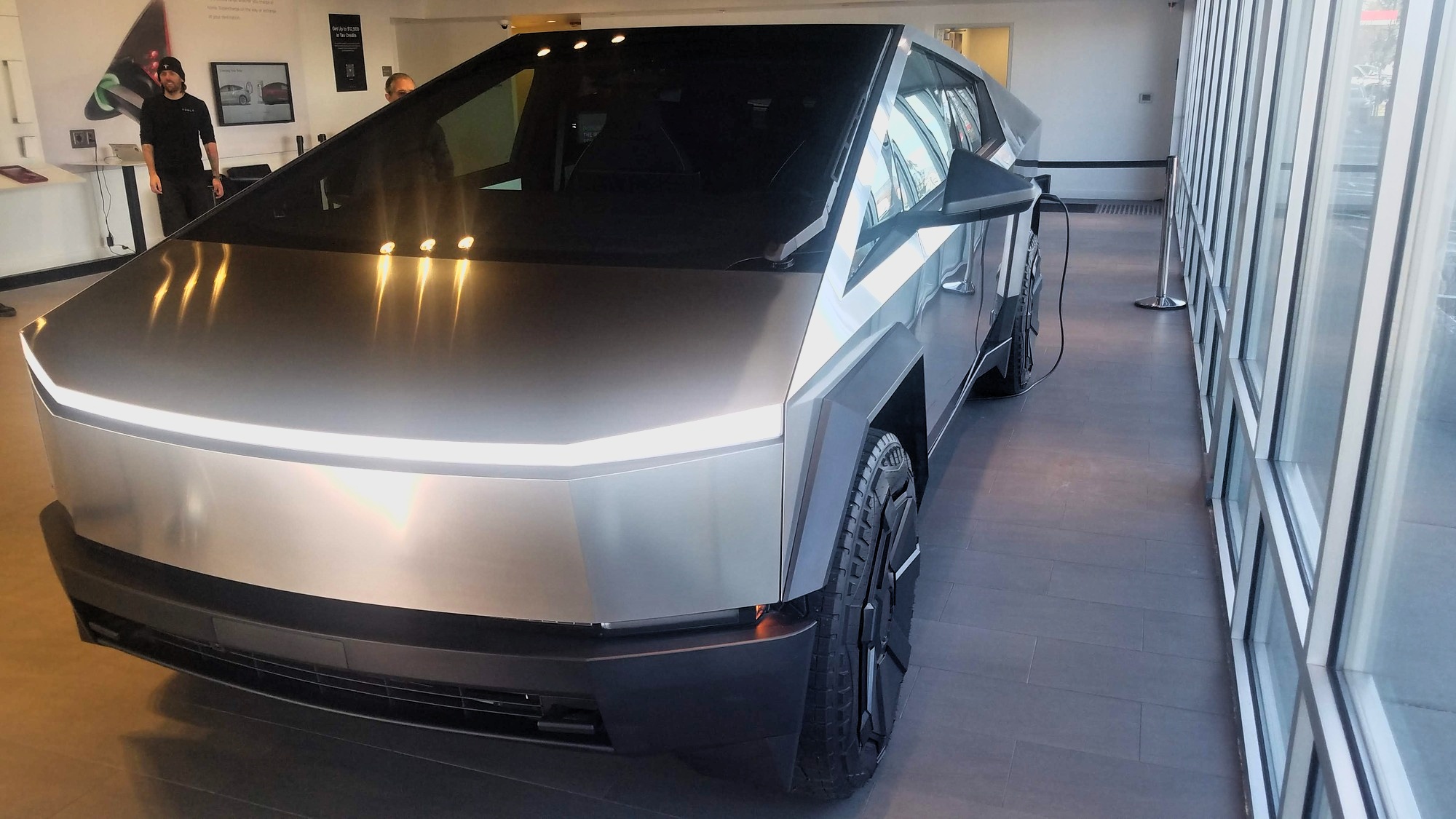
The data sheet
The wind-down
| Field | Detail |
| Announced | Elon Musk on X, Nov 6, 2026 |
| Plan | Gradual reduction of Cybertruck production at Giga Texas toward mid-2027 |
| Successor on the line | Cybercab robotaxi |
The record (Cox Automotive / KBB)
| Field | Detail |
| 2024 | 38,965 sold |
| 2025 | 20,237 sold (−48%) |
| Jan–Sep 2026 | 11,586 sold |
| Forecast once projected | 250,000 per year |
Sources
- Elon Musk, post on X (Nov 6, 2026): gradual Cybertruck wind-down toward mid-2027 for the Cybercab; statement by Wes Morrill.
- Cox Automotive / Kelley Blue Book: Cybertruck sales 2024–2026.
- Photos: Tesla official press material; production-line photo via Musk (Nov 2023), via Teslarati.