
Tesla will refund Cybertruck deposits: too many orders, eight months of line left, and a robotaxi waiting for the floor
The strangest refund in the car business is not about a truck nobody wants. On Monday, Elon Musk said Tesla will have to return deposits to a lot of Cybertruck customers — not for lack of demand, he insists, but because orders are arriving faster than the line can build, and the line itself has about eight months to live. Behind the refund sits the real transaction: Gigafactory Texas floor space is worth more building robotaxis than stainless-steel pickups, and the Cybertruck is about to pay for that arithmetic with its life.
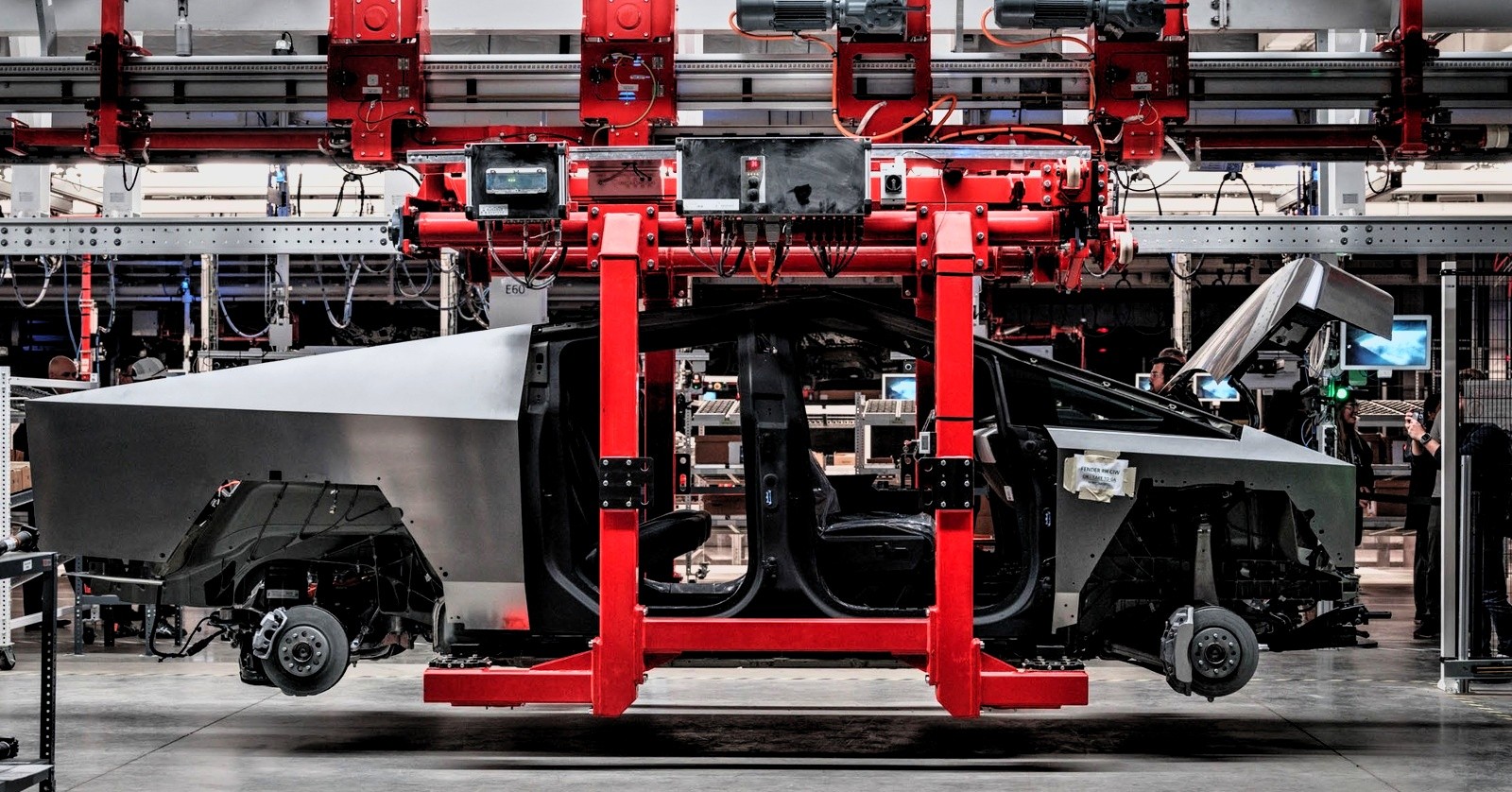
The body on the line: a Cybertruck shell on its carrier — the line now has a closing date.
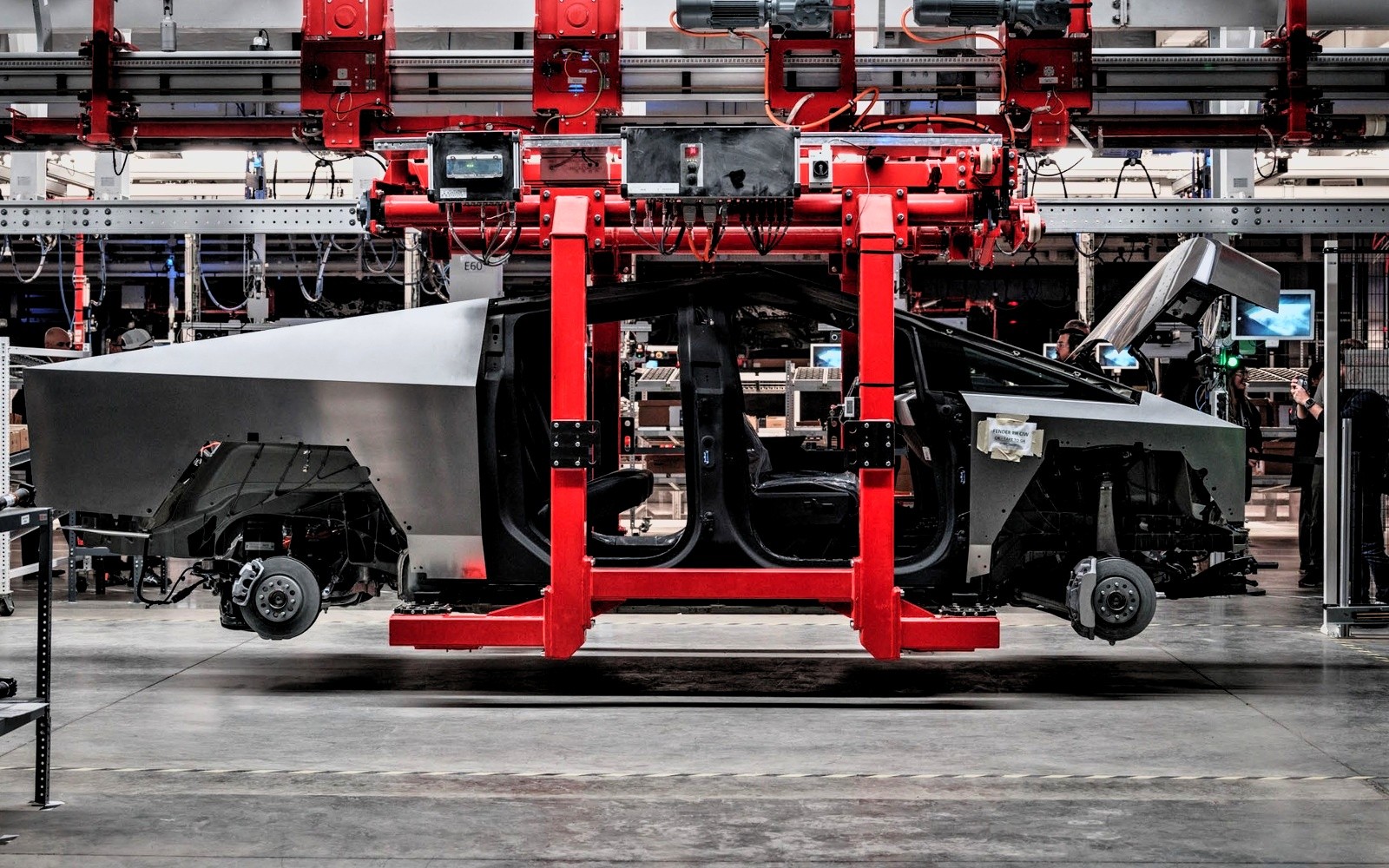
Photo: Tesla, Q4 2023 shareholder update. Web version: house treatment — natural image, frame edges lightly darkened.
Three posts in three days told the story in instalments. On Friday, November 6, Musk announced that Tesla will wind down Cybertruck production at Gigafactory Texas around the middle of next year to make room for increased Cybercab production. Over the weekend came the second act: the order backlog, he said, is far more than Tesla can build before the line is dismantled around June or July of next year, and the company will add an extra shift to try to get every order done in time. On Monday came the third, and it is the one that lands in customers' bank accounts: Tesla will try to make as many trucks as possible before shutting the line down in about eight months — but it will have to return deposits for a lot of people.
Eight months, one extra shift, and a queue that will not clear
Musk was explicit about what the refund is not. «This is not a case of Cybertruck being unprofitable, as has been misreported by legacy media», he wrote, «but rather that the opportunity cost of the complexity of Cybertruck is vastly outweighed by the value of incremental Cybercab production.» Read that sentence as a factory manager would. A production line is a fixed asset with one product at a time. Every month the Texas line spends assembling a low-volume, notoriously difficult stainless-steel truck is a month it does not spend building the two-seat robotaxi on which Tesla has staked its next decade. The refund is simply what that decision costs at the customer end: money handed back because the calendar ran out.
It helps to understand what the Cybertruck asks of a factory. Its body is an exoskeleton of ultra-hard stainless steel that cannot be stamped like ordinary panels; it is bent, laser-scored and folded, on dedicated equipment, at a pace the line never truly mastered. Tesla's own shareholder update lists installed Cybertruck capacity at more than 125,000 vehicles a year. What the line actually produced tells a different story: deliveries of Tesla's «other models» — the grouping that, with the Model S and X gone, is now effectively the Cybertruck — totalled 8,295 in the third quarter of 2026, an annualised pace near 30,000 trucks against a line built for four times that. Complexity was supposed to buy distinction. In the end it bought a bottleneck.
The two readings of a refund
Which is why the deposit news deserves a colder reading than either camp gave it on Monday. Musk's claim — an order rate that «far exceeds» the production rate — is entirely possible and entirely compatible with weak sales: it takes only a modest flow of orders to outrun a line that has been throttled down toward its shutdown. Critics were quick with the counter-arithmetic: a truck selling at roughly an eighth of its planned volume, discounted and re-priced through 2026, with prices raised again the week its ending was announced — the Premium all-wheel-drive now starts at $92,490, the Cyberbeast at $102,490, per Electrek's tracking. Both things can be true at once, and on the evidence available, both are: demand exists, and it is nowhere near what the factory was built for. The refund does not settle that argument; it retires it. Whatever the order book holds, Tesla has decided the floor is worth more than the answer.
For the customers in the queue, the practical questions are embarrassingly unanswered. Tesla has not said how many orders remain open, how much deposit money is involved, or what order the refunds will follow. Since 2019 the truck's reservation economics have changed more than once — early holders put down small refundable deposits; today's order flow carries a $250 order fee that Tesla made non-refundable years ago, and Musk's post did not say whether that fee comes back. The one piece of advice that survives every version of this story is unglamorous: get your delivery estimate from Tesla in writing, and do not change your order in the meantime. The trucks built in the next eight months may be all the Cybertrucks there ever are.
The floor changes hands
There is a precedent, and it is only weeks old. In October, Tesla cancelled the Cybertruck for Australia and New Zealand outright — markets where customers had held deposits since 2019 — and refunded them in full. That refund was about a truck that would never be built for those roads. Monday's is about a truck that will be built, just not enough of it, and not for long. Between the two episodes, a pattern hardens: the Cybertruck is being withdrawn market by market and month by month, each withdrawal dressed in the language of scarcity. The scarcity, this time, is real — Tesla is manufacturing it on purpose, by closing the line.
The heir to the floor is already working. The Cybercab — the two-seat autonomous car with no steering wheel and no pedals — began production at Gigafactory Texas in the second quarter of 2026 and has been carrying passengers inside Tesla's Austin robotaxi service since September. Tesla's third-quarter update lists installed capacity above 125,000 a year for the Cybercab as well as for the truck it replaces: the factory's future is not a new building but a substitution. Fremont told the same story earlier this year, when the Model S and X lines gave way to Optimus robots. Tesla is converting car lines into robot lines one factory at a time, and the Cybertruck — the most theatrical car of the decade — turns out to be a transitional product in its own plant.
The decision this sets
The market, at least, took Monday's chapter calmly: Tesla shares closed up 4.23% at $358.22, per Benzinga's session data — investors heard a capacity decision for the autonomy story, not an obituary for a truck. The epitaph register came instead from inside the program: the truck's engineering lineage, its team says, passes on to the machine that replaces it. What remains is eight months of production, one extra shift, a queue that will be served until it isn't, and then the refunds. The Cybertruck was unveiled in 2019 with a smashed window and a promise to reinvent the pickup. It ends as a lesson in the only metric that ever really governed it: what a factory floor is worth, per month, to the next product in line.
What is established
- The refund is announced: Musk says Tesla will return deposits to a lot of customers, with an extra shift added to build as many trucks as possible first.
- The clock: the line shuts in about eight months; its floor passes to expanded Cybercab production around mid-2027.
- The floor's next tenant is working: Cybercab production began at Gigafactory Texas in Q2 2026 and it carries robotaxi passengers in Austin since September.
What to watch
- The refund mechanics: how many orders, how much money, and whether the $250 order fee is returned — none of it stated yet.
- The order book vs. the line: orders outrunning a winding-down line is not the same as outrunning the 125,000-a-year line Tesla built.
- The precedent: Australia and New Zealand holders, waiting since 2019, were refunded in full in October — the withdrawal pattern to watch.
The file
The sequence
| Field | Detail |
| Nov 6, 2026 | Musk announces the wind-down of Cybertruck production at Gigafactory Texas around mid-2027, to make room for increased Cybercab production |
| Nov 7–8, 2026 | Musk says the order backlog is far more than Tesla can build before the line is dismantled around June/July 2027; an extra shift will be added to try to complete orders |
| Nov 9, 2026 | Musk says Tesla will make as many as possible before shutting the line in about eight months, but will have to return deposits for a lot of people; he rejects the claim that the truck is unprofitable |
| Mid-2027 | The Texas line's space passes to expanded Cybercab production (Musk, Nov 6) |
The numbers, as reported
| Field | Detail |
| Installed Cybertruck capacity | More than 125,000 vehicles a year at Gigafactory Texas (Tesla Q3 2026 update) |
| Q3 2026 'other models' deliveries | 8,295 — the category that is now effectively the Cybertruck (Tesla, via Electrek's estimate of 7,000–8,000 Cybertrucks) |
| U.S. sales 2025 | 20,237, down 48% year over year (Cox Automotive / Kelley Blue Book) |
| Prices after the November increase | Premium AWD from $92,490; Cyberbeast $102,490 (Electrek) |
| Refunds | Amount, count of affected customers and treatment of the $250 order fee: not stated by Tesla or Musk |
Sources
- Reuters (Nov 9, 2026), 'Tesla to refund many Cybertruck deposits as demand exceeds production, Musk says': the deposit refunds, orders far exceeding production capacity, and Musk's full statement on X.
- Elon Musk on X (Nov 6, 2026): wind-down of Cybertruck production at Gigafactory Texas around the middle of next year to make room for increased Cybercab production. Musk on X (Nov 7–8, as reported by Reuters and Benzinga): the backlog is far more than Tesla can build before the line is dismantled around June/July next year; an extra shift will be added.
- Electrek (Nov 9, 2026): installed capacity above 125,000 a year against a Q3 2026 'other models' delivery pace of 8,295 (≈7,000–8,000 estimated Cybertrucks); 2026 discounting and re-pricing; post-announcement prices from $92,490 (Premium AWD) and $102,490 (Cyberbeast). Cox Automotive / Kelley Blue Book: 20,237 U.S. sales in 2025, down 48%.
- Tesla Q3 2026 update: installed annual capacity above 125,000 vehicles each for Cybertruck and Cybercab at Gigafactory Texas. EV Central / The Driven (Oct–Nov 2026): the Australia and New Zealand cancellation, with deposits held since 2019 refunded in full.
- Benzinga session data (Nov 9, 2026): TSLA closed at $358.22, up 4.23%. Photo: Tesla, Q4 2023 shareholder update (Photos & Charts, p. 19) — a Cybertruck body on the Gigafactory Texas line.