
Gemini Wins the User Vote, Claude Wins the Benchmarks: The Real Map of AI for 2026
Ask users which AI answer they prefer and Google wins: Gemini 4 Carbon tops Arena's blind-duel text table with 1,538 points. Ask an independent lab to grade the work itself and Anthropic wins: Claude Fable 5.2, launched November 9, leads the Artificial Analysis Intelligence Index with 65 points and tops five more tables besides. Both answers are true — because they measure different things. This is the verified map of the models and the apps built on them.
How it was measured — and why the winner changes with the ruler
There is no single ranking of AI models, because there is no single thing being ranked. The tables behind this article fall into three families.
The user vote. Arena — formerly LMArena — shows each visitor two anonymous answers to the same prompt and asks which is better. Millions of those blind duels produce a Bradley-Terry rating, the same family of mathematics as chess Elo. Arena's text table, updated on November 11, 2026 and covering 421 models, is the closest thing the industry has to a popular vote. Its limit is built into the method: it measures which answer people prefer in a chat window, and a long, well-formatted answer can win even when it contains an error. Style is part of what is being voted on.
The technical index. Artificial Analysis runs nine of its own tests, under the same conditions for every model, and folds them into a single Intelligence Index — version 5.0 since October 28. LiveBench sets models to real work with tools and grades the results automatically; Terminal-Bench 4.0 gives an agent 66 long terminal jobs, each ending in something checkable; ARC-AGI-3 asks a model to learn games it has never seen. These measure whether the work is right, not whether it reads well — and scores move sharply with the reasoning effort allowed and the harness used, which is why this article names the configuration alongside the number.
The composite. A third approach averages the first two: the DOA ranking is a normalized mean of Arena and Epoch AI, explicitly relative — 100 is simply the best model in its list on that source. Composites hide exactly the disagreement that matters, which is why the cross-check later in this article keeps the tables separate.
A fourth metric is not a benchmark at all: adoption. No source opened here publishes a verified adoption figure for the current generation, so adoption is context, never a score. When the tables disagree, that is not a contradiction. It is the information.
Five surprises in the table — and what explains each
Read against each other, the November tables produce five results that look anomalous until the method behind each number is stated. Every explanation below is drawn from the cited sources; where no opened source explains a result, the article says so.
1. Gemini leads the user vote, above Claude and GPT. Carbon's 1,538 and Argon's 1,529 head Arena's text table. The method explains the shape of the result: Arena scores which answer users prefer in blind duels, and Metix's methodology notes record that a long, well-presented answer can win a duel even when it contains an error. The lead is also provisional — Carbon holds it on 4,273 votes, and its confidence interval still overlaps Argon's.
2. Muse Wonder, Meta's newcomer, is fifth — above OpenAI's models. Muse Wonder scores 1,503 in Arena's text table, ahead of GPT-6.1 Sol at 1,445. The divergence is measurable: in the Artificial Analysis index, the API version of Muse Wonder scores 44 and Muse Wonder Full 50 — mid-table, not fifth. The sources establish that the preference vote and the technical index place Meta's model differently; none of them explains why duel voters rate its answers as they do. That remains an open question, recorded as one in this article's verification notes.
3. OpenAI's models sit low in the preference table — and near the top of the capability tables. GPT-6.1 Sol rates 1,445 and GPT-6 Astra 1,440 in Arena's text table, with Astra 78th; the same Astra is second in LiveBench (84.5) and fourth in Artificial Analysis (57). Two sourced facts frame the drop: in Arena's November 11 update, OpenAI's models lost more than 30 points each (Astra from 1,475 to 1,440; Sol from 1,482 to 1,445); and, in Metix's summary, Arena does not measure who reasons best but which answer people like in a conversation. No opened source publishes a verified consumer-adoption ranking, so none is claimed here.
4. Claude is third in the vote and first in the benchmarks. Anthropic holds third and fourth in Arena's text table (Opus 5.5, 1,514; Fable 5.1, 1,512), while Fable 5.2 leads Artificial Analysis (65), LiveBench (84.9), the Coding Agent Index (58.5, inside Claude Code) and Arena's web-development (1,826) and agent tables. The split has a mechanical cause the sources document: Fable 5.2 does not yet appear in Arena's text table — Arena classifies a model only once enough blind duels have accumulated, and Trendy Tech Tribe lists it among the recently launched models still unclassified there. The vote measures the previous generation; the indices measure the new one.
5. The top of the table is crowded with models launched within days. Fable 5.2 was presented on November 9; Gemini 4 Carbon opened to the public on November 10; Gemini 4 Hydrogen was presented on November 12. The crowding is arithmetical too: fewer than 50 points separate first from eighth, and when the leaders' 95% margins overlap, Trendy Tech Tribe notes, the head of the table is a statistical tie. Metix's changelog shows the order at the top changing on November 2, 9 and 16.
Crossing the rankings: where they agree, where they split
The consensus. Two families head almost every table opened for this article. Google and Anthropic models take the first four places in Arena's text table, the first three in the Artificial Analysis index (Fable 5.2, 65; Carbon, 60; Opus 5.5, 59) and four of the top five in LiveBench. The older Epoch AI snapshot aggregated by DOA — data from October 8, before the November launches — also placed an Anthropic model first: Opus 5.5, with an Epoch Capabilities Index of 167.3. Where independent methods agree across two months of releases, the signal is the strongest available.
The divergences. Three models change position so sharply that the tables, not the models, explain the move. OpenAI's models fall in the preference vote and rise in every capability measure — Astra is second in LiveBench and scored 166.5 in the October Epoch snapshot. Muse Wonder runs the opposite way: fifth in Arena's text vote, 44 in Artificial Analysis in its API version and 70.7 in LiveBench. And Fable 5.2 is absent from Arena's text table while leading the other three — a timing artifact of Arena's vote threshold, documented above. OpenRouter's usage ranking was opened for this cross-check — models ranked by tokens processed through its API, a technical-adoption signal — but the per-model chart values were not legible in the page as opened, so the cross table records no usage figure rather than estimate one.
| Model | Arena text (Nov 11) | Artificial Analysis | LiveBench | Epoch ECI (via DOA, Oct 8) | OpenRouter usage |
|---|---|---|---|---|---|
| Gemini 4 Carbon (Google) | 1,538 · 1st | 60 · 2nd | 83.5 · 4th | No data | No data |
| Gemini 4 Argon (Google) | 1,529 · 2nd | 50 | 77.7 · 8th | No data | No data |
| Claude Opus 5.5 (Anthropic) | 1,514 · 3rd | 59 · 3rd | 83.4 · 5th | 167.3 | No data |
| Claude Fable 5.1 (Anthropic) | 1,512 · 4th | No data | 84.0 · 3rd | 164.7 | No data |
| Muse Wonder (Meta) | 1,503 · 5th | 44 (API version) | 70.7 | No data | No data |
| Gemini 4 Hydrogen (Google) | 1,502 · 6th | 54 | 77.0 | No data | No data |
| GPT-6.1 Sol (OpenAI) | 1,445 | 55 | 81.4 · 6th | 166.1 | No data |
| GPT-6 Astra (OpenAI) | 1,440 · 78th | 57 · 4th | 84.5 · 2nd | 166.5 | No data |
| Claude Fable 5.2 (Anthropic) | Not yet ranked | 65 · 1st | 84.9 · 1st | No data | No data |
Sources: Arena, Artificial Analysis and LiveBench as compiled by Metix (November 16, 2026); Epoch AI as aggregated by DOA (October 8, 2026 — predating the November launches, hence the gaps); OpenRouter, methodology only. “No data” means the model does not appear in that table as opened — never an estimate.
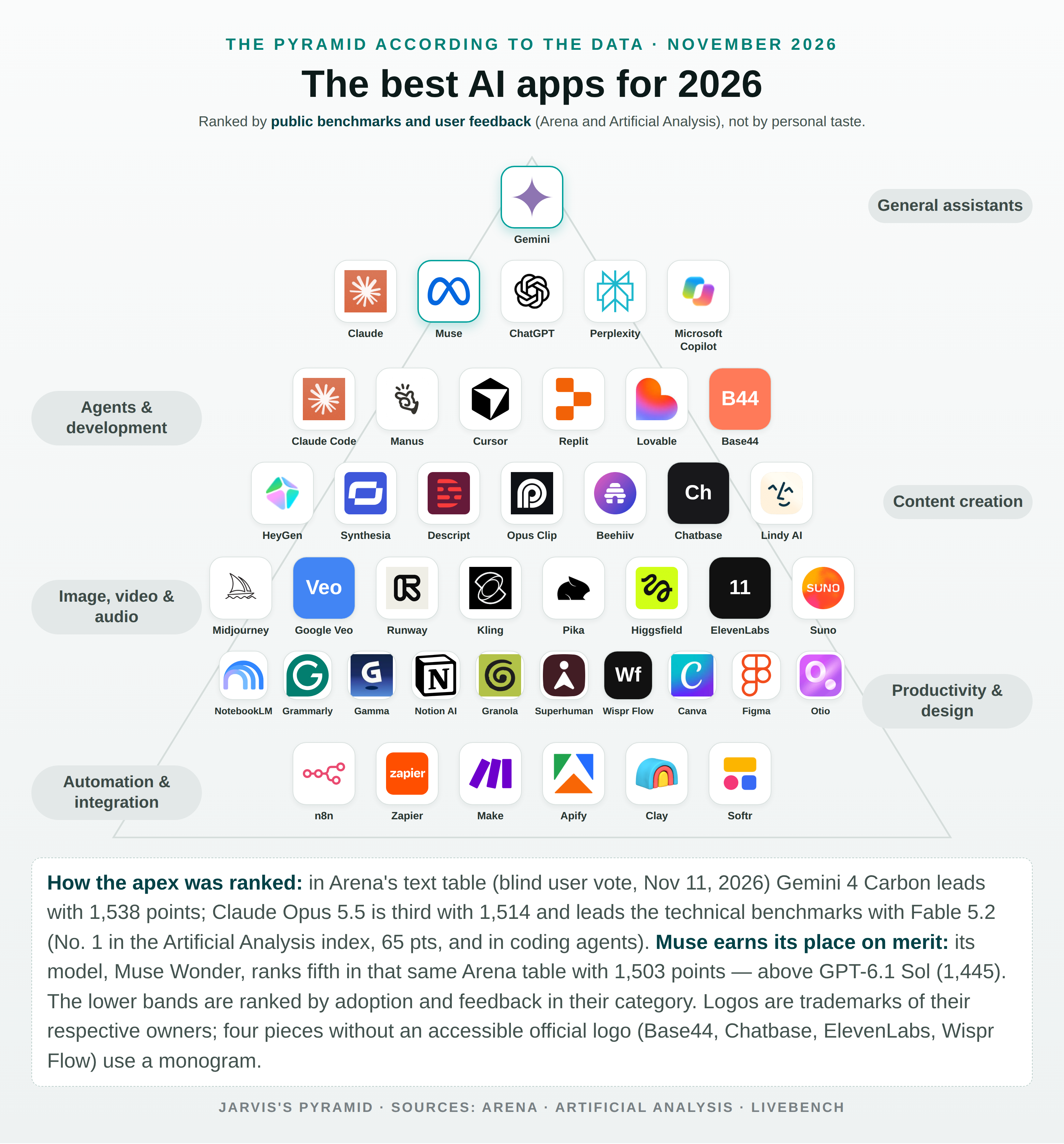
The apex and the second band: the general assistants
At the top of the pyramid sits Gemini, because Google's flagship wins the metric with the most voters behind it. In Arena's November 11 text table, Gemini 4 Carbon scores 1,538 and Gemini 4 Argon 1,529 — first and second. A caution: Carbon's lead rests on 4,273 votes, and its confidence interval still overlaps Argon's, which has 20,779 votes. The top of the popular vote is, statistically, close to a tie — and Carbon has been public since November 10.
The second band holds five assistants, and the order inside it depends on the ruler. Claude: Anthropic takes third and fourth in Arena's text table — Opus 5.5 with 1,514 and Fable 5.1 with 1,512 — while Fable 5.2 is not yet ranked there at all, for the timing reason documented in the surprises above. Muse, Meta's assistant line, places Muse Wonder fifth in the full Arena listing with 1,503; read the same table by each model's best reasoning setting and Muse Wonder (max) stands third with 1,511 — this article uses the conservative 1,503 and fifth place wherever a single figure is needed. ChatGPT is the band's counterpoint: GPT-6.1 Sol rates 1,445 in Arena's text table and GPT-6 Astra 1,440, with Astra 78th there, while the same Astra is second in LiveBench and third in ARC-AGI-3 under the standard harness. Perplexity holds its place as the answer engine, built around sourced search, and Microsoft Copilot as the assistant inside the office suite companies already pay for. Neither is placed by the model tables: their position reflects their role as general-purpose assistants, not a benchmark score.
Agents and development: where Claude's lead is widest
If the general-assistant race is a split decision, the agent race is not. Claude Fable 5.2 is first in Arena's agent table — decided not by votes but by real agent sessions, scored on task completion, user praise or complaints, acceptance of corrections and whether the model invents tools it does not have — and first in Arena's web-development table with 1,826 points, ahead of Opus 5.5 at 1,816 and Sonnet 5.5 at 1,772, with Gemini 4 Carbon fourth at 1,768. It is also first in the Coding Agent Index with 58.5 points, measured inside Claude Code — a lead of one tenth, at a higher price: $15.47 per task on average against $12.61 for Opus 5.5 in the same harness. In Terminal-Bench 4.0 the two tie outright at 65.15% of tasks resolved. Anthropic's own guidance, reported in the sources: start with Opus 5.5 for most work, reserve Fable for the hardest.
The band's tools compete inside that context. Claude Code is the harness in which the leading models post their leading scores — tool and model are measured together, and buyers should read the pair as one product. Manus represents the autonomous general agent, sold as finished work rather than as a coding seat. Cursor and Replit anchor the AI-native development environments — the editor and the browser-based builder — while Lovable and Base44 occupy the prompt-to-app end, where a non-developer describes a product and receives a working application. The buying distinction here is how much autonomy is being purchased, and the benchmark that matches it is the agent table, not the chat table.
Content creation: the production line
The third band is where AI became a production department. HeyGen and Synthesia lead avatar video — a script in, a presented video out. Descript made audio and video editable as text, and Opus Clip industrialized the derivative: one long recording in, short clips out. Beehiiv carries the band into publishing, as the newsletter platform built for audience businesses; Chatbase turns a company's documents into a support agent that answers from them; Lindy AI assembles employee-style agents for office workflows. No public benchmark ranks these tools against each other — the sources opened here measure models, not finished products — so their position is a category map: names to pilot on the buyer's own material.
Image, video and audio: the generative studios
The fourth band is the creative studio. Midjourney remains the reference point for still-image generation. In video, Google Veo, Runway, Kling, Pika and Higgsfield contest the same brief — text or image in, motion out. ElevenLabs is the voice layer, Suno the music layer. One discipline note: no source opened for this piece publishes Arena's text-to-image table, so no image-model score is claimed; the omission is recorded in the verification notes.
Productivity and design: the quiet multipliers
The fifth band attaches to work that already exists. NotebookLM turns a set of sources into a grounded research brief. Grammarly is the writing layer; Gamma, the presentation generator; Notion AI, the intelligence inside the workspace where the documents live. Granola takes meeting notes without sending a bot into the call; Superhuman rebuilds email around speed; Wispr Flow makes dictation the input method. Canva brings generation to the template-driven mainstream, Figma keeps the professional design workflow, and Otio serves research synthesis. The pattern is the one Copilot exploits one band up: distribution into an existing habit beats a marginally better model behind a new login. Evaluate these tools on time returned to a specific role — measurable in a pilot, invisible in any ranking.
Automation and integration: the plumbing that pays
The base of the pyramid is the least glamorous band and, for operating businesses, frequently the most valuable. n8n, Zapier and Make are the workflow-automation tier — connectors moving data between the applications a company already runs, now with AI steps inside the flow. Apify is the web-data layer; Clay applies the same enrichment logic to go-to-market data; Softr turns databases into portals and internal tools without code. Nothing here is ranked by Arena or Artificial Analysis — the point of its place at the base: model intelligence is the apex, integration is the foundation.
What it means for technology buyers
Deploy by use case, and let each use case pick its own table. For a general assistant rolled out to a whole company, the Arena vote is the relevant prior — it predicts which answers staff will like — and the top is statistically bunched: the first eight models sit within 46 points, from 1,538 down to 1,492. For agents and software development, read the agent and coding tables instead, where Anthropic's lead is priced: Fable 5.2 tops the index at 65 and the coding-agent index at 58.5, yet at maximum effort its measured cost per index task is $26.54, against $10.04 for Opus 5.5 and $5.48 for Carbon — and Arena's agent table shows the same spread in median cost per task, $9.02 against $1.35. The rational fleet is tiered: a frontier model for the hardest tasks, a fast model — Hydrogen scores 54 on the index and 1,502 in Arena's text table — for volume. For content, creative and productivity tools, where no trustworthy public ranking exists, run paid pilots on your own material and measure output and hours, not demos. And distrust any number quoted without its configuration: the same Opus 5.5 scores from 35 to 59 on the index depending on the reasoning effort allowed.
A note on transparency
This ranking includes Muse, the platform whose model — Muse Wonder, from Meta — runs this newsroom's own workflow. Its position here comes from Arena's public table, cited above, and not from editorial choice; where two readings of that table exist, this article uses the lower one.
Sources
- Metix — “Benchmarks de IA hoy: ranking actualizado (noviembre 2026)”, updated November 16, 2026: Arena text table (November 11), Arena web-development and agent tables (November 15), Artificial Analysis Intelligence Index v5.0, Coding Agent Index, LiveBench, Terminal-Bench 4.0 and ARC-AGI-3 figures and per-task costs cited here. https://metix.ninja/modelos/benchmarks-ia/
- Trendy Tech Tribe — “Ranking de modelos de IA”, table dated November 11, 2026: the LMArena text table read by best reasoning setting per model (Muse Wonder (max) 3rd, 1,511), margins and launch dates. https://trendytechtribe.com/es/ai/ai-model-rankings
- DOA IA — “Modelos de IA”: the composite method (normalized average of Arena and Epoch AI) and the Epoch Capabilities Index figures in the cross table (data of October 8, 2026). https://www.doa-ia.es/es/modelos
- OpenRouter — LLM Rankings, usage data through November 17, 2026: methodology of the usage ranking (tokens processed through the OpenRouter API; the page states it does not measure users or spend). Per-model chart values were not legible in the page as opened; no usage figure is cited. https://openrouter.ai/rankings
- Pyramid graphic: THE BUYER'S PULSE, compiled from the tables above; unranked bands are presented as category maps.