
The jet was ready. The number was not: United's departures waited at the gate for a final weight that never came
At about 5:00 p.m. Eastern on Monday, United Airlines confirmed that a technology issue was delaying its departures. About an hour later, it said the issue was resolved. In between, an internal pilots' union memo pointed to the two things that had failed together: the crew messaging applications — and the final aircraft weight that no departure can leave without.
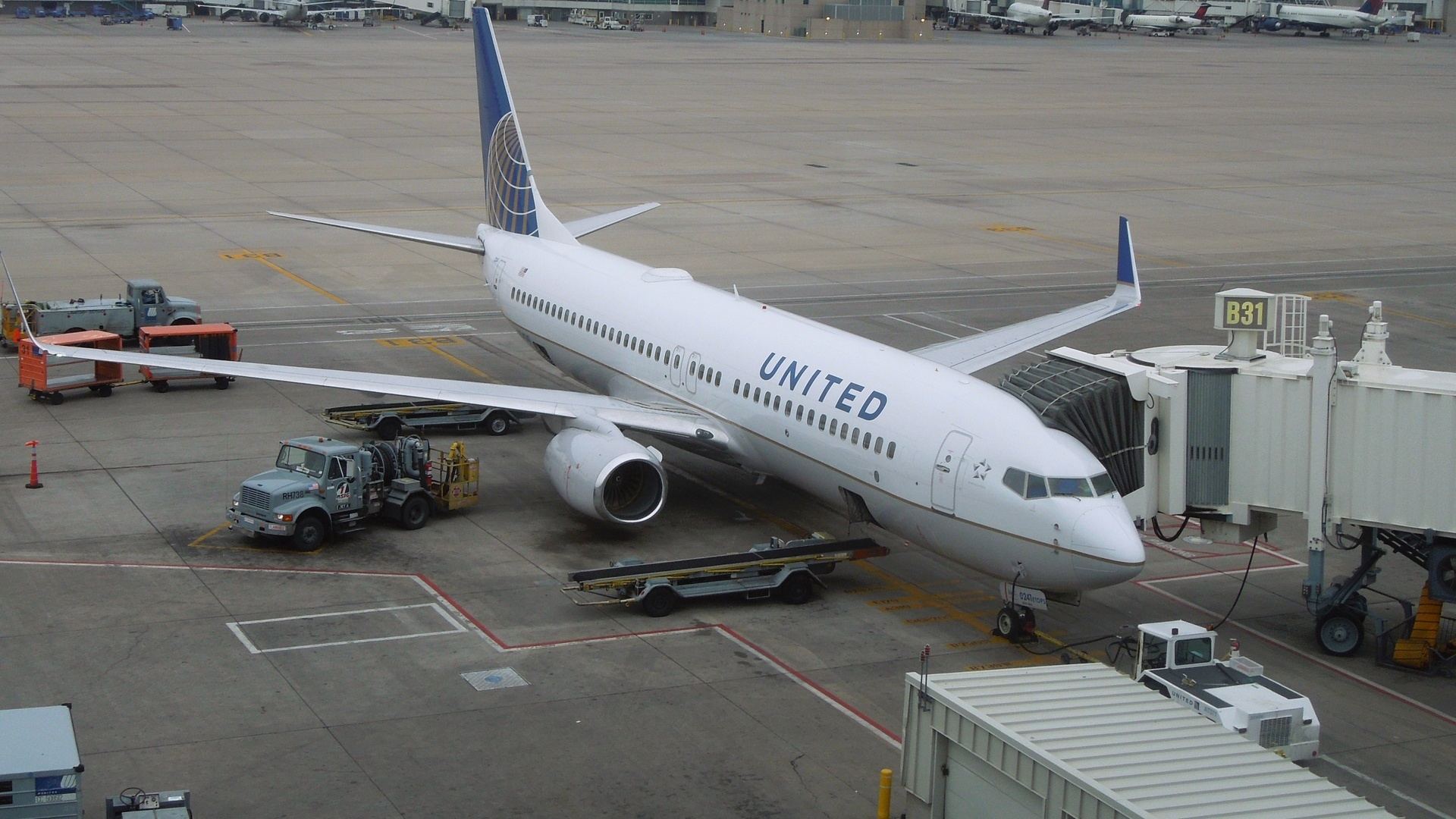
Photo: © DReifGalaxyM31 / CC BY 3.0 (via Wikimedia Commons) — file photo of a United Boeing 737-800 at Gate B31, Denver International Airport; not a scene from November 16, 2026.
For about an hour on Monday afternoon, United Airlines had everything a departure needs except the one thing it cannot fly without. The aircraft were at their gates. The crews were in their seats. The passengers were boarded or boarding. What was missing was a number — the final weight of the airplane — and the internal applications that deliver it. At about 5:00 p.m. Eastern time on Monday, November 16, United confirmed that a technology issue was delaying flight departures across its mainline network. Roughly an hour later, at about 6:00 p.m. Eastern, the airline announced that the problem was resolved: "We have resolved a technology issue that delayed flight departures." Between those two statements, one of the largest airlines in the world discovered — again — how completely a modern departure depends on software that passengers never see.
The scope, as United itself drew it, was precise. The failure hit departures on the mainline operation. Flights already in the air kept flying, and flights operated by United Express — the regional network that flies under the United brand — were not affected. United also addressed the question that now follows every outage of this scale within minutes: the airline said there was "no indication" that the incident was a cybersecurity-related issue. What United did not do, on Monday or in its first statements afterward, was name the root cause. The airline has not disclosed what failed, and nothing in this story should be read as an answer to that question — because, on the verified record, there is not one yet.
What failed: United's own internal applications
The clearest account of what broke did not come from the airline's public statements. It came from an internal memorandum of the Air Line Pilots Association — ALPA, the union that represents United's pilots — seen by Reuters and ABC News. According to that memo, the failure was a companywide outage of web-based applications used by flight crews. Among the affected tools were the systems crews use for communications and messaging — the channel through which pilots and the airline coordinate the final steps before a departure. And, critically, the outage reached the calculation that closes every departure: United was unable to provide final aircraft weights for departing flights.
The memo, as reported, advised pilots to follow the guidance of airport station personnel on whether to leave their gates — an instruction that captures the strange shape of the failure. Nothing was wrong with the airplanes. Nothing was wrong with the weather system, the runways or the airspace. The breakdown sat in the layer of internal software between the airline and its own crews: the messaging that coordinates a departure, and the weight figure that authorizes one. A subsequent union communication said United's systems were coming back online and directed pilots to check updated company instructions — the operational all-clear that preceded the airline's public announcement that the issue was resolved.
The number a departure cannot leave without
To a passenger, a departure looks like a physical event: doors close, the jet bridge pulls back, the aircraft pushes away from the gate. In operational terms, a departure is a calculation that happens to end in a takeoff. Before any commercial flight can leave, the crew must know the aircraft's final weight — the airframe plus fuel, passengers, baggage and cargo as actually loaded — and confirm that the weight, and the way it is distributed, sit inside the limits for that aircraft, that runway and that day's conditions. Takeoff speeds, climb performance and stopping margins all derive from that figure. Without it, there is no safe or legal departure, whatever the state of the airplane itself.
That is why a failure in a weight-calculation feed does not produce a workaround culture on the ramp. There is no estimating a final weight, no departing on the planned figure and reconciling later. When the number does not arrive, the correct action is the one United's operation took on Monday: the aircraft waits at the gate. The same logic explains why the outage's footprint was departures only. An aircraft already airborne has already made its calculation; an aircraft on the ground, mid-turnaround, is a departure waiting for its data. The technology issue did not stop United from flying. It stopped United from starting — which, across a network the size of United's, is quite enough.
One hour on the clock — and an evening in the numbers
The public timeline is short. United acknowledged the problem at about 5:00 p.m. Eastern, telling customers its teams were working to restore the systems. About an hour later, around 6:00 p.m. Eastern, the airline said the technology issue had been resolved. The operational timeline and the passenger timeline, however, are different things: a departure bank that misses its hour does not recover in the next one, because aircraft and crews end up displaced from the positions the rest of the evening's schedule assumed. The clearest way to watch that residue accumulate is the running tally published by the flight-tracking service FlightAware, as reported through the evening by Reuters and USA TODAY.
| Time (ET), Mon Nov 16 | United cancellations | United delays | Share of the day's schedule |
|---|---|---|---|
| 6:10 p.m. | 22 | 554 | ~17% |
| 6:50 p.m. | 25 | 645 | ~20% |
| 9:50 p.m. | 28 | 811 | ~25% |
Read the table the way the sources present it. These are FlightAware's totals for United's whole day at each timestamp — every delay and cancellation the tracker recorded for the airline by that hour, from every cause that operated on Monday: weather, congestion, the continuing recovery from Friday's national disruption, and this outage among them. They are not, and no source cited here presents them as, a count of flights the technology issue itself delayed. What they do show is the shape of the evening: an airline that entered the afternoon already carrying the weekend's disruption absorbed a second, self-inflicted shock at the start of its evening departure bank, and the delayed share of its day climbed from about 17 percent to about 25 percent between the resolution of the failure and the close of the evening.
Not the FAA: the line officials drew immediately
Because of what had happened three days earlier, the first institutional question on Monday was jurisdictional: was this the same failure, still unfolding? Officials answered it at once, and in the negative. Transportation Secretary Sean Duffy separated the two events explicitly, saying of United's problem: "This is not an FAA system-wide problem," and adding that he did not know the root cause of United's failure. The Federal Aviation Administration said the same thing from its side: an FAA spokesperson, Hannah Walden, told CNN that United was experiencing a technology outage on its own end and that it was not an FAA equipment issue.
That separation matters, and this magazine states it as plainly as the officials did: there is no verified evidence connecting Monday's United outage to the FAA's nationwide ground stop of Friday, November 13. The two failures lived in different systems, owned by different organizations — one in the federal air traffic network, the other inside a single airline's internal applications. Anyone drawing a line between them is drawing it without evidence. What can honestly be said is narrower, and it is the subject of the next section: they happened four days apart, to the same industry, in front of the same passengers.
Four days after the country stopped
On Friday, November 13, the FAA ordered every airport in the United States to hold its departing flights on the ground, after a telecommunications outage silenced the en route centers that guide the nation's flights — the story this magazine told in Every departure in America stopped, and whose political aftershock it followed in the sequel on the reaction in Washington. That stop lasted four hours and 22 minutes, and its residue — thousands of cancellations, aircraft and crews out of position — was still working its way through airline schedules on Monday. United's own operation was among those still recovering when its internal systems failed.
The juxtaposition is not a connection, and the distinction is worth keeping sharp, because the two events teach different lessons. Friday's failure was a commons failure: shared national infrastructure that every airline depends on and no airline controls. Monday's was a house failure: one company's internal applications, on which that company's departures — and only that company's — depended. American aviation managed to produce one of each in the space of four days. For the passenger standing at a gate, of course, the taxonomy is invisible. What is visible is the same board, the same word — delayed — and the same discovery that the system has more single points of failure than its size suggests.
The second technology failure in four days, days before Thanksgiving
Timing is the multiplier in both stories. Friday's ground stop hit the Friday evening departure bank, the heaviest of the week. Monday's outage hit the start of an evening bank again — and it hit an industry now counting in days, not weeks, to the Thanksgiving travel peak, one of the most congested periods of the American aviation year. Airlines do not experience these weeks as ordinary operations with more passengers; they experience them as a system run deliberately close to its limits, in which slack — spare aircraft, spare crews, spare hours — is the first thing the schedule spends.
That is the context in which a one-hour internal outage becomes a 25-percent-delayed day. The failure itself was brief, contained and, on the airline's account, resolved cleanly. Its consequences were neither, because consequences in aviation are a function of position, not of duration: a departure missed at 5 p.m. is an arrival missed at 8, a crew out of legal position by midnight, and a first departure at risk the next morning. The lesson of Monday is not that United's systems failed for an hour. It is that in the weeks when the network runs hottest, an hour is not a small unit of failure.
A familiar failure mode
There is a precedent inside United's own recent history, and Reuters noted it in its account of Monday's outage. In August 2025, United temporarily grounded its flights after a problem with its Unimatic system — the platform that supplies flight information to the systems used to calculate aircraft weight and balance. The family resemblance to Monday's failure is hard to miss: then, as now, the vulnerable point was not propulsion, navigation or communications with air traffic control, but the data feed behind the weight-and-balance calculation on which every departure depends. United has not said whether the same system, or any related one, was involved on Monday — the root cause is undisclosed — and this magazine does not claim otherwise.
The pattern is not United's alone. Alaska Airlines briefly halted departures nationwide in April 2024 after a problem with its own weight-and-balance system. The recurrence across carriers points at the structural fact underneath all three episodes: the modern departure is a data product before it is a physical one, and the weight-and-balance chain — load data in, final figure out, crew authorized — is one of the places where that product has the least tolerance for interruption, because there is no manual estimate waiting behind it. Airlines have automated the departure to the point where the automation is the departure. Monday showed what that means on the day the automation pauses.
What remains unknown
What remains unknown is, once again, the part that matters most. United has not disclosed the root cause of Monday's outage: which platform failed, why a web-based application outage reached the weight data a departure depends on, or what has been changed to keep the same hour from repeating. The airline's verified statements establish the what, the when and the perimeter — mainline departures delayed, airborne and United Express flights untouched, no indication of a cybersecurity issue — and they stop there. Secretary Duffy, for the government, said the same thing in fewer words: he did not know the root cause of United's failure.
So the verified record of Monday, November 16, 2026, is this. At about 5:00 p.m. Eastern, the internal applications that connect United Airlines to its own crews — their messaging, and the final-weight calculation that closes a departure — went down, and departures waited at gates across the mainline network. At about 6:00 p.m. Eastern, United said the issue was resolved. By 9:50 p.m. Eastern, FlightAware's tally for United's day stood at 811 delays and 28 cancellations, a total that includes far more than this outage and that no honest account should lay entirely at its door. It was the second technology failure to stop American departures in four days — the first belonging to the nation's air traffic system, this one to a single airline's house — with no verified evidence connecting the two, and the busiest travel days of the season still ahead. The airplanes, all afternoon, were ready. The number was not.
Published Monday evening, November 16, 2026. This story will be updated when United discloses the cause of the outage.
𝐆𝐄𝐓 𝐅𝐑𝐄𝐄 𝐅𝐔𝐋𝐋 𝐌𝐀𝐆𝐀𝐙𝐈𝐍𝐄 𝐀𝐓 thebuyerspulse.com
Sources
- Reuters (Nov 16, 2026), “United Airlines says technology issue affecting departing flights”: United's confirmation and resolution; flights airborne and United Express unaffected; the ALPA internal memo seen by Reuters (web-based outage, crew communications, final aircraft weights); FlightAware counts via Reuters (645 delays / 25 cancellations at 6:50 p.m. ET).
- USA TODAY (Nov 16, 2026), “United resolves 'widespread' system outage that delayed some flights”: FlightAware at 6:10 p.m. ET (22 canceled / 554 delayed, ~17%) and at 9:50 p.m. ET (28 canceled / 811 delayed, ~25%); Secretary Duffy separating the outage from FAA systems. https://www.usatoday.com/story/travel/airline-news/2026/11/16/united-airlines-system-outage/92817134007/
- Associated Press, ABC News, CNN, CBS News, NBC News, CNBC and The Verge (Nov 16, 2026): parallel coverage of the outage and its resolution; the ALPA memo via ABC News; FAA spokesperson Hannah Walden to CNN (a United-side outage, not an FAA equipment issue); United's “no indication” of a cybersecurity issue.
- Reuters via BusinessWorld (Nov 17, 2026): Secretary Duffy on Fox News' “Hannity” — “This is not an FAA system-wide problem”, root cause of United's failure unknown; the August 2025 Unimatic precedent and the April 2024 Alaska Airlines weight-and-balance halt. https://bworldonline.com/technology/2026/11/17/794444/united-airlines-says-technology-outage-that-delayed-departures-has-been-resolved/
- FlightAware data as reported by Reuters and USA TODAY at the timestamps shown in the table. Day totals include delays and cancellations from all causes; they are not an outage-only count.
- Photo: © DReifGalaxyM31 / CC BY 3.0 (via Wikimedia Commons), “United Airlines Boeing 737 at Gate B31” — file photo, Denver International Airport. https://commons.wikimedia.org/wiki/File:United_Airlines_Boeing_737_at_Gate_B31.jpg