
Every departure in America stopped: a telecommunications outage silenced the centers that guide the nation's flights
At 3:54 p.m. Eastern on Friday, the FAA ordered every airport in the United States to hold its departing flights on the ground. The failure was not in the towers. It was in the communications layer that connects the 22 en route centers guiding aircraft between airports — The stop lasted four hours and 22 minutes: the FAA lifted it at 8:15 p.m. Eastern, but the recovery had barely begun — by late evening more than 6,800 U.S. flights had been canceled, and hundreds more were already scrubbed for Saturday.
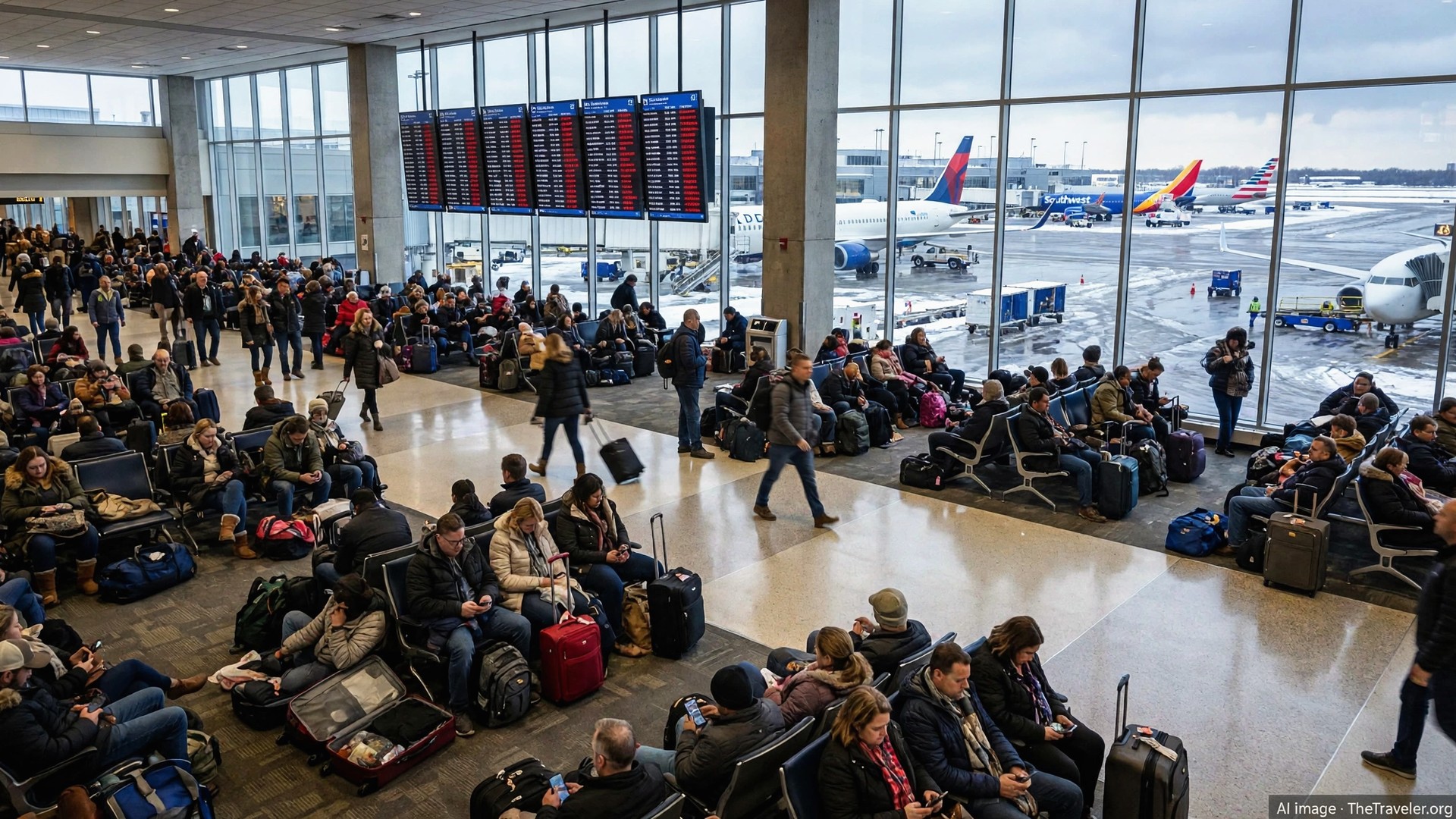
Illustration: TheTraveler.org (AI-generated image, chosen November 13, 2026).
At 3:54 p.m. Eastern time on Friday, November 13, the Federal Aviation Administration did something it has done only once since September 11, 2001: it stopped everything. Advisory 111, issued by the FAA's Air Traffic Control System Command Center, ordered a national ground stop for every airport in the United States. "Due to extraordinary circumstances and for reasons of safety," the advisory read, "all departing traffic should remain ground stopped until further notice. Inbound international flights will be managed on a case by case basis." The reason code attached to the order was two words long: EQUIPMENT / OUTAGE.
The failure behind the order was a telecommunications outage that struck the communications and frequencies of the Air Route Traffic Control Centers — the 22 regional facilities, known as ARTCCs, that direct aircraft en route between airports at cruising altitude. It is the layer of the system that most passengers never think about: not the tower at the airport, which handles takeoffs and landings, but the network of centers that hands each flight from one sector of sky to the next, by radio, thousands of times a day. When that layer lost its communications on Friday afternoon, the FAA decided that aircraft on the ground would stay there.
To understand what broke, it helps to picture the journey of a single flight. A departure is cleared by the tower at its airport, but within minutes the aircraft leaves the tower's airspace and is handed to an en route center, which guides it — by radio instructions on assigned frequencies — across its sector and then hands it to the next center, and the next, until the destination's approach control and tower take over for landing. A flight from Las Vegas to Chicago passes through the hands of several centers this way. The system works because every handoff is a conversation: controller to pilot, center to center, on frequencies that must simply work. A telecommunications failure at that level does not close one airport or one route. It removes the conversations themselves, across the whole map at once — which is why the FAA's response was not a delay program at a few hubs but a stop on every departure in the country.
Transportation Secretary Sean Duffy stated the scope in a post at 4:16 p.m. Eastern: "The FAA issued a nationwide ground stop for all U.S. airports following a communication issue impacting all Air Route Traffic Control Centers. FAA technicians are investigating the issue. We will provide immediate updates as we have them." An FAA spokesperson, speaking to other outlets, described the problem as affecting "multiple" centers; the "all 22" formulation is the secretary's. Shortly before the national order, Reuters reported, the FAA had already halted traffic in Chicago over air traffic control communications problems. According to the National Business Aviation Association's Air Traffic Desk, reported by AIN, the stoppage followed frequency and radar outages at several en route centers, and a later advisory extended flight-plan drop times to 240 minutes for all en route centers, citing the nationwide communications failure. The FAA has not named the exact component that failed, and no official has identified a root cause.
Aircraft already in the air were not ordered to land. At 4:19 p.m. Eastern, the flight-tracking service Flightradar24 counted 3,100 aircraft bound for U.S. airports still airborne, with no new departures joining them. The FAA said later that every flight had been accounted for and that international flights would be handled case by case. The disruption crossed the border on its own: NAV CANADA applied traffic-management measures at Toronto Pearson, Montreal-Trudeau, Calgary and Vancouver, and Toronto reported no scheduled U.S.-bound departures or arrivals during the stop — effects of the American order, not part of it.
Outside the White House, Homeland Security Secretary Markwayne Mullin addressed the question that follows any event of this scale. "We're wanting to assure all the American people, this isn't a safety threat to the American people or another 9/11 — that's not the case," he said. "There is no prior indication as of yet that this was a nefarious attack against us. It's just a telecommunications outage as of right now." Asked whether a cyberattack or an AI intrusion had been ruled out, he answered: "We don't want to get ahead of ourselves. We're not ruling anything out at this point." The FAA's own statement used the same register: "There has been a temporary telecommunications outage — out of an abundance of caution all flights have been halted." Mullin added the sentence passengers most needed to hear: "Everybody's safe. There's no reason to be concerned about your loved ones if they're flying." He also said officials had not discussed any time frame for restarting flights, and he downplayed any connection to a concurrent Microsoft Outlook outage: "I don't see any reason to connect those two at all."
The numbers on the ground grew by the hour. Reuters, citing the tracking service FlightAware, reported nearly 7,000 flights delayed or canceled in the first snapshot of the afternoon. By 5:44 p.m. Eastern, FlightAware's count had passed 9,086 delays with 1,147 cancellations in the United States, and later tallies put delays above 10,000. The cancellations kept climbing even after the order was lifted, as airlines cut what was left of the evening rather than try to fly it: by 9:50 p.m. Eastern, FlightAware's running total for the day stood at 6,820 cancellations within, into or out of the United States, and nearly 800 more cancellations were already posted for Saturday. The exposure was enormous from the start: according to Cirium data reported by CNBC, some 11,000 flights had been scheduled to depart U.S. airports after 4 p.m. Eastern alone — the Friday evening bank of departures, business returns and weekend trips, all of it held at gates. Airlines for America, the trade group of the major U.S. carriers, said it was in close communication with the FAA and the Department of Transportation.
In Las Vegas, Harry Reid International Airport issued its own advisory — "Due to an equipment outage, the FAA has implemented a nationwide ground stop. All travelers should check with their airline for current flight status" — and local television reported an approximately 15-minute delay early in the event, passengers deplaned at gates, and at least one flight canceled after taxiing back. It was the same scene, at national scale: aircraft loaded and pushed back with nowhere to go, crews and passengers waiting on information that, for hours, consisted of a single fact — the order had no end time. The advisory's filed window ran to 11:30 p.m. Eastern; the FAA noted that the listed expiration did not guarantee flights would resume by then.
The end came in two steps. The first movement came at 5:46 p.m. Eastern, when a Command Center update — Advisory 120 — said the stop remained in effect but flights would be allowed to depart in coordination with the Command Center as the en route facilities recovered. Then, at 8:19 p.m. Eastern, Advisory 005 cancelled the nationwide ground stop outright, effective 8:16 p.m. — four hours and 22 minutes after it began. At the White House, Secretary Duffy put the reopening a few minutes earlier, at 8:15 p.m.: "At 8:15 tonight, Eastern time, we've opened up the airspace," he said. "Now does that mean every flight is going to fly right now? It's going to be slow." Departures are restarting under coordination — release times, call-for-release procedures and spacing restrictions — and the Command Center's overnight operations plan kept its hotlines open, with the next national update due at 6 a.m. Eastern on Saturday. Late in the evening the Command Center's board still listed five narrower ground stops, each limited to a single carrier at a single airport and imposed at the airline's own request, and JetBlue cancelled most of the flying it had left on Friday. A ground stop of this kind does not end like a switch being flipped. Aircraft and crews end the day out of position, connections break in sequence, and a departure released late in the evening arrives at an airport whose own operation has already been rearranged around its absence. The lifting of the order on Friday night leaves exactly that residue: a mass of cancellations and delays moving through the weekend schedule.
At the same briefing, Duffy gave the fullest official account yet of what failed. At 3:36 p.m. Eastern, he said, "we experienced instability for our radar and our communications in our centers and our TRACONs across the country": the system's switches and routers "got overloaded with data" and began returning inconsistent information, and the network was shut down on that basis. "We didn't lose all telecom, we didn't lose all radar," he added. He blamed an "incredibly old" air traffic control system running on analog lines — "We use 1980s little copper lines" — and said technicians had restored full functionality at the centers and TRACONs before the airspace reopened. Mullin, beside him, closed the other door: so far there is no evidence of a cyberattack, and "it appears that this was mechanically driven," though the review continues. The precise root cause has still not been identified.
One line of the investigation is already public, and it is the one this magazine's readers will follow most closely. Three days earlier, on Tuesday, November 10, the FAA had announced the nationwide expansion of SMART — Strategic Management of Airspace, Routes, and Trajectories — a system built by Air Space Intelligence that combines some 200 data streams, from weather to flight paths to controller staffing, to flag problems and propose reroutes. SMART launched in the Washington, D.C. area on September 21 and, by its developer's description, supports planning alongside existing systems: it does not replace controllers and it does not control aircraft. Secretary Mullin said investigators will look at whether there is any link to the rollout — and the Associated Press noted, in the same breath, that the system operates out of one location near Washington and only sends recommendations to the control centers. Air Space Intelligence answered directly: "The current ground stop is not based on or a result of the SMART system, any product of ASI or our integration with FAA and ATC." No official has established any link between the new system and Friday's failure. What is established is narrower and, for now, more important: a telecommunications failure in the en route network was enough, on its own, to stop a nation's departures.
The precedent underlines the scale. Friday's halt was the second nationwide ground stop of all departures since the September 11 attacks; the other came in January 2023, when the FAA paused all domestic departures for less than two hours after its NOTAM system — the Notice to Air Missions network that distributes safety information to pilots — failed because contractors accidentally deleted files while synchronizing the primary database with its backup. The 2023 failure was a database. The 2026 failure, on the evidence published so far, is a communications layer. Two different systems, the same lesson written twice: American aviation runs on a small number of shared technical foundations, and when one of them fails, the failure is not local. It is total, immediate and measured in thousands of flights.
What remains unknown is the part that matters most for what happens next. The FAA has not said which component failed, whether the outage was in FAA equipment or in a carrier's network feeding it, or why the failure reached across centers instead of being contained in one. Those answers will decide whether Friday was an accident of aging infrastructure, a flaw in a recent change, or something else entirely — and officials, to their credit, refused on Friday to guess in public. Until the agency publishes its findings, the verified record of November 13, 2026 is this: at 3:54 p.m. Eastern, the communications that guide America's flights between airports failed, and the safest decision available was the largest one in aviation — stop everything. The voices came back at 8:15 p.m. Eastern. The explanation has not.
Updated on Friday night, November 13: the FAA lifted the nationwide ground stop at 8:15 p.m. Eastern and departures are resuming gradually. This story will be updated again when the FAA confirms the cause of the outage.
𝐆𝐄𝐓 𝐅𝐑𝐄𝐄 𝐅𝐔𝐋𝐋 𝐌𝐀𝐆𝐀𝐙𝐈𝐍𝐄 𝐀𝐓 thebuyerspulse.com
Sources
- FAA Air Traffic Control System Command Center, Advisory 111 — National Ground Stop, November 13, 2026 (text via CNN, USA TODAY and AIN).
- Reuters (Nov 13, 2026), “FAA issues national ground stop due to extraordinary circumstances, reasons of safety”: the Chicago halt, the nearly 7,000 delayed or canceled flights (FlightAware), and the January 2023 precedent.
- Associated Press (Nov 13, 2026): Secretary Duffy on the 22 en route centers; Secretary Mullin's remarks outside the White House; investigators to examine any link to the SMART rollout.
- USA TODAY live coverage (Nov 13, 2026): the advisory's filed window; Flightradar24's count of 3,100 airborne aircraft; the Air Space Intelligence statement on SMART.
- AIN (Nov 13, 2026), “Citing Communication Fault, FAA Issues U.S. Ground Stop”: the NBAA Air Traffic Desk on frequency and radar outages; NAV CANADA measures.
- FlightAware data via Reuters and TheTravel (delay and cancellation counts, timestamped 5:00 p.m. and 5:44 p.m. ET); Cirium data via CNBC (11,000 departures scheduled after 4 p.m. ET).
- Harry Reid International Airport advisory (Nov 13, 2026) and FOX5 Las Vegas reporting from the terminal.
- FAA Air Traffic Control System Command Center, Advisory 005 — cancellation of the nationwide ground stop, issued 8:19 p.m. ET, November 13, 2026, effective 8:16 p.m. ET (text via AP and Flying Magazine); Advisory 120 (5:46 p.m. ET) on coordinated departures; overnight operations plan with the next national update at 6 a.m. ET on Saturday.
- White House briefing on Friday night, November 13, 2026: Secretary Duffy on the 3:36 p.m. ET radar and communications instability, the switches and routers overloaded with data, the 8:15 p.m. ET reopening and the gradual resumption; Secretary Mullin on the absence of evidence of a cyberattack (via AP, NBC News and The Hill).
- FlightAware live counters read at 9:50 p.m. ET, November 13, 2026 (6,820 cancellations within, into or out of the United States for the day); Associated Press on the cancellations already posted for Saturday.
- Illustration: TheTraveler.org — AI-generated illustration of a departure hall during the ground stop (not a photograph).