
Stolen Faces: 293 accounts turned real creators into fake political news
A McGill University investigation tracked at least 293 TikTok and Instagram accounts that stole real creators' videos, replaced their voices with synthetic narration and re-animated their lips: 3,201 videos, 22.1 million views, and a target — Canada — chosen on purpose.
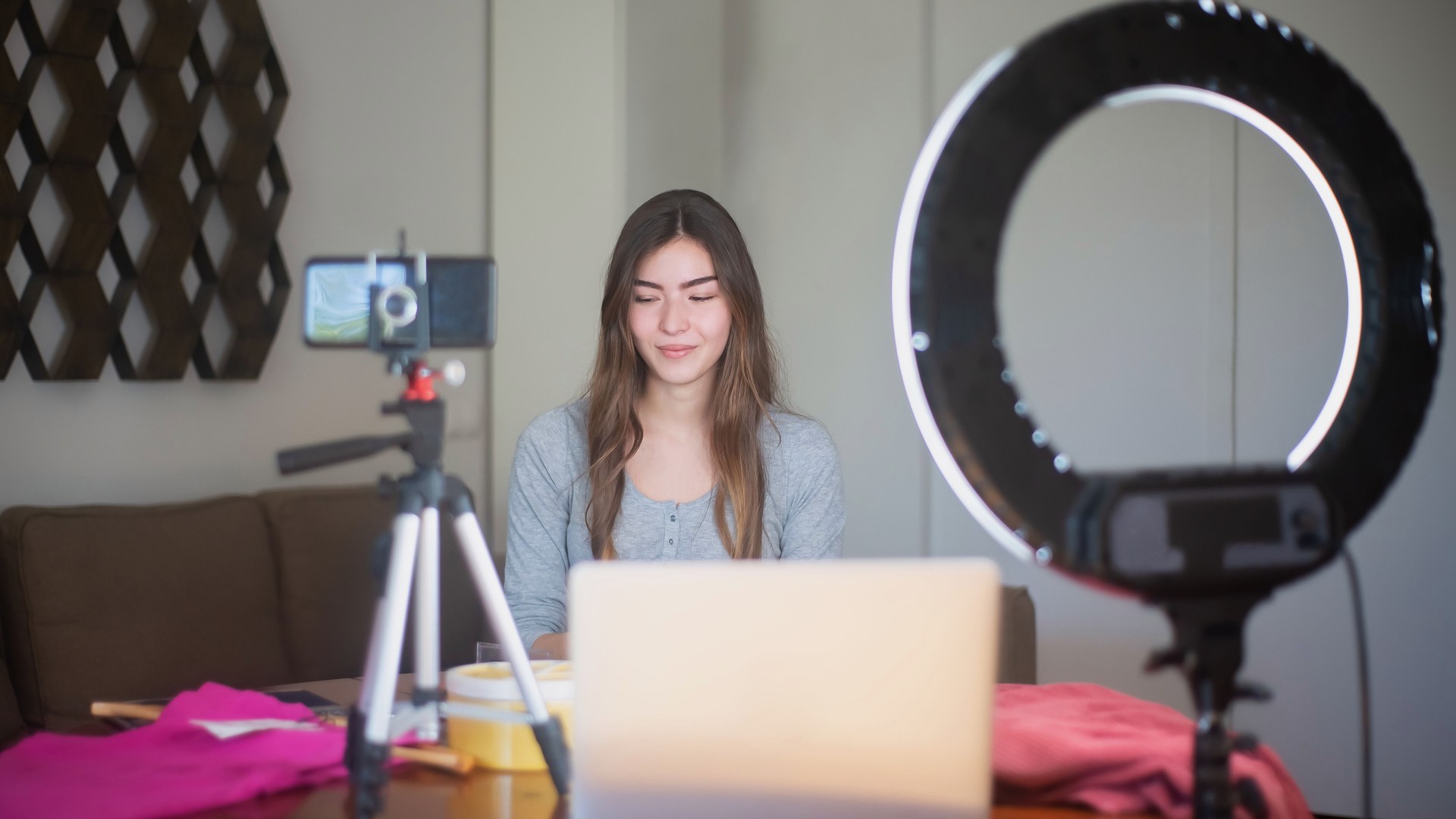
Photo: Kampus Production, via Pexels (Pexels License — free to use). The creator pictured is not among the victims identified by the researchers; the image illustrates the kind of video the network steals.
Start with what stealing a face actually means, because it is simpler — and harder to spot — than the word deepfake usually suggests. A creator records an ordinary video: face to the camera, in their own room, talking about whatever they talk about. Every pixel of it is real. Then someone else takes that video, throws away the original sound and lays down a new narration, spoken by a synthetic voice. The last step closes the trap: software re-animates the person's mouth so the lips move in time with the invented words. What reaches your feed is a real person, in a real place, with real gestures — saying things they never said.
That machine now has a map and a measurement. In «Stolen Faces», a report published on November 12, 2026 by the Centre for Media, Technology and Democracy at McGill University, researchers document a network of at least 293 accounts on TikTok and Instagram that did exactly this, at an industrial pace: 3,201 videos published between August 7 and November 4, 2026, accumulating 22.1 million views. And when the team closed its data collection, the network had not slowed down — it was still publishing around 100 videos a day, and its accounts were still active on November 11.
Watch one as a viewer and the seams sit where you would never think to look. The greeting is hers. The pause before the strong claim is hers. The hand that rises on the emphasized word is hers, because she really made that gesture — under a different sentence, in a different video, possibly about something else entirely. Nothing in the frame announces the substitution, because almost nothing in the frame was substituted: one voice, and the movement of one mouth.
How a face gets stolen
The method needs no studio, no actor and no lookalike, which is why it scales. The raw material is free: any public video of a person speaking to a camera. The network replaces the audio track with synthetic narration — a generated voice reading a script the creator never saw — and then applies a lip-sync deepfake: software that redraws the mouth region, frame by frame, so the visible speech matches the invented one. The face, the eyes, the hands, the room and the light all stay original, because all of them were really filmed.
Creators are, without knowing it, the ideal suppliers of this raw material. They film themselves exactly the way the software needs: face to the camera, close, well lit, steady, talking for minutes at a time. Every talking-head video a creator publishes is also — seen from the network's side of the fence — a clean recording of a face producing thousands of mouth shapes, ready to be re-voiced.
The mouth is the detail that matters. For years, the practical tells of a fake video were a voice that did not fit and lips that did not quite move with the words; viewers catch both without thinking. This method removes exactly those two tells and leaves everything else untouched. What remains is the strongest evidence a feed can offer — a recognizable person, apparently speaking — pointing in exactly the wrong direction.
That is what makes the stolen-face variant more corrosive than a fully synthetic video. A clip of a person who does not exist can be dismissed as fabrication. A stolen face borrows the credibility of a real creator: their audience recognizes them, the platform sees an ordinary upload, and the lie does not have to manufacture trust. It rents it, from someone who never agreed to lend it.
The count, and its shape
The researchers counted for ninety days, from August 7 to November 4, 2026, and the shape of the count matters as much as its size. The 3,201 videos average out to about 36 a day across the period. But the operation the team measured at the end of the window was running at roughly 100 videos a day — nearly three times the period's average. Read in sequence, the figures describe not a campaign winding down but one still accelerating when it was measured.
The target was Canada
The network was not spraying content at random. According to the report, 84 percent of the videos were about Canada and aimed at a Canadian audience, and the fabricated politics revolved around the trade war between the United States and Canada: invented statements, invented confrontations and invented deadlines, all spoken by real faces.
The most-watched fabrication shows the recipe at full strength. One story claimed that Donald Trump had given Prime Minister Mark Carney a «48-hour ultimatum». It never happened. But the invented ultimatum accumulated 5.1 million views, spread across 161 publications in 129 different accounts. That redundancy is part of the design: no single post has to survive for the story to reach millions, because the same lie can walk in through a hundred doors at once — and an invented deadline is built to be shared before it is checked.
The choice of subject was not decorative. An invented ultimatum hangs on a real, running dispute — the trade war — so the fabrication arrives pre-fitted with a context the audience already believes: real tension, real leaders, real stakes. The lie only has to supply the one element that does not exist, the deadline — and a deadline is the most shareable unit in political content, because it tells the viewer that checking later is already too late.
Nobody knows who is running it
The report's most uncomfortable finding may be what it could not find. The researchers conclude that the network operates almost certainly from outside North America — but who directs it, and who finances it, has not been identified. The accounts were still active on November 11, the day before publication, and the operation was still producing at a rate of roughly one hundred videos a day.
That combination — foreign operation, domestic faces, no identified owner — is precisely the configuration that platform enforcement handles worst. The content is local, the speakers are real and reachable, and the people actually responsible are neither.
Two platforms, two answers
Once the report was out, the two platforms hosting the network moved at different speeds. TikTok permanently banned the accounts named in the investigation. Instagram, where 36 of the accounts operated, announced no equivalent measure. The asymmetry matters because the network never depended on a single platform: a face silenced in one feed can keep talking in the other.
What the ban reached, precisely, was the set of accounts the report named. A network publishing through at least 293 accounts — and still adding roughly a hundred videos a day when last measured — is built to lose accounts; replacement is an operating cost, not an existential threat. Which is why the researchers' unanswered question outweighs the takedowns: nobody has identified who runs the network, or who pays for it.
The labeling gap is wider still. Only about 4 percent of the videos the researchers sampled carried TikTok's AI label — the disclosure tag meant to tell viewers that what they are watching was generated or altered. A network built on stolen faces does not volunteer that information, and in the overwhelming majority of sampled cases, nothing on screen supplied it.
What a stolen face changes
For years, the working defense against fabricated video was the face itself: if you could see a known person saying it, that counted as evidence. «Stolen Faces» documents the industrial version of the moment that defense expires — not with a fake person, but with real people conscripted as unwilling spokespeople, aimed at one country's politics, at a hundred videos a day.
The report also redraws where the burden of proof now sits. It used to sit with the fake: a fabricated video had to pass as real. With stolen faces, the burden has moved to the real — a genuine creator video and a re-voiced one are the same object until the words are checked, and the words are the one part of a video that cannot be verified by looking at it.
The researchers have published the map: 293 accounts, 3,201 videos, 22.1 million views, one target country. What remains open is everything behind the map — who runs the network, who pays for it, and how much of it is still standing now.
For the creators whose faces were used, the theft has a particular shape: their most recognizable asset — the face their audience trusts — was made to argue positions they never took, in a political fight most of them were never part of. The videos were real. Only the words were stolen.
𝐆𝐄𝐓 𝐅𝐑𝐄𝐄 𝐅𝐔𝐋𝐋 𝐌𝐀𝐆𝐀𝐙𝐈𝐍𝐄 𝐀𝐓 thebuyerspulse.com
Sources
- «Stolen Faces», Centre for Media, Technology and Democracy, McGill University (report published November 12, 2026) — the network's scale (at least 293 accounts, 3,201 videos and 22.1 million views between August 7 and November 4, 2026), the lip-sync method, the Canadian focus (84% of videos), the most-watched fabrication, the unidentified operators and the platforms' responses.
- TechTimes — coverage of the McGill report and the network's activity.
- The Globe and Mail — coverage of the report and its Canadian target.
- Photo: Kampus Production, via Pexels (Pexels License — free to use). Illustrative: the creator pictured is not one of the victims identified by the researchers; the image shows the kind of video the network steals.