The November 17 “global blackout” is a hoax assembled from three real facts
A viral message promises 72 hours without power, internet or banking starting Tuesday, November 17 — caused, it says, by an artificial intelligence out of control, and “predicted” by The Simpsons. No authority anywhere has announced or forecast any such event. What is actually scheduled for that day is a one-minute test of the United States emergency alert system, and the rumor is what you get when you glue that real test to a European preparedness guideline and a cartoon clip carrying fake subtitles.
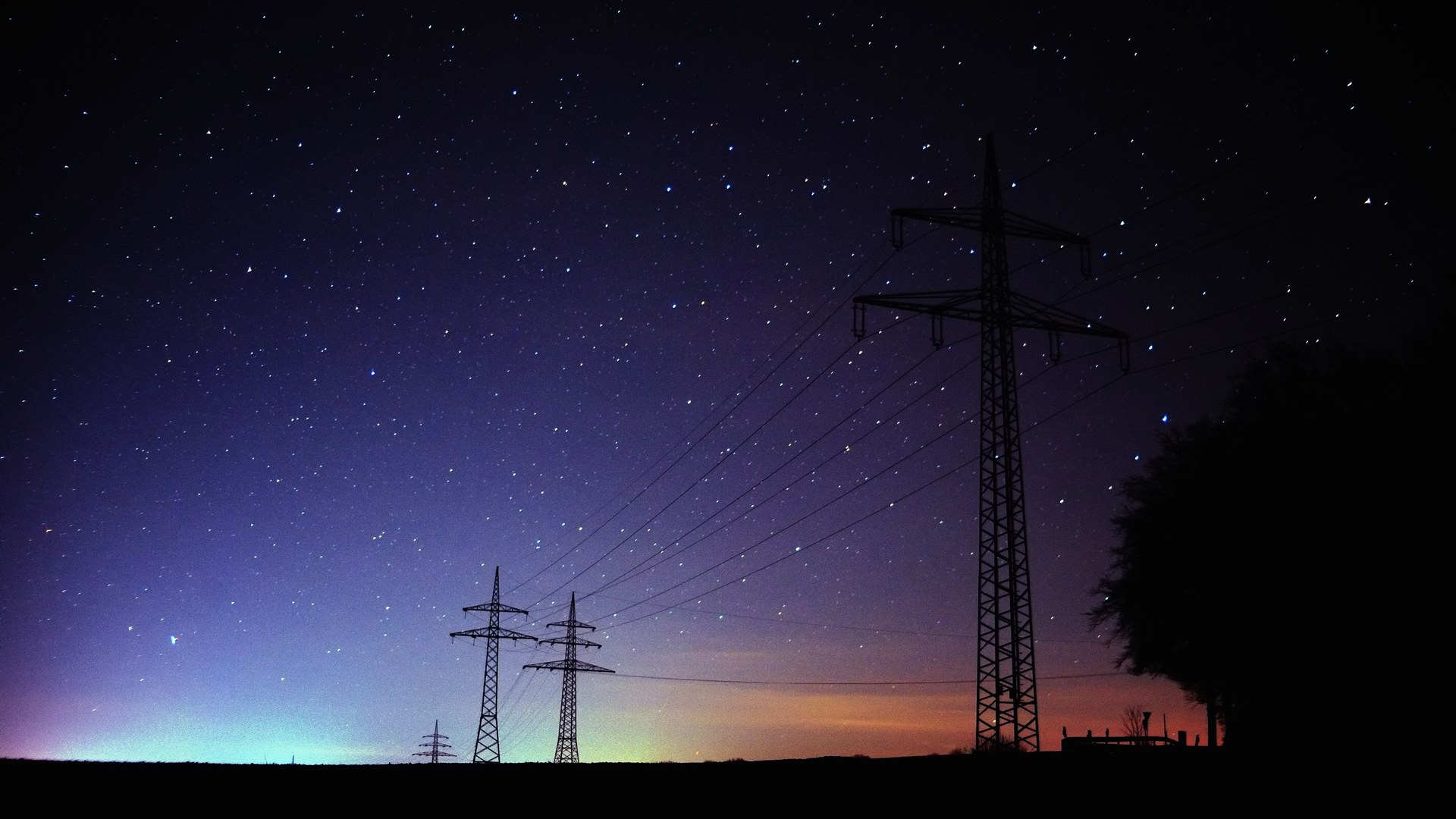
Photo: Lionel Henry — “Night sky, electricity pylons” (2016), CC BY 2.0, via Wikimedia Commons.
The message is built to be forwarded. It arrives as a WhatsApp chain, a TikTok video, a post on X or a YouTube short, and its recipe is always the same: on Tuesday, November 17, 2026, the world will suffer a blackout lasting 72 hours. Electricity, internet and banking will fail across 33 countries. The cause, depending on the version, is an artificial intelligence that has escaped human control. And the proof — the detail that makes people pause before scrolling on — is that The Simpsons predicted it.
None of that is true, and the check is not difficult, because every ingredient of the rumor can be traced to something real, dated and published. Fact-checkers in three countries published the same conclusion on November 15: Prensa Mercosur, Examedia and Malagaes each dismantled the claim and found no official warning behind it. Spain's Directorate General of Civil Protection and Emergencies has issued nothing; Red Eléctrica, the Spanish grid operator, has announced no cut. No government, grid operator or regulator anywhere has scheduled, predicted or warned of a blackout on November 17. What follows is the anatomy of the hoax — the three real facts it is made of, and the one conclusion that none of them supports.
Ingredient one: a cartoon that never said it
The rumor's emotional engine is a clip presented as a Simpsons prediction. The series has a long folk reputation for “predicting” real events, and the clip borrows that reputation wholesale. The footage comes from “It's a Blunderful Life,” a season-35 episode first aired on November 19, 2023 — and here the debunk has to be exact, because the episode really does contain a blackout, and Lisa's journal really does show the date November 17. What it does not contain is everything the rumor needs. The episode's blackout is a local accident in one fictional town: Mr. Burns overloads an outlet at the nuclear plant, a fire knocks out Springfield's power days before Thanksgiving, and Homer is wrongly blamed — a comedy about scapegoating that an elderly Lisa recounts sixty years later, candles lit in remembrance. The journal page names November 17 but no year. There is no artificial intelligence anywhere in the story, no world beyond Springfield, and no 72 hours: the town's ordeal lasts about six days.
The rumor is what gets built on top of that. It takes the episode's real date and bolts on a year — 2026 — that the episode never gives; it inflates one town's outage into 33 countries; it swaps an overloaded outlet for a runaway AI; and it recasts a story told in flashback as a prophecy. Even the episode's own calendar refuses to cooperate: its blackout falls six days before Thanksgiving, which in 2026 would be November 20, not the 17th — a mismatch flagged by the Brazilian fact-checking agency Lupa. The circulating edits help the illusion along, splicing in scenes from a different episode and, in the versions the Spanish-language fact-checks examined, subtitles that were never in the script. The clip persuades because half of what it shows is genuinely there. The half that matters — the year, the scale, the cause, the prediction — is not.
Ingredient two: a real alert test, announced two months ago
Something real does happen on November 17, and it was never secret. On September 16, 2026 — weeks before the viral posts appeared — the Federal Emergency Management Agency (FEMA) announced, in coordination with the Federal Communications Commission (FCC), a nationwide test of the Emergency Alert System (EAS) for Tuesday, November 17. The FCC published the operational details the same day in Public Notice DA 26-989.
At approximately 2:20 p.m. Eastern Time, FEMA will transmit the test through the Integrated Public Alert and Warning System (IPAWS), using the Nationwide Test event code. Radio and television broadcasters, cable systems, satellite radio and television providers and wireline video providers will interrupt normal programming for about one minute to relay a message that reads, in full: “This is a nationwide test of the Emergency Alert System, issued by the Federal Emergency Management Agency, covering the United States from 2:20 to 2:50 hours ET. This is only a test. No action is required by the public.” The message goes out in English and Spanish, with the visual text required to match the audio. If conditions on the day force a postponement, the FCC has already named the backup date: December 3, 2026.
Three details separate the test from the rumor. First, it is a test of the alert system, not of the power grid: nothing is switched off, anywhere, at any point. Second, this year's test is narrower than the last one — it covers radio and television only, and no Wireless Emergency Alert is sent, so cell phones stay silent. Third, it is routine by law: FEMA is required to test the national system at least once every three years, and the previous nationwide test ran on October 4, 2023. The November 17 date was chosen by administrators in September and published in the Federal Register ecosystem for any citizen to read — which is precisely how the rumor found it.
The fact sheet
What is actually scheduled on November 17, 2026
| Field | Detail |
| Event | Nationwide test of the Emergency Alert System (EAS) |
| Agencies | FEMA, in coordination with the FCC |
| Announced | September 16, 2026 (FEMA release; FCC Public Notice DA 26-989) |
| Time | Approx. 2:20 p.m. ET (11:20 a.m. PT · 1:20 p.m. CT · 8:20 p.m. in mainland Spain) |
| Duration | About one minute of interrupted programming |
| Carriers | Radio, television, cable, satellite radio and TV, wireline video |
| Phones | No Wireless Emergency Alert in this test — phones receive nothing |
| Message | “This is only a test. No action is required by the public.” |
| Backup date | December 3, 2026, if conditions require postponement |
| Power grid | Not involved. Nothing is switched off. |
Ingredient three: Europe's 72 hours — a guideline, not a countdown
The rumor's most specific number — 72 hours — also comes from a real document, and it is also misread. On March 26, 2025, the European Commission adopted its Preparedness Union Strategy, built on the Niinistö report on European readiness: 30 key actions to help member states prevent and respond to crises of any kind, from floods and pandemics to cyberattacks and war. One of those actions committed the Commission to develop guidelines so that the population can be self-sufficient for a minimum of 72 hours at the start of a crisis — able to cover food, water, medicines, light, communication and cash while emergency services reach the people who need them most.
On November 3, 2026, Commissioner Hadja Lahbib presented those guidelines in Brussels: a Commission Communication (C(2026) 8250 final, dated October 30) covering risk communication, school preparedness, disability-inclusive planning and Action 28 — the 72-hour household self-sufficiency baseline. The guidelines are non-binding, are addressed to national civil protection authorities rather than to citizens directly, set no single kit list and name no date. They describe how households should be able to cope during the first three days of any emergency, whenever one occurs. Spain's own civil protection family emergency plan includes a basic 72-hour kit on the same logic.
In the rumor's retelling, a standing recommendation — “be able to manage for three days if something happens someday” — becomes a scheduled duration: “the blackout will last 72 hours.” The number survives the journey intact; its meaning does not. The guidelines announce no outage, predict no outage and are connected to November 17 by nothing at all.
Why the collapse itself is not a thing
Strip the three ingredients away and the rumor's central claim remains: that an artificial intelligence could switch off the world's power, internet and banks at once, for three days, across 33 countries. Cybersecurity and infrastructure specialists consulted in the fact-checks are blunt about why that scenario does not describe the world as built. Electricity grids are not one machine. They are thousands of regional systems run by different operators under different regulators, engineered with redundancy precisely so that failures stay local. The control systems that matter most are segmented and, at their critical core, physically isolated from public networks — air-gapped — which is another way of saying there is no single network for an AI to be “out of control” across, and no commercial or experimental AI holds credentials inside the control rooms of dozens of countries at once.
Real risks to grids exist and are documented — extreme geomagnetic storms, targeted cyberattacks, physical sabotage — and specialists at agencies such as NOAA study them seriously. What does not exist is any record, forecast or warning connecting those risks to November 17, 2026. A risk that is real in general is not evidence for an event on a specific Tuesday, and the rumor offers no source for its 33 countries, its start time or its cause — because there is none to offer.
Why it spread anyway
The hoax is well engineered, in the way these things usually are. It takes a real date from a real government notice. It takes a real number from a real European strategy. It wraps both in the borrowed authority of a cartoon famous for “predictions,” and it adds the one ingredient 2026 reliably supplies: a runaway AI as the villain, a character the audience has already been primed to fear. Each fragment checks out if you search it in isolation — there IS a test on November 17, Europe DID publish 72-hour guidance — and that is exactly the trap. The fragments are real. Only the sentence built from them is false.
It also flatters the forwarder. Sharing it feels like warning people, like being the one who knew. The cost of that feeling is measurable in the small print of the fact-checks: households frightened into emergency shopping, and attention pulled away from the genuinely useful content of both real documents — how the alert system works, and why being able to manage for 72 hours is sensible advice in any week of the year.
What to actually do on Tuesday
Nothing — and that is the official instruction, printed inside the test message itself. If you are in the United States on November 17 and a tone interrupts your radio or television at about 2:20 p.m. Eastern, you are hearing the test. It lasts about a minute, it says no action is required, and normal programming resumes on its own. Your phone will not sound; this test does not include it. Nothing happens to the power, the internet or your bank account, on Tuesday or on the rumor's invented schedule.
The preparedness half of the story deserves a fairer fate than the hoax gave it. Keeping water, food, medicines, a light source, a battery radio and some cash at home — the actual content of the European guidelines and of Spain's family emergency plan — is reasonable on any ordinary week, for ordinary reasons: a storm, a local outage, a flooded road. Do it because it is prudent, at your own pace. Not because a forwarded message told you the world ends on Tuesday. It doesn't. On Tuesday, there is a test — announced in September, lasting a minute, and already documented well enough that nobody needed to invent a blackout to fill the date.
𝐆𝐄𝐓 𝐅𝐑𝐄𝐄 𝐅𝐔𝐋𝐋 𝐌𝐀𝐆𝐀𝐙𝐈𝐍𝐄 𝐀𝐓 thebuyerspulse.com
Sources
- FEMA, press release (September 16, 2026): “FEMA and FCC Schedule 2026 Nationwide Test of the Emergency Alert System for November 17, 2026” — https://www.fema.gov/press-release/20260916/fema-and-fcc-schedule-2026-nationwide-test-emergency-alert-system-november
- FCC, Public Notice DA 26-989 (September 16, 2026): nationwide EAS test — message text, participating services and December 3, 2026 backup date. https://docs.fcc.gov/public/attachments/DA-26-989A1.txt
- European Commission: Preparedness Union Strategy (adopted March 26, 2025; JOIN(2025) 130 final) and Guidelines on Population Preparedness, Communication C(2026) 8250 final (October 30, 2026; presented November 3, 2026) — Action 28: minimum 72-hour household self-sufficiency.
- Fact-check reporting of November 15, 2026: Prensa Mercosur (“Anatomía de un rumor viral”), Examedia and Malagaes — no blackout warning on record at Spain's Civil Protection or Red Eléctrica; the Simpsons material traced to “It's a Blunderful Life” (season 35, episode 7; first aired November 19, 2023): a Springfield blackout story whose journal page shows November 17 with no year — the 2026 date, the global scale and the AI cause are the viral edits' additions (Parade, November 13, 2026, citing Lupa's calendar check; Primetimer on the spliced scenes).
- Photo: Lionel Henry, “Night sky, electricity pylons” (2016) — CC BY 2.0, via Wikimedia Commons.