Phison unveils the SSD that thinks: AI runs inside the drive — no permission asked from the processor
The bottleneck of the AI era is not thinking. It is hauling. AI servers spend a large share of their day dragging datasets out of their SSDs and up to a processor somewhere else, and Phison — the Taiwanese maker whose controllers sit inside a large part of the world's flash storage — has decided the trip is the problem. At Supercomputing 2026 (SC26), in Chicago, the company presented a computational storage SSD design with an integrated NPU and 64 GB of internal memory running at 130 GB/s: a drive that runs PyTorch, vLLM, OpenVINO and llama.cpp where the data already lives, and sends back only the results. The promise attached is large — 10 to 100 times less data movement on the workloads that fit. The fine print is equally large: the design is still in development, it has no name, and its only compute figure comes with a warning label.
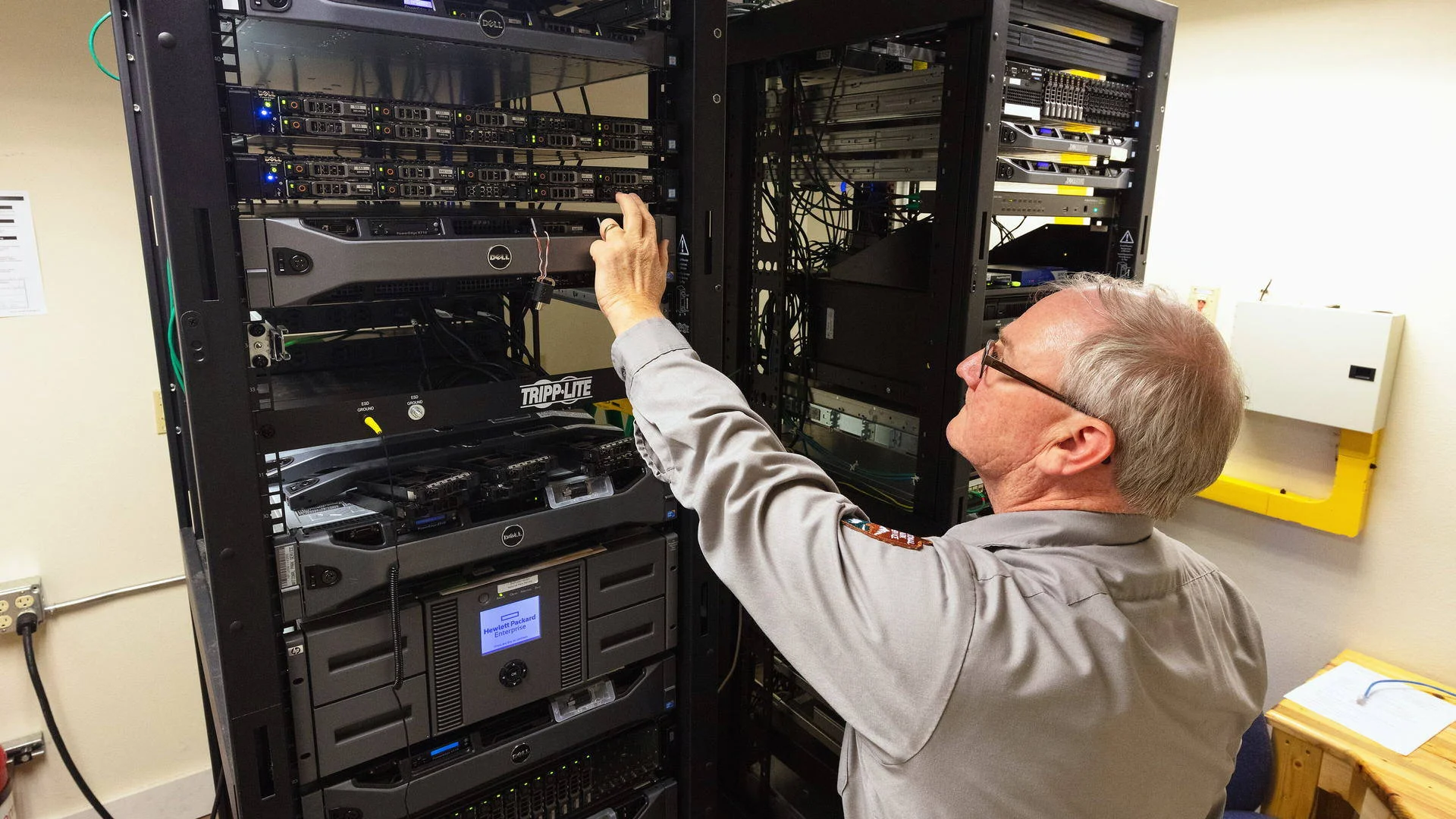
It is a game changer: until now the drive only stored the data while the processor did the thinking; Phison moves the brain into the drive — an NPU and 64 GB of its own memory, right where the data already lives — and the processor only sees the result. Phison Electronics presented the design on November 17 at Supercomputing 2026 (SC26) in Chicago.
The problem it attacks: data spends its life traveling
Traditional storage architecture is a delivery service. The data sits on the SSD; when a CPU or a GPU needs it, the whole dataset travels — from the drive, across the PCIe bus, into system memory, and only then to the processor that will actually work on it. In AI and HPC workloads, where the same enormous datasets are scanned again and again, that journey is the bottleneck: faster processors alone cannot fix it, because they spend their time waiting for the delivery.
Phison's computational storage inverts the route. The drive scans and processes the data in parallel, where it already resides, and returns relevant results instead of entire datasets. The company puts the saving at 10 to 100 times less data movement for applicable workloads, with a second dividend: the host's CPU cycles are freed for work only the host can do.
The internal numbers explain why the idea is not absurd. The design's 64 GB of memory runs at 130 GB/s — and the fastest pipe out of a drive that Phison itself announced at the same show tops out at 28 GB/s. In the company's own figures, then, the drive can read its own data several times faster than it could ever ship that data to the server. If the answers are small and the datasets are huge, computing at the source stops being a curiosity and starts being arithmetic.
The software is the software developers already use
The detail that separates this proposal from a laboratory demo is the toolchain. The design supports PyTorch, vLLM, OpenVINO and llama.cpp — the frameworks AI developers already build with — and Phison stresses that developers can build on the technology without specialized programming tools. The bet is explicit: an intelligent drive that demands a new programming religion dies in the booth; one that speaks the languages the industry already speaks has a chance of being tried.
That is also the honest limit of the announcement: what runs, and how well, was described by the company, not benchmarked by third parties. The workloads that fit — the release's own words are “for applicable workloads” — are the ones where a small answer hides inside a very large pile of data: filtering, scanning, pre-processing, retrieval. Nobody at SC26 claimed the SSD replaces the GPU, and this design does not try to.
The fine print: no name, no date, and a number from another era
Now the part of the story that keeps it in the “in development” drawer, where Phison itself puts it. The design has no product name. There is no sampling date — no moment when a customer can even ask for a unit to test. And the company has not disclosed what type of memory the 64 GB pool is made of, a detail that matters for cost, endurance and performance alike. The company says many of the products and features it showcased are still in development and will become available as they are finalized.
And then there is the figure. The only compute number in the announcement is 36,800 DMIPS for the integrated NPU. DMIPS — Dhrystone million instructions per second — is a CPU integer benchmark from another era; it is not a measure of AI performance in TOPS, the unit in which neural accelerators are normally rated. Tom's Hardware warns that the figure probably describes the general-purpose CPU cores sitting next to the accelerator, not the accelerator itself. Until Phison publishes a TOPS rating, the honest sentence is the uncomfortable one: the drive's actual AI capability cannot be assessed from what was disclosed.
This piece therefore runs as a story in development: what Phison has shown is an architecture with named software, real internal bandwidth figures and a clear thesis — and a product that, for now, does not exist as something anyone can order, test or price.
The traveling companion: PCIe 6.0 at 28 GB/s
The computational design did not travel alone. In the same presentation, Phison detailed its X3 (PS5303) enterprise SSD controller: PCIe 6.0 x4 with the NVMe 2.3 interface, targeting 28 GB/s of sequential throughput and 6.8 million IOPS — approaching twice the throughput of today's PCIe Gen5 drives, with more bandwidth per drive and better throughput per watt. It is the conventional half of the same argument: if data must travel, make the road twice as wide; and where the road is not enough, move the factory to the warehouse.
What to watch
The idea of the thinking drive returns every few years, and it returns because the physics that inspires it does not go away: moving data costs more than processing it, and AI has made the datasets enormous. What decides whether this attempt is different will not be decided on the SC26 stage. It will be a name, a sampling date, a TOPS figure, a memory type — the four missing data points that turn an architecture into a product. The Buyer's Pulse keeps this story in active follow-up, and we are watching for Phison to put those numbers on the table.
Published on Sunday, November 22, 2026.
Sources
- Phison Electronics, November 17, 2026 (press release, via StorageNewsletter): the SC26 announcement — computational storage architecture with an integrated NPU rated at 36,800 DMIPS and 64 GB of memory at 130 GB/s; support for PyTorch, vLLM, OpenVINO and llama.cpp without specialized programming tools; the promised 10–100× reduction in data transfers for applicable workloads; and the X3 (PS5303) PCIe 6.0 controller targets (28 GB/s sequential, 6.8 million IOPS, NVMe 2.3).
- TechSpot, November 21, 2026: coverage of the SC26 design — the in-development status, the absence of a product name, sampling date and memory type, and the comparison between the drive's internal memory bandwidth and its host interface.
- Tom's Hardware, November 2026: the 36,800 DMIPS figure is a legacy CPU integer benchmark rather than an AI rating in TOPS, and likely describes the companion CPU cores rather than the accelerator.