
Read bandwidth just doubled: Supermicro ships the first PCIe Gen 6 all-flash storage servers
The argument in AI infrastructure has moved one shelf down the rack. At Supercomputing 2026 in Chicago, Supermicro started shipping the first storage servers built on PCIe Gen 6 — all-flash Petascale systems whose sequential read bandwidth doubles the PCIe Gen 5 generation, built on a simple premise: clusters no longer wait for arithmetic; they wait for data.
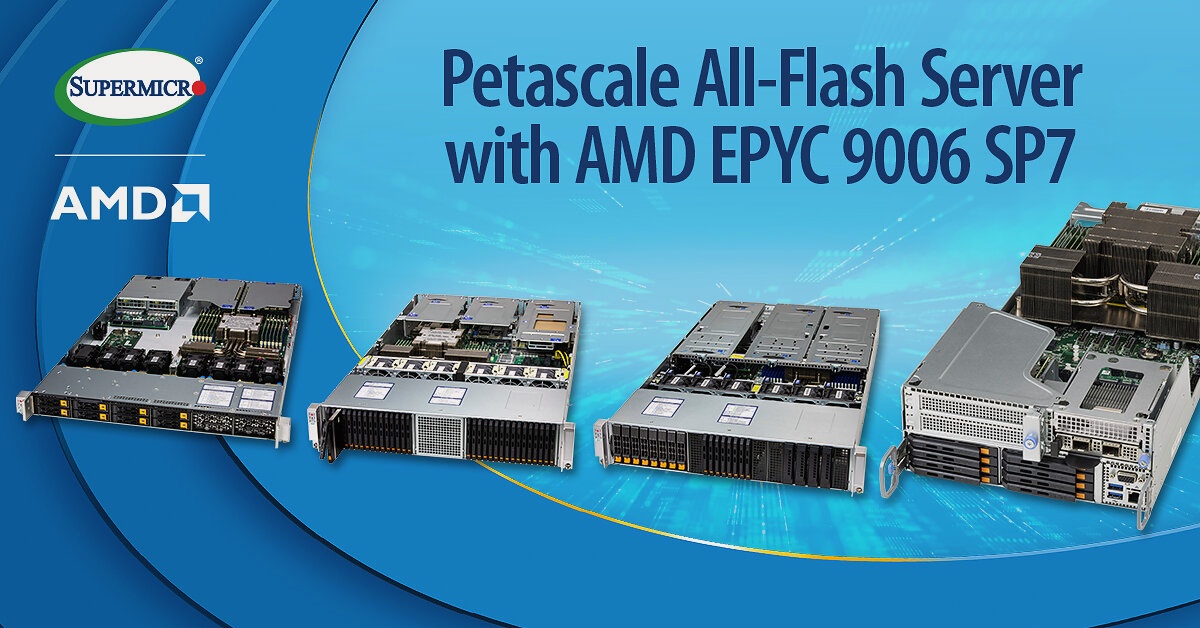
Photo: Supermicro (official press image distributed with the November 18, 2026 announcement, via PR Newswire) — the Petascale all-flash server with AMD EPYC 9006 SP7.
The announcement came from two cities at once — San Jose, where Supermicro is headquartered, and Chicago, where the Supercomputing 2026 conference is running from November 15 to 20 — and its most important word is not a specification. It is a tense. The new Petascale all-flash storage servers, the first storage products built on the PCIe Gen 6 specification, are not promised for a future quarter: they are now shipping. The first system pairs the 6th-generation AMD EPYC 9006 processors — the family formerly codenamed "Venice" — on the SP7 platform, and Supermicro is showing the machine this week at booth #4017 in Chicago. For a company that trades on the NASDAQ as SMCI and sells speed as its identity, arriving first at a new interconnect generation, with boxes customers can actually order, is the whole story in one sentence. The rest of the announcement explains why the generation matters.
Why the bottleneck moved to storage
For three years, the AI industry's argument was about compute: who had the accelerators, in what quantity, at what power. Supermicro's chief business officer, Vik Malyala, used the announcement to move the argument one shelf down the rack. "Expanding AI and HPC workloads require storage that can match the performance of today's CPU and GPU clusters," he said. "With our new all-flash storage servers based on AMD EPYC processors, and the flexibility of the DCBBS architecture, we are delivering improved PCIe Gen 6 bandwidth, high density, and scalable capacity." The logic is the arithmetic of idle silicon: a training cluster or an inference fleet that waits on data is capital standing still, and the wait is set by how fast the storage tier can read. Doubling sequential read bandwidth over PCIe Gen 5 attacks the wait directly — it is a performance claim about the whole system, made from the component that had become its slowest part.
Malyala's second point is about who gets to use the hardware. The platforms, he said, "can be customized for HPC, AI training, and inference workloads, while providing software-defined storage partners with proven, validated systems they can rely on." That is the building-block model Supermicro calls DCBBS — Data Center Building Block Solutions — applied to the storage tier: one validated hardware base, configured per workload, with the software layer chosen by the customer from a list that was tested before the press release, not after. The announcement is an extension of the company's existing AMD EPYC all-flash portfolio, not a new product line from zero — which is precisely why it can ship on day one.
The machine: 3.93 petabytes in two rack units
The first system of the family concentrates the argument into a 2U chassis. It supports up to 32 E3.S NVMe SSDs, and with 122 TB drives fitted, that is as much as 3.93 PB of all-flash capacity in two units of rack height. Supermicro describes the I/O architecture as balanced, and the balance has a specific shape: up to four x16 high-performance networking cards, so that the bandwidth the drives can now deliver over PCIe Gen 6 has somewhere to go. A storage server whose flash outruns its network ports is a bottleneck with better marketing; the design brief here is sustained throughput, aimed at the workloads the release names — AI data lakes, large-scale analytics and high-throughput storage networking — with room for customers to optimise the configuration for their specific workload and fabric requirements.
Density is the other half of the equation, and it is worth pausing on what 3.93 PB in 2U means operationally. Capacity at this concentration changes the shape of an AI data lake: the hot tier — the data a training run or an inference pipeline touches constantly — can live on flash, close to the compute, instead of being staged from slower tiers. The release does not sell that as a benchmark; it sells it as headroom. The chassis is the first of a family, and the family is the point: this is a platform launch wearing a product launch's clothes.
Venice underneath, SP8 next
The compute under the flash is AMD's. The first Petascale system runs the 6th-generation EPYC 9006 series on the SP7 platform, and Supermicro is explicit that more products will follow as AMD launches new SP8 CPU versions — the storage family is pegged to AMD's platform cadence, in both directions. AMD's Dan McNamara, senior vice president and general manager of Compute and Enterprise AI, framed the fit in the terms storage architects actually use: "As software-defined storage architectures demand greater energy efficiency, high single-socket performance, and large numbers of PCIe lanes, the AMD EPYC family is ideally suited. The latest Venice SP7 and SP8 platforms deliver the core density and PCIe Gen 6 connectivity that modern storage workloads require."
The lane count is the quiet specification in that quote. A 32-drive all-flash array with four x16 network cards is, at bottom, a machine for moving data across PCIe lanes without queueing; a storage processor is judged less by its cores than by whether its I/O can keep every drive and every port fed at once. That is the workload the EPYC 9006 platform was brought in to serve, and it is why the partnership language in this release is unusually specific: McNamara also noted that AMD and Supermicro have spent years bringing EPYC processing capabilities to the Petascale all-flash servers — this generation is an iteration of an existing line, with the interconnect as the new variable.
The software layer was validated before the headline
Hardware this dense is only as deployable as the software that can run on it, and the release spends as much space on validation as on the chassis. The platform — which the announcement notes includes the CloudDC, GrandTwin and Hyper families — has been validated with eight software-defined storage partners: Hammerspace, IBM, MinIO, Nutanix, Scality, VAST Data, VDURA and WEKA. The partner statements, read together, are a map of where each vendor thinks the Gen 6 bandwidth will be spent. IBM's is the most diagnostic. "AI inference is no longer a single workload – it's a pipeline that spans data ingest, model loading, retrieval, and KV cache and each stage must maximize GPU utilization efficiency," said Vincent Hsu, IBM Fellow, VP and CTO of IBM Storage, describing IBM Storage Scale on the new Petascale server as a platform for the entire inference pipeline, "with PCIe Gen 6 bandwidth and greater headroom for both performance and capacity growth."
WEKA's statement makes the complementary claim — that its architecture can actually consume the new bandwidth. Ajay Singh, the company's chief product officer, said WEKA NeuralMesh "is fully software-defined and distributed, so it scales uniformly across Supermicro's new Petascale server and puts the full bandwidth of PCIe Gen 6 and AMD EPYC 9006 processors to work from day one, with no hardware tiers to create bottlenecks." MinIO's CTO, Ugur Tigli, positioned MinIO AIStor and MemKV across the same pipeline — ingestion, training and inference — serving "all of their throughput, IOPS, and latency needs" from a compact footprint. And the efficiency vendors made the cost argument: Hammerspace's Gregg Machon framed the platform as "maximizing performance per dollar, per watt, and per rack" inside a single global namespace, while VDURA's CEO, Ken Claffey, promised "more performance per watt and per rack unit at the best cost per terabyte" — the two currencies, watts and rack units, in which AI infrastructure is actually rationed. Nutanix, Scality and VAST Data complete the validated list, covering the agentic-AI full stack, AI data infrastructure and the VAST AI Operating System respectively.
What to watch
Three things will decide whether this announcement is a milestone or a footnote. The first is the shipping claim itself: in an industry of roadmap presentations, Supermicro has put a Gen 6 storage system on sale during the conference where its customers are standing in the aisles — booth #4017 is the proof-of-presence. The second is the follow-through: the SP8-based products still to come will show whether Petascale Gen 6 becomes a family or remains a flagship. The third is the question every buyer of AI infrastructure now has to ask their storage vendor, in Supermicro's framing of it: not how fast the drives are, but whether the whole path — lanes, ports, and the validated software on top — can move data at the speed the GPUs consume it. On November 18, the first answer to that question with PCIe Gen 6 written on it went on sale.
Published Wednesday, November 18, 2026.
𝐆𝐄𝐓 𝐅𝐑𝐄𝐄 𝐅𝐔𝐋𝐋 𝐌𝐀𝐆𝐀𝐙𝐈𝐍𝐄 𝐀𝐓 thebuyerspulse.com
Sources
- Supermicro, press release via PR Newswire (Nov 18, 2026): the first all-flash storage servers with PCIe Gen 6 are now shipping — the Petascale system with 6th Gen AMD EPYC 9006 ('Venice') processors on the SP7 platform, with more products to follow as AMD launches SP8 CPU versions; up to 100% greater sequential read bandwidth over PCIe Gen 5; 2U chassis with up to 32 E3.S NVMe SSDs, delivering as much as 3.93 PB with 122 TB drives; up to four x16 high-performance networking cards; shown at booth #4017, Supercomputing 2026, Chicago, November 15–20, 2026.
- Vik Malyala, chief business officer, Supermicro (quoted in the release): 'Expanding AI and HPC workloads require storage that can match the performance of today's CPU and GPU clusters'; improved PCIe Gen 6 bandwidth, high density and scalable capacity through the DCBBS architecture; platforms customizable for HPC, AI training and inference, giving software-defined storage partners proven, validated systems.
- Dan McNamara, senior vice president and general manager, Compute and Enterprise AI, AMD (quoted in the release): software-defined storage architectures demand greater energy efficiency, high single-socket performance and large numbers of PCIe lanes; the Venice SP7 and SP8 platforms deliver the core density and PCIe Gen 6 connectivity modern storage workloads require.
- Partner validation statements in the same release: IBM Storage Scale (Vincent Hsu, IBM Fellow, VP & CTO of IBM Storage) on the inference pipeline — data ingest, model loading, retrieval and KV cache; WEKA NeuralMesh (Ajay Singh) on putting the full bandwidth of PCIe Gen 6 to work from day one; MinIO AIStor and MemKV (Ugur Tigli) across ingestion, training and inference; Hammerspace (Gregg Machon) on performance per dollar, per watt and per rack; VDURA (Ken Claffey) on performance per watt and best cost per terabyte; validation statements also from Nutanix (Ketan Shah), Scality (Paul Speciale) and VAST Data (Phil Manez). The validated platform includes the CloudDC, GrandTwin and Hyper families.
- Photo: Supermicro official press image, 'Petascale All-Flash Server with AMD EPYC 9006 SP7', distributed with the November 18, 2026 release via PR Newswire.