
Juniper's second front: Oracle's AI data centers
The announcement is from September 2 — this magazine says so up front. What makes it this week's story is that the same Juniper stack now sits in two of the most demanding networks on earth at once: a national laboratory's new AI machine, and a hyperscaler's gigawatt-scale AI build-out. Underneath both is the defining argument of AI infrastructure: Ethernet against the InfiniBand stronghold.
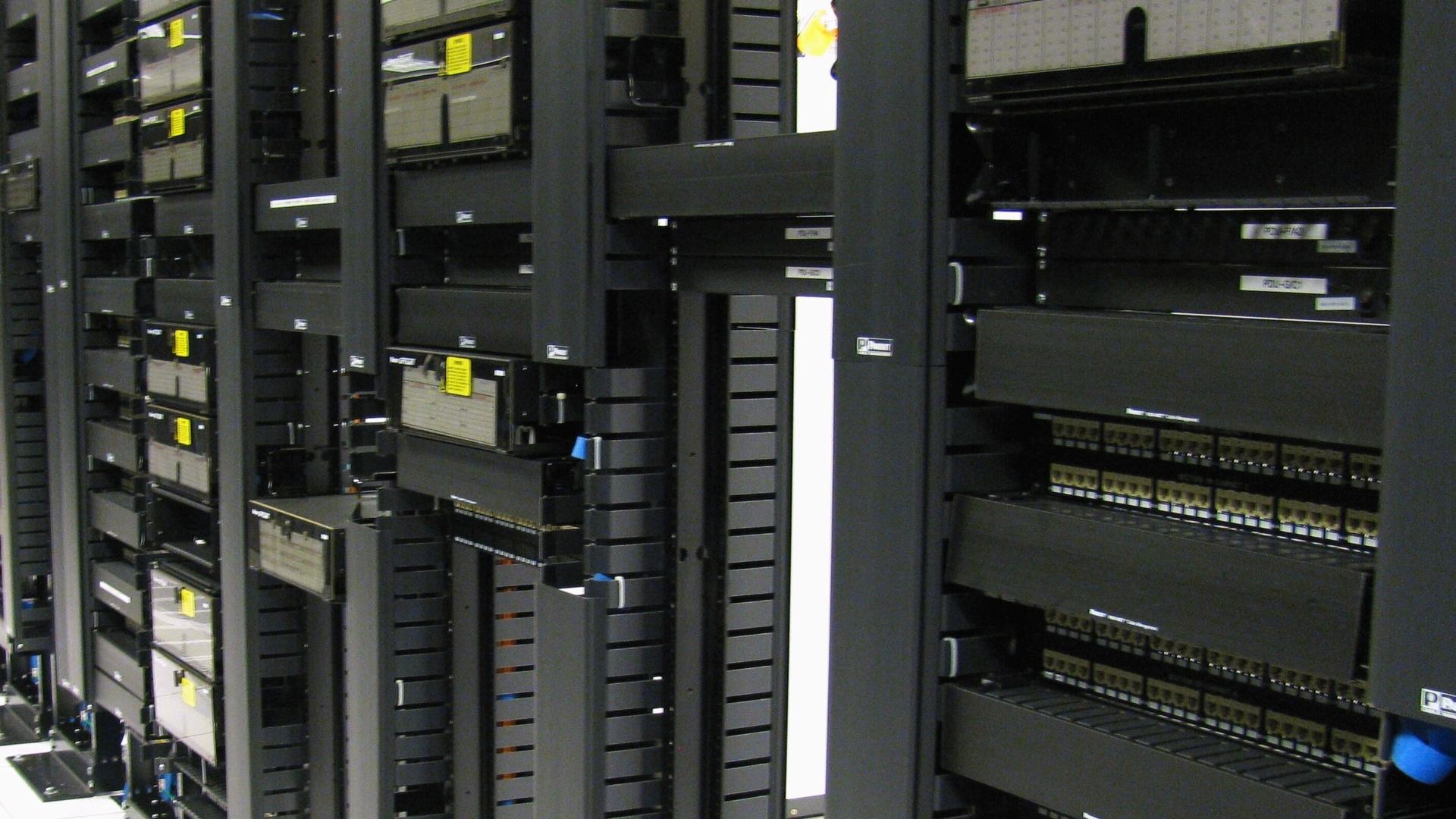
Photo: © Robert.Harker / CC BY-SA 3.0 (via Wikimedia Commons) — file photo of a data-center network aisle; it is not an Oracle facility and does not show Juniper equipment.
This is not an announcement from today, and this magazine will not dress it up as one. HPE announced its expanded networking collaboration with Oracle on September 2, 2026 — more than two months ago. The reason it earns an analysis now is what happened this week: on Monday, November 16, the Lux AI cluster at Oak Ridge National Laboratory debuted at No. 14 on the TOP500 list of the world's most powerful supercomputers, running on 800G HPE Juniper Networking QFX switches — the first HPE Networking deployment at a U.S. Department of Energy national laboratory, told in this magazine in The national lab that bet on Ethernet. In the same week, the same Juniper stack sits at the center of two very different machines: a national laboratory's AI cluster, and the AI data centers of one of the largest cloud providers on earth. That coincidence is the story — because the fight underneath it is the defining infrastructure argument of the AI era: Ethernet against the InfiniBand stronghold in the AI backend.
What was actually announced on September 2
On September 2, 2026, HPE announced an expanded collaboration with Oracle: HPE Juniper Networking will be deployed across Oracle's AI data centers to scale its global AI infrastructure. HPE described it as a multi-year, global deployment and as one of the largest AI infrastructure deployments in the industry. The agreement builds on more than a decade of joint Oracle–Juniper engineering, and it is not a box sale: it includes network support services and financing capabilities alongside the hardware.
One sentence in the release matters more than the headline, because it establishes that this is an expansion, not an arrival: today, Juniper routing and switching already support key elements of OCI's data and edge networks. Oracle Cloud Infrastructure was not shopping for a new network vendor in September. It was extending a supplier already inside its production networks into the most demanding build-out in its history — its AI data centers.
Oracle said so in its own words. Mahesh Thiagarajan, executive vice president of Oracle Cloud Infrastructure, put it this way: "HPE Juniper Networking has been an important part of our cloud architecture and now plays a key role in our AI clusters, regional data centers and edge networks, with the scale, performance and reliability our customers expect." Read the list carefully — AI clusters, regional data centers, edge networks. The same networking supplier across all three layers is the point: Oracle is not buying switches for one showcase cluster; it is standardizing a fabric across the estate.
What Oracle is buying: four platforms, two jobs
The deployment names four Juniper platform families, and they divide into the two classic jobs of a data-center network. Routing — moving traffic between sites, regions and the outside world — falls to the PTX and MX series. Switching — moving traffic inside the facility, rack to rack and GPU to GPU — falls to the QFX and EX series.
| Platform | Role in the announcement | What the record says |
|---|---|---|
| PTX | Routing | Built on Juniper's own Express 5 ASIC; HPE was first to market with 1.6-terabit routing, air-cooled, with a direct liquid-cooling option (Neri, via CRN) |
| MX | Routing | Named with PTX as the routing layer of the deployment |
| QFX | Switching | The newest QFX bring high-density connectivity, dynamic load balancing and advanced congestion management for AI backend networks over RoCEv2; QFX silicon is Broadcom Tomahawk in a scale-out architecture (Neri, via CRN) |
| EX | Switching | Named with QFX as the switching layer of the deployment |
The QFX line deserves the closest read, because it is where the AI argument lives. AI training clusters are not ordinary data-center traffic. Thousands of accelerators work on the same problem at the same time, and the network between them is not plumbing behind the computation — it is part of the computation. When the fabric congests, expensive GPUs sit idle waiting for data. That is why the three capabilities HPE names for the newest QFX are precisely the three an AI backend needs: high-density connectivity (many accelerators per fabric), dynamic load balancing (traffic spread across paths as conditions change) and advanced congestion management (the fabric protecting itself when every node talks at once).
RoCEv2: Ethernet's claim on the AI backend
Those QFX capabilities are specified, in the announcement, for AI backend networks running RoCEv2 — RDMA over Converged Ethernet, version 2. That single protocol name is the strategic core of the whole deal, and it is worth unpacking without jargon. RDMA lets one machine write directly into another machine's memory without waking its processor — the low-latency behavior AI training demands. For years, that behavior belonged to InfiniBand, the purpose-built fabric that became the default inside AI clusters and something close to a stronghold: specialized, high-performing, and a separate world from the Ethernet networks the rest of the industry runs. RoCEv2 is Ethernet's answer — RDMA carried over the Ethernet networks operators already know how to build and run.
So what Oracle is buying, underneath the platform names, is a position in that argument. A hyperscaler committing its AI data centers to a Juniper Ethernet fabric — with RoCEv2, dynamic load balancing and congestion management as the named mechanisms — is evidence that the backend of AI no longer belongs automatically to the incumbent fabric. Ethernet's claim is operational as much as technical: one networking discipline, one supplier ecosystem, from the edge network to the AI cluster. InfiniBand's performance pedigree is not erased by one deal, and this magazine is not declaring a winner. But every gigawatt-scale commitment like this one moves the burden of proof.
The silicon split: Tomahawk outside, Express 5 inside
The most revealing detail of the deal did not come from the press release. It came from HPE's earnings call, as reported by CRN, where CEO Antonio Neri described the engineering split inside the Juniper portfolio. The QFX switches use Broadcom Tomahawk silicon in a scale-out architecture — merchant silicon, bought from the industry's largest networking-chip supplier, deployed wide. The PTX routing platform, by contrast, runs on Juniper's own Express 5 ASIC — custom silicon, designed in-house, deployed where routing performance is the differentiator. On the same call, Neri noted that HPE was the first to market with 1.6-terabit routing, air-cooled, with a direct liquid-cooling option.
That split is a strategy in miniature, and it is the kind of detail buyers should steal for their own evaluations. Juniper does not try to out-design Broadcom where merchant silicon is good enough — the scale-out switching layer. It spends its own silicon budget where it believes design wins deals — the high-end routing layer. Two supply chains, two risk profiles, one portfolio. It also means the Oracle deployment is not a single bet: the switching fabric rides the industry's highest-volume switch silicon, while the routing layer rides Juniper's own chip roadmap.
Gigawatt scale — and warrants underneath
Neri described the agreement as operating "at gigawatt scale". That is not a networking metric; it is a power metric, and its use here is deliberate. AI data centers are now planned the way power plants are planned — by the gigawatt — and a networking deal described in those units is a deal sized against the largest infrastructure build-out in the industry's history. HPE's own framing of the deployment, "one of the largest AI infrastructure deployments in the industry," says the same thing from the other side.
The financial structure underlines how much HPE wanted this win. As part of the agreement, HPE issued Oracle warrants to purchase shares of HPE common stock. Warrants are an alignment instrument: Oracle gains upside if HPE's value rises, and HPE binds its customer closer than any purchase order can. Combined with the financing capabilities inside the deal and the multi-year, global scope, the structure reads as a partnership priced for duration — not a quarter's hardware transaction. This magazine notes what the record does not contain: neither the financial size of the deployment nor the warrant terms beyond their existence were disclosed in the announcement, and no figure is printed here for either.
The same stack, the same week, in a national laboratory
Which returns the story to Monday. On November 16, the Lux AI cluster at Oak Ridge National Laboratory debuted at No. 14 on the TOP500 — running, per the record of that debut, on 800G HPE Juniper Networking QFX switches, in what was described as the first HPE Networking implementation at a DOE national laboratory. The full account is this magazine's sister piece: the Lux cluster's TOP500 debut and its Ethernet bet.
Put the two facts side by side and the pattern is the analysis. In one week, the same Juniper QFX line appears as the fabric of a national laboratory's new AI machine — a scientific instrument, procured under public scrutiny — and as a named platform in a hyperscaler's gigawatt-scale AI build-out. Those are the two most demanding networking environments that exist, and they audit purchases differently: the laboratory buys proof, the hyperscaler buys scale economics. A supplier that wins both in the same season is no longer the challenger in the AI backend argument. It is one of the defaults the argument is now about.
What this means — and what remains unknown
For enterprise buyers, the lesson is not "buy Juniper." It is that the AI backend decision has become a first-order architecture decision with real alternatives, and it should be evaluated the way this deal was structured: fabric behavior under congestion (load balancing and congestion management, named in writing), the silicon roadmap underneath each layer (merchant where volume rules, custom where design differentiates), and commercial structures — financing, support services, equity alignment — that match a multi-year build rather than a one-off purchase.
What remains unknown is substantial, and this magazine prints the gaps rather than filling them. The announcement does not disclose the deployment's financial size, its per-site schedule, the specific QFX and PTX models per facility, or how OCI's fabric divides between RoCEv2 Ethernet and any other backend technology. Those details will decide how large this second front really is. What is already decided is the direction: the network — the unglamorous layer of racks, ASICs and congestion algorithms — is where the AI infrastructure war is now being fought, and as of this week it is being fought, at gigawatt scale and at No. 14 on the TOP500, on Juniper's second front.
Analysis published Tuesday, November 17, 2026, of an announcement dated September 2, 2026. This piece will be updated if HPE or Oracle disclose the deployment's financial terms or site schedule.
𝐆𝐄𝐓 𝐅𝐑𝐄𝐄 𝐅𝐔𝐋𝐋 𝐌𝐀𝐆𝐀𝐙𝐈𝐍𝐄 𝐀𝐓 thebuyerspulse.com
Sources
- HPE newsroom (press release, Sep 2, 2026): expanded Oracle collaboration — HPE Juniper Networking deployed in Oracle's AI data centers to scale global AI infrastructure; multi-year global deployment, 'one of the largest AI infrastructure deployments in the industry'; more than a decade of Oracle–Juniper joint engineering; network support services and financing capabilities; Juniper routing and switching already support key elements of OCI's data and edge networks today; platforms PTX, MX, QFX, EX; newest QFX with high-density connectivity, dynamic load balancing and advanced congestion management for AI backend networks with RoCEv2; Mahesh Thiagarajan (EVP, Oracle Cloud Infrastructure) quote as printed; HPE issued Oracle warrants to purchase HPE common stock as part of the agreement. https://www.hpe.com/us/en/newsroom/press-release/2026/09/hpe-and-oracle-deepen-networking-collaboration-to-accelerate-gigawatt-scale-ai-infrastructure.html
- CRN coverage of HPE's earnings call (2026): Antonio Neri — the QFX switches use Broadcom Tomahawk silicon in a scale-out architecture; the PTX platform uses Juniper's own Express 5 ASIC; HPE was first to market with 1.6-terabit routing, air-cooled with a direct liquid-cooling option; Neri described the agreement as operating at gigawatt scale. Data Center Dynamics coverage of the same call was used as cross-check.
- TOP500 / Oak Ridge National Laboratory (Nov 16, 2026): the Lux AI cluster debuted at No. 14 on the TOP500 with 800G HPE Juniper Networking QFX switches — the first HPE Networking implementation at a DOE national laboratory. Told in this magazine: https://thebuyerspulse.com/articulos/lux-ai-cluster-oak-ridge-top500
- Photo: © Robert.Harker / CC BY-SA 3.0 (via Wikimedia Commons), “Network Aisle Front” — a data-center network aisle; file photo, not an Oracle facility. https://commons.wikimedia.org/wiki/File:Network_Aisle_Front.jpg