
Lux debuts at No. 14 on the TOP500 — the first AI factory of the Genesis Mission is open, and half its hours are for sale
A TOP500 machine that behaves like a cloud and sells half its hours: Lux, built by HPE and AMD for Oak Ridge, is the first dedicated AI factory of the Genesis Mission — 4,032 MI355X GPUs on an 800G Ethernet fabric, inside a national laboratory, open for business.
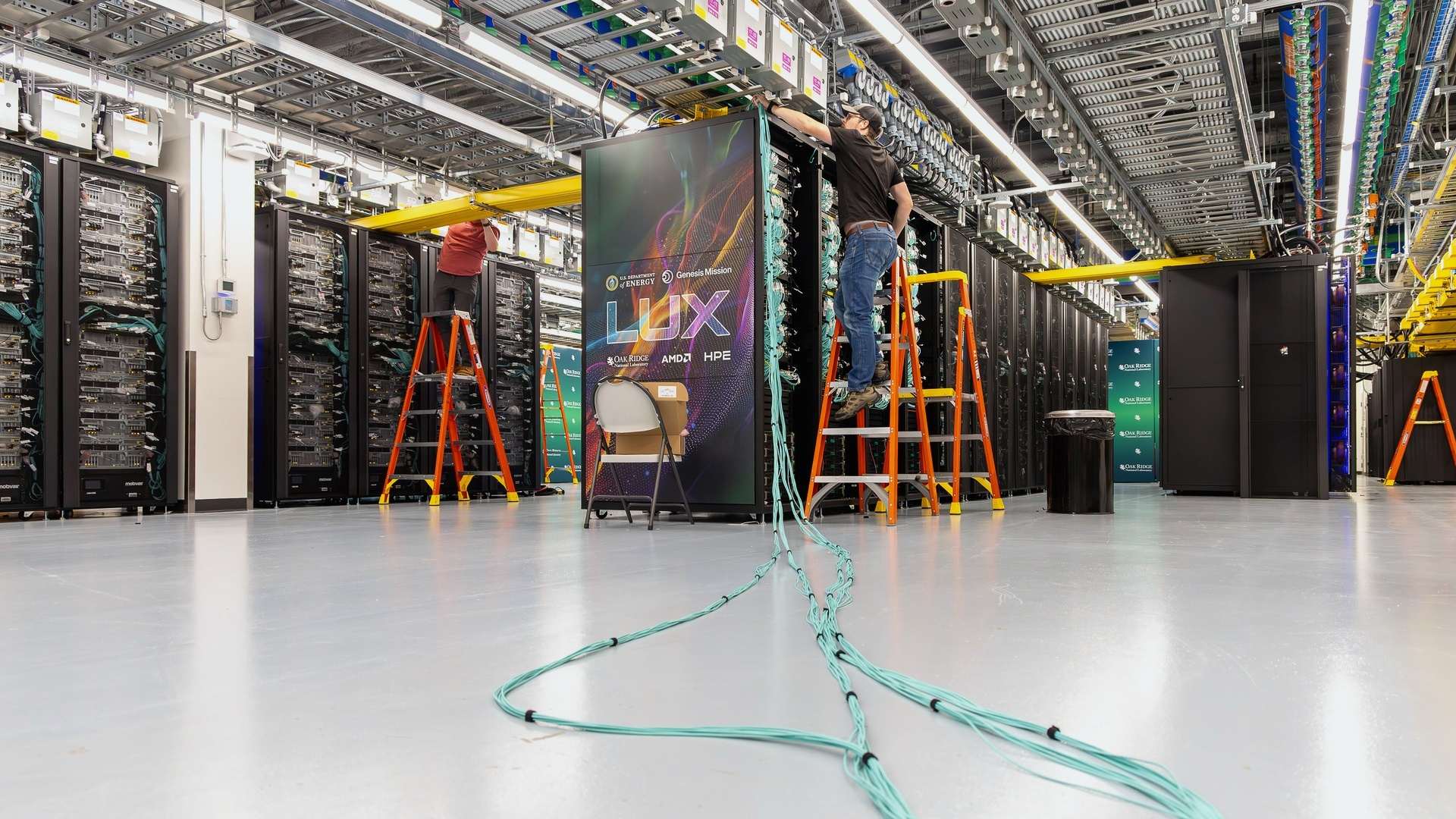
Photo: Oak Ridge National Laboratory — technicians installing and connecting the LUX cabinets at the Oak Ridge Leadership Computing Facility (OLCF). Official OLCF system page.
The most important supercomputer announced this year will not be measured only in flops. On Monday, November 16, 2026, at SC26 in Chicago, Lux — the artificial intelligence cluster co-designed and co-built by HPE and AMD for Oak Ridge National Laboratory (ORNL) — made its debut at No. 14 on the TOP500 list of the world's most powerful supercomputers, with a measured 220.79 petaflops on the HPL benchmark (AMD). On the same day, AMD announced that Lux is already open to scientific users. A machine that enters the world ranking at No. 14 and opens its doors on day one is news. What makes Lux a blueprint is everything around that number: it is the first dedicated AI system brought online for the U.S. Department of Energy's Genesis Mission, it runs on 800-gigabit Ethernet inside a national laboratory, it behaves like a cloud — multitenant, scheduled with Slurm and Kubernetes — and half of its annual hours are, quite literally, for sale.

A debut at No. 14 — and a door already open
Supercomputers usually arrive in stages: installation, acceptance, a ranking, and only later, users. Lux compressed the sequence. The TOP500 debut and the opening to scientific users landed on the same Monday, under a public-private partnership between AMD and the DOE, with the system co-designed and co-built by HPE and AMD for ORNL (HPE; AMD). AMD describes Lux as the first dedicated “AI Factory” in the United States for the Genesis Mission — the DOE-led initiative to accelerate science with artificial intelligence — and HPE calls it the first dedicated AI system brought online designed for that mission. The wording matters: ORNL already operates Frontier, the first exascale machine. Lux is not a bigger Frontier. It is a different kind of machine, built for AI workloads first, and offered to users in a different way.
The ranking itself deserves a precise reading. No. 14 on the TOP500 is measured on HPL, the traditional double-precision benchmark — 220.79 petaflops as reported by AMD. But Lux was not designed to win that benchmark; it was designed to train and run AI models at scale, and OLCF's own figures for the system are stated in the precisions AI actually uses: peaks of 40 exaflops in FP4 and 20 exaflops in FP8, alongside 317 petaflops in FP64 for classical simulation (OLCF). Read the two sets of numbers together and the design intent is unmistakable: a leadership machine whose headline metric is no longer the one it was ranked by.
The machine, piece by piece
The compute platform is the HPE ProLiant Compute XD685, with direct liquid cooling (HPE). Inside each node, the accelerators are AMD Instinct MI355X GPUs — 288 GB of HBM3e memory per GPU at 8 TB/s of bandwidth, per OLCF — paired with AMD EPYC CPUs. The system is organized, at the scale OLCF publishes, as 504 nodes with eight MI355X accelerators each: 4,032 GPUs in total (OLCF). AMD Pensando DPUs handle data-processing offload, and the software stack is AMD ROCm (AMD). Each node carries more than 24 TB of local NVMe storage, and the system connects to OLCF's Orion Lustre file system, at more than 600 petabytes (OLCF).
None of those components is, by itself, exotic in 2026 — and that is precisely the point a buyer should take from Lux. The recipe — a volume server platform from HPE, a merchant GPU with very large HBM, a merchant CPU, DPUs for offload, an open software stack in ROCm — is the recipe of the commercial AI data center, executed here at national-laboratory scale and discipline. What a laboratory used to build as a one-off, the industry now builds as a product line.
The network is the story: 800G Ethernet inside the laboratory
For anyone who specifies infrastructure, the most consequential line in the announcement is the networking one. Lux's fabric is HPE Juniper Networking: QFX switches supporting 800G, with advanced load balancing and congestion management, operated through HPE Networking Data Center Director — intent-based deployment, management and lifecycle automation (HPE). HPE states plainly that Lux is the first implementation of HPE Networking solutions in a DOE national laboratory.
Consider what that certifies. National laboratories are the most demanding network customers on earth: an AI training job that stalls on congestion wastes the scarcest resource in the building. For decades, that class of fabric was the home turf of specialized interconnects. Lux puts an Ethernet fabric — Juniper's, at 800 gigabits, with the congestion machinery to keep thousands of GPUs fed — in that seat, and wraps it in intent-based automation rather than hand-built configuration. If 800G Ethernet with advanced load balancing passes acceptance at Oak Ridge, the argument that serious AI training requires an exotic fabric gets much harder to make in an enterprise design review. The blueprint travels: the same QFX-and-Director pattern is what HPE sells to companies building their own AI factories, at whatever scale their budget allows.
A supercomputer you can rent
The operating model is the second half of the blueprint. Lux is multitenant, with cloud-like access, and it schedules work with the two systems that split the modern world between them: Slurm, the HPC standard, and Kubernetes, the cloud standard (OLCF). One machine, both grammars — batch supercomputing for the laboratories, container orchestration for everyone who arrives from the cloud side.
Then there is the capacity math, published by OLCF: 3.5 million node-hours per year. Half is reserved for the Genesis Mission. The other half is for proprietary use — paid, at the DOE's user-facility rate. Engagements run from six months to five years and can start in any month; the minimum proprietary commitment is 175,000 node-hours per six-month engagement, per OLCF's user guidance. Translate that into procurement language: the U.S. Department of Energy is selling time on a TOP500 machine the way a cloud sells reserved capacity — a defined minimum, a defined term, a published rate card logic — except the capacity in question sits inside Oak Ridge's security perimeter, next to 600 petabytes of Orion storage.
Who is that for? The obvious customers are the ones whose AI workloads are too sensitive, too large or too export-controlled for a public cloud region — and who cannot justify building a 4,032-GPU cluster of their own. Lux turns that build-versus-buy decision into a third option: rent the nation's machine.
Security at the level of Frontier
A rentable supercomputer inside a national laboratory only works if the security model is explicit, and OLCF's is: Lux operates under DOE Moderate controls — the same level as Frontier — and supports export-controlled applications, with Moderate-Enhanced controls in plan for workloads such as ITAR and PHI (OLCF). That combination is the commercial key to the whole offer. Multitenancy usually means a shared, lowest-common-denominator environment; here it means shared infrastructure under the control baseline of an exascale system, with a roadmap to the enhanced tier that regulated industries actually need. For a chief information security officer evaluating AI capacity, that paragraph of the spec sheet may matter more than the petaflops.
What Lux will work on first
The Genesis Mission projects already allocated to Lux sketch the intended workload mix (AMD). First, AI-assisted design of fusion power plants — simulation-heavy, model-hungry work at the boundary of HPC and AI. Second, a foundation-model factory for materials development and advanced manufacturing: not one model, but a production line for models, which is exactly what an “AI factory” is supposed to mean. Third, Earth-system prediction — forecasting water availability, streamflow and river temperature in the Tennessee Valley Authority region, the laboratory's own backyard. Fusion, factories and rivers: energy, industry and territory, the three classic missions of the DOE, each reframed as an AI workload.
The people signing the announcement frame it the same way. Georgia Tourassi, ORNL's associate laboratory director for Computing and Computational Sciences, called Lux “the first major addition to DOE's computing infrastructure in support of the Genesis Mission”, turning a national vision into tangible capability for researchers (AMD). Thomas Zacharia, AMD's senior vice president for Global Public Sector and Strategic Partnerships, pointed to the partnership model and to an “open, sovereign AI stack” that researchers across the country can use (AMD). And Trish Damkroger, HPE's senior vice president and general manager for HPC & AI Infrastructure Solutions, stressed the engineering delivery: HPE and its partners, she said, have “delivered breakthrough engineering innovation to advance the nation's scientific computing resources” (HPE; AMD).
The partnership, and the road to Discovery
Lux did not appear from nowhere. HPE and AMD announced it roughly a year earlier, on October 27, 2025, alongside Discovery — the system that will succeed Frontier at Oak Ridge, due in 2028 and built on the HPE Cray GX5000 platform with AMD's MI430X accelerators. Read in sequence, the plan is a staircase: Frontier proved exascale; Lux industrializes dedicated AI capacity now, in 2026; Discovery merges the two lines at the end of the decade. HPE's commitment is not only engineering: the company put a US$37 million in-kind investment into the program (HPE).
There is even an early sign of the ecosystem forming around the machine. In AMD's SC26 summary, the Pelagos white paper — an open tool from AMD and IBM for quantum error-correction decoding — reports 6.23× scaling from one to eight MI355X GPUs running on Lux. Small print, large meaning: third parties are already publishing results measured on the system in its first week of public life.
What this means if you specify infrastructure
Strip away the national-laboratory setting and Lux reads as a reference architecture with a price model attached. One: the AI factory is now a product pattern, not a research project — volume servers, merchant silicon, liquid cooling, ROCm, assembled by an integrator. Two: Ethernet at 800G, with serious congestion management and intent-based operations, has a national-laboratory reference deployment; architects can cite Oak Ridge in the design review. Three: the access model — multitenant, Slurm and Kubernetes side by side, capacity sold in node-hours with minimums and terms — is cloud grammar applied to sovereign hardware, and it will be copied by every institution that owns more machine than it uses.
And four, the quietest and largest point: a TOP500 system whose second-largest allocation is a commercial offer changes what “capacity” means for everyone else. A company that needs 175,000 node-hours of MI355X-class compute under DOE Moderate controls no longer has to build, borrow or wait. It has to write a proposal and a check. Lux debuted at No. 14 on the TOP500. Its real debut is as a blueprint — of how AI factories will be built, networked and sold.
𝐆𝐄𝐓 𝐅𝐑𝐄𝐄 𝐅𝐔𝐋𝐋 𝐌𝐀𝐆𝐀𝐙𝐈𝐍𝐄 𝐀𝐓 thebuyerspulse.com
Sources
- HPE (press release, November 2026): “HPE-built Lux AI cluster debuts at No. 14 on the TOP500” — co-design and co-build with AMD for ORNL; HPE ProLiant Compute XD685 with direct liquid cooling; HPE Juniper Networking QFX switches supporting 800G with advanced load balancing and congestion management; HPE Networking Data Center Director (intent-based deployment, management and lifecycle automation); first implementation of HPE Networking solutions in a DOE national laboratory; US$37 million in-kind HPE investment; Trish Damkroger, SVP and GM, HPC & AI Infrastructure Solutions, HPE.
- AMD (news release, November 16, 2026): “AMD-powered Lux supercomputer opens to scientific users” — No. 14 on the TOP500 with 220.79 petaflops (HPL); open to scientific users; first dedicated U.S. AI Factory for the Genesis Mission; AMD EPYC CPUs, Instinct MI355X GPUs, Pensando networking and ROCm software in a system built by HPE; Genesis Mission allocations (fusion plant design, foundation-model factory for materials and advanced manufacturing, Earth-system prediction for the Tennessee Valley Authority region); quotes from Thomas Zacharia (SVP, Global Public Sector and Strategic Partnerships, AMD) and Georgia Tourassi (associate laboratory director, Computing and Computational Sciences, ORNL).
- AMD (SC26 summary, November 2026): “SC26: AMD expands frontier scientific computing” — including the Pelagos white paper result (AMD + IBM open quantum error-correction decoding tool) reporting 6.23× scaling from 1 to 8 MI355X GPUs on Lux.
- Oak Ridge Leadership Computing Facility (OLCF), Lux system page and user guidance: 504 nodes × 8 AMD Instinct MI355X = 4,032 GPUs; MI355X with 288 GB HBM3e at 8 TB/s; peaks of 40 exaflops FP4, 20 exaflops FP8 and 317 petaflops FP64; more than 24 TB NVMe per node; Orion Lustre file system above 600 PB; multitenant, cloud-like access with Slurm and Kubernetes scheduling; 3.5 million node-hours per year, half for the Genesis Mission and half for paid proprietary use at the DOE user-facility rate; engagements of six months to five years starting any month, with a 175,000 node-hour minimum per six-month proprietary commitment; DOE Moderate controls (the same level as Frontier), export-controlled applications supported, Moderate-Enhanced (ITAR/PHI) in plan.
- Context (HPE and AMD, October 27, 2025): Lux announced alongside Discovery; Discovery will succeed Frontier at ORNL in 2028, built on the HPE Cray GX5000 platform with AMD MI430X accelerators.
- Video: Oak Ridge National Laboratory, “Inside Lux: Powering the Future of the Genesis Mission” (YouTube, official ORNL channel, 2:02) — Scott Atchley, CTO of the National Center for Computational Sciences. Production of ORNL, the DOE laboratory operated by UT-Battelle; embedded via the official YouTube player (youtube-nocookie). It is not redistributed: on LinkedIn the piece links to this article and to the official video (a UT-Battelle contractor production under the standard YouTube license, not public domain).
- Photo: Oak Ridge National Laboratory, via the OLCF Lux system page (file 26AH-8605, 3000×2000) — technicians installing and connecting the LUX cabinets at OLCF.