
Google's new model doesn't write answers — it scores them: Gemini Decision 1 takes 1,000 questions in a single pass
Google DeepMind's Gemini Decisions API, launched on November 11, is powered by a model that generates no text at all. Gemini Decision 1 reads one multimodal input — text, images, audio, video, PDFs — and scores up to 1,000 yes/no, choice and rubric questions against it in one forward pass, returning probabilities with confidence scores in 150 to 250 milliseconds, at $0.10 per million input tokens and zero for output.
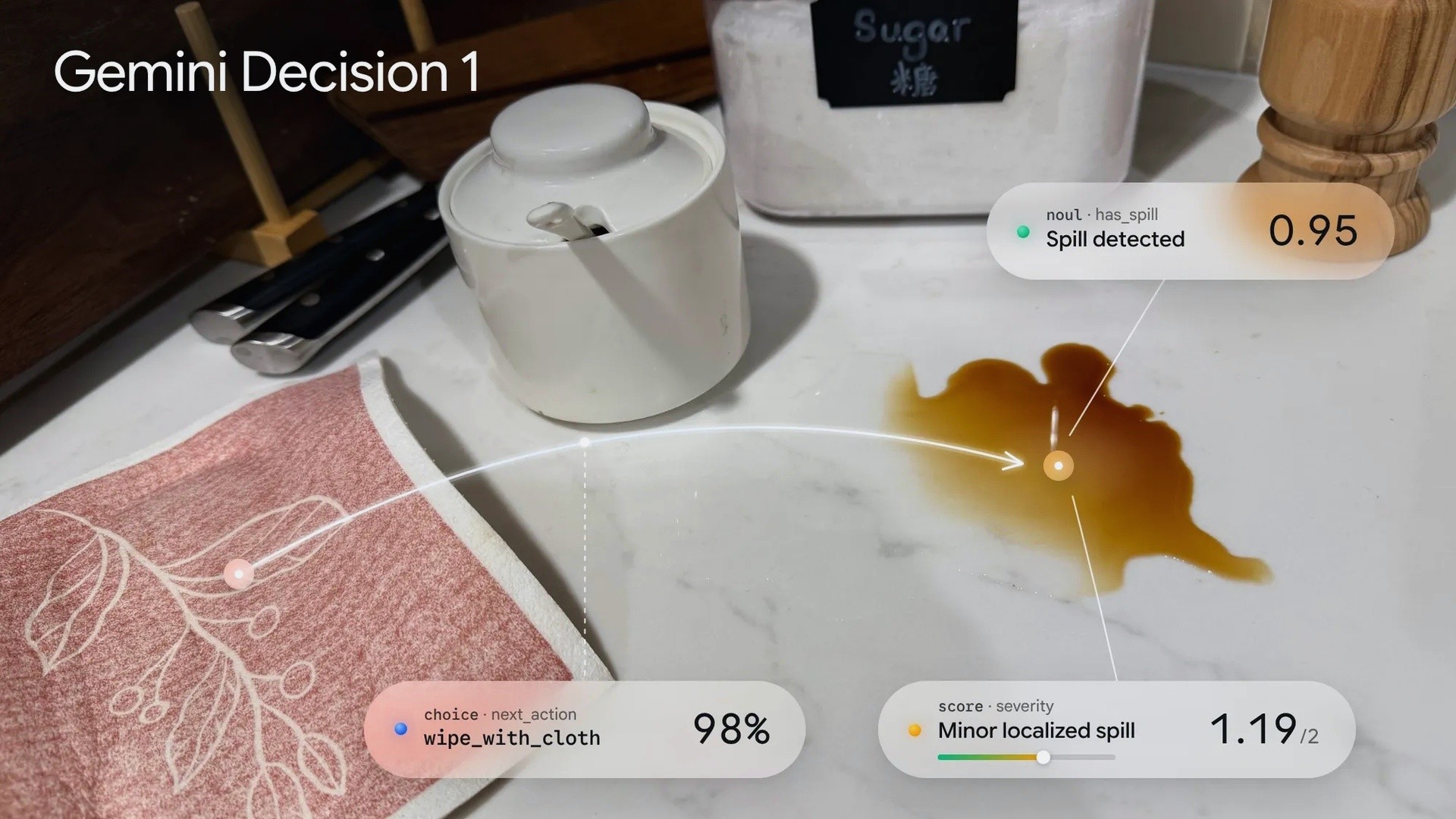
Artwork: Google DeepMind (official blog) — the launch image published with the November 11 announcement of the Gemini Decisions API. Decision 1 is a software model; the photograph it scores is Google's own worked example.
A model that refuses to write
Every frontier model of the last three years has competed on the same axis: generating better text. On November 11, Google DeepMind shipped a model that generates none. The Gemini Decisions API, announced on Google's official blog by product manager Min Choi and principal scientist Felix Yu, is powered by a new model called Gemini Decision 1 (gemini-decision-1) — a system built to do one thing: look at a multimodal input once, and score the answers to as many as 1,000 closed questions about it, in a single forward pass.
The questions are the kind software asks a thousand times a day and currently pays a full chat model to answer in prose: Is there a spill in this photo? Which of these 200 emoji fits this message? Should this query go to the fast model or the deep one? Does this tool call violate policy? Gemini Decision 1 returns no sentences — it returns probabilities, one per allowed answer, each with a confidence score between 0 and 1, in 150 to 250 milliseconds end to end.
Three question types, one pass
The API's vocabulary is deliberately small. A noul question asks whether a yes/no condition holds, with optional descriptions of what "true" and "false" look like. A choice question selects among 2 to 255 candidates and returns the winner with normalised probabilities for every option. A score question grades the input against an ordered rubric starting at 0, returning a continuous weighted score and per-level probabilities. All three types can be mixed in a single request against the same input, and the shared input is billed once, however many questions ride on it — each question adds only its own instruction and criteria tokens.
Google's own worked example is the photograph at the top of this article: a breakroom counter, a text note ("Breakroom counter check before the 9 AM client meeting"), and three questions. The model finds the coffee spill (probability 0.95), selects wipe_with_cloth as the next action at 98% confidence, and grades the severity at 1.19 on a 0-to-2 rubric. It is a deliberately mundane demo, and that is the point: the workload being targeted is not conversation but judgement — the millions of small, bounded verdicts that agent systems, safety filters and routing layers issue every second.
Why scoring is cheaper than writing
The economics follow from the architecture. A generative model answering a classification question must decode an answer token by token, and the industry has been paying output-token prices — plus the latency of generation — for what is often a single word of content. A decision model skips decoding entirely: one forward pass over the input, one scoring head per question. Google says median model compute stays between 50 and 100 milliseconds and remains nearly flat as a request grows from 1 to 100 questions at contexts up to 16K tokens, because the expensive part — reading the input — happens once.
Hence the price card: $0.10 per million input tokens and zero for output, with no separate charges for audio transcription or OCR, and a no-cost tier in Google AI Studio for prototyping. Google claims the setup is nearly five times cheaper than running the same evaluations through Gemini 3.5 Flash-Lite on the Interactions API, across a shared benchmark suite spanning agent routing, reasoning, ranking and multimodal understanding — a suite on which, the company says, Decision 1 leads with the lowest calibration error. Those are the vendor's numbers, published with the launch; independent replication has yet to appear. But the direction of the claim is checkable by any developer with an API key, which is more than can be said for most benchmark charts.
Already running inside Google
Google's strongest evidence is not the benchmark table but the list of its own products already wired to the API. Gemini Notebook uses it as a real-time router, classifying the intent of incoming queries in milliseconds and sending everyday questions to lighter tiers — up to 40% lower latency, the company says — while reserving deep-reasoning models for hard tasks. Stitch, Google's design tool, uses it in a rapid-canvas experiment that turns voice or tap edits into playable wireframes in seconds. CC, a Google Labs assistant, uses it to pick the right emoji reaction from a palette of more than 200 options. And Search uses it as a safety layer, screening MCP tool behaviour for adversarial patterns inside the latency envelope a search page allows.
That list sketches the intended market precisely: not end users, but the control planes of other AI systems. As agent architectures multiply, the number of micro-decisions per user request — routing, grading, gating, ranking, checking — grows faster than the number of requests themselves. Google is selling the layer that makes those decisions at a price and speed that make "just ask the big model" look wasteful.
The fine print
The launch documentation draws clear boundaries. The Decisions API runs on the Gemini Developer API, through Google AI Studio; support on Google Cloud's Vertex AI is promised but undated. Per the documentation as read at launch, the model does not support the Batch API, context caching, function calling or structured output — it is a scoring endpoint, not a general model with extras removed. The endpoint itself is a dedicated one (POST /v1beta/decisions), and the official SDKs need google-genai 3.2 or later. Ecosystem integrations are rolling out across OpenRouter, LangChain, Vercel, LiteLLM, Pydantic AI, Pipecat, LiveKit and OpenCode.
There is also a conceptual limit worth naming. A model that only scores options you give it cannot notice the option you forgot. Its judgements are calibrated, Google says — the probabilities mean something — but they are judgements inside a frame the developer drew. The confidence score is the safety valve: route the uncertain cases to a bigger model or a human, and the system's honesty about its own uncertainty becomes part of the design.
What thrills
- The right shape for the job: routing, grading and policy checks never needed prose; a scorer is faster, cheaper and easier to wire into code than a chatbot emitting JSON.
- Honest uncertainty: every answer carries a calibrated confidence score, so ambiguous cases can be escalated by design rather than by failure.
- Input billed once: 1,000 questions over one document, video or recording cost one read of the input — a genuinely new price shape for evaluation workloads.
What to watch
- Vendor benchmarks: the "leads the suite, ~5× cheaper" claims are Google's, measured against Google's own Flash-Lite; third-party replication is pending.
- A narrow instrument: no batch API, no caching, no function calling at launch, and Vertex AI support undated — enterprise adoption waits on the platform roadmap.
- The frame problem: the model scores the options it is given; a badly drawn option set gets fast, confident, wrong answers.
A new category, priced like a utility
Step back and the launch marks a structural shift in what a "model" is sold as. The Gemini family now spans models that reason (Carbon), models that answer at population scale (Hydrogen) and, with Decision 1, a model that judges — an industrial component whose output is not content but control. Google is not alone in seeing the layer: hosted decision models appeared in the open-source ecosystem the same week. But Google has put a price, a latency figure and its own production traffic behind the idea.
The test arrives quickly, because the claim is falsifiable in an afternoon: any team running classification through a chat model can reroute a sample through the Decisions API and compare cost, latency and accuracy on its own data. If the numbers hold, a meaningful slice of what the industry currently buys as "generation" was only ever judgement wearing a more expensive costume — and November 11 is the day the biggest model vendor said so out loud, and priced the alternative at ten cents.
𝐆𝐄𝐓 𝐅𝐑𝐄𝐄 𝐅𝐔𝐋𝐋 𝐌𝐀𝐆𝐀𝐙𝐈𝐍𝐄 𝐀𝐓 thebuyerspulse.com
The data sheet
Gemini Decision 1 (Google DeepMind)
| Field | Detail |
| Model ID | gemini-decision-1 |
| Announced | November 11, 2026 — Google official blog (Min Choi, Felix Yu) |
| Access | Gemini API in Google AI Studio; free prototyping tier |
| Questions | Up to 1,000 per request — noul (yes/no), choice (2–255 options), score (ordered rubric) |
| Input | One shared multimodal input up to 256K tokens: text, images, audio, video, PDFs |
| Latency | 150–250 ms end-to-end; median model compute 50–100 ms (Google) |
| Price | $0.10 per million input tokens; $0 output; input billed once per request |
| Limits at launch | No Batch API, context caching, function calling or structured output (documentation); Vertex AI support to come |
Sources
- Google, official blog (Min Choi and Felix Yu, Google DeepMind, November 11, 2026): 'Gemini Decisions API: Fast multimodal decisions' — the model, the three question types, the 256K-token input, latency and pricing, the benchmark and calibration claims, the internal uses (Gemini Notebook, Stitch, CC, Search) and the ecosystem integrations.
- Gemini API documentation and launch coverage read November 11–14, 2026 (GeekByte, MLQ, AI agent trackers): the /v1beta/decisions endpoint, the google-genai 3.2 SDK requirement, and the launch limits — no Batch API, context caching, function calling or structured output; Vertex AI support promised, undated.
- Artwork: Google DeepMind (official blog) — the Gemini Decision 1 launch image (decisions-hero-hud) published with the November 11 announcement.