Scientists give Claude the data and the writing — and keep the questions for themselves
Anthropic classified 207,049 research sessions on Claude and Claude Code, and the ledger is lopsided: data analysis and writing absorb most of the use, while ideation and hypothesis generation — the task scientists rank first for producing important results — takes just 4.2% of sessions.
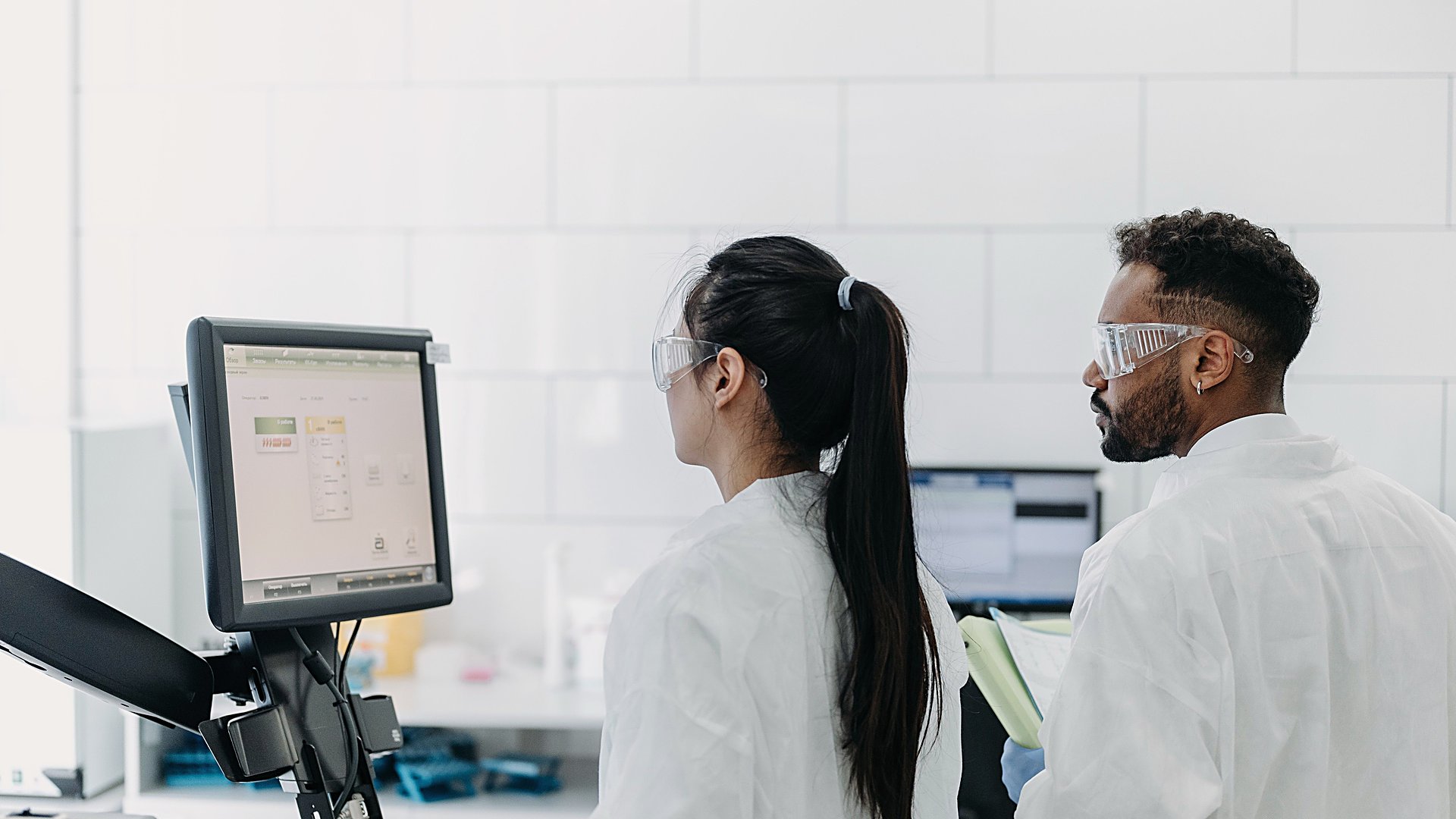
Photo: Pavel Danilyuk / Pexels (Pexels free license).
AI is already inside the laboratory — but it is not doing the job the headlines imagine. In the largest count yet of how scientists actually use a frontier model, Anthropic classified 207,049 research sessions on Claude and Claude Code and found the work concentrated where research is most mechanical: data analysis takes 33.7% of sessions on Claude and 48.1% on Claude Code, and writing and communication take another 32.0% on Claude. The task scientists themselves rank as the most important in discovery — generating ideas and hypotheses — accounts for just 4.2% of sessions.
The report, “AI for Scientific Discovery: How Researchers Use Claude,” was published by Anthropic on November 5, with Johannes Hermle, Ben Jones and Lukas Althoff as lead authors. Its finding is not that AI has entered science — that is settled — but where it has entered: at the desk, in the analysis and the drafting, rather than at the point where a researcher decides what is worth investigating. The machine accelerates the work. The questions remain human.
What Anthropic counted
The study reads usage, not output. Using privacy-preserving infrastructure, Anthropic ran each session on consumer plans through a language-model classifier that assigned it a scientific field, subfield and research task from SciNet, a taxonomy of 7,262 tasks spanning 34 fields and 318 subfields. The classifiers retained only the labels — no datasets, hypotheses, methods or unpublished results were extracted — and results were reported only in aggregate, for groups meeting a minimum number of distinct accounts.
The main sample covers August 2 to September 30, 2026: 128,914 sessions from Claude's chat and Cowork interfaces and 78,135 from Claude Code, the agentic tool that works directly in a user's files, writing and running code. A smaller supplemental sample comes from Claude Science, Anthropic's research workbench. Alongside the session data, the team surveyed 528 scientists — primarily in the life and health sciences, mostly in the United States and Canada, recruited from applicants to its AI for Science grant programs — and the authors note plainly that these respondents are active adopters, likely heavier AI users than the typical scientist.
The work scientists actually hand over
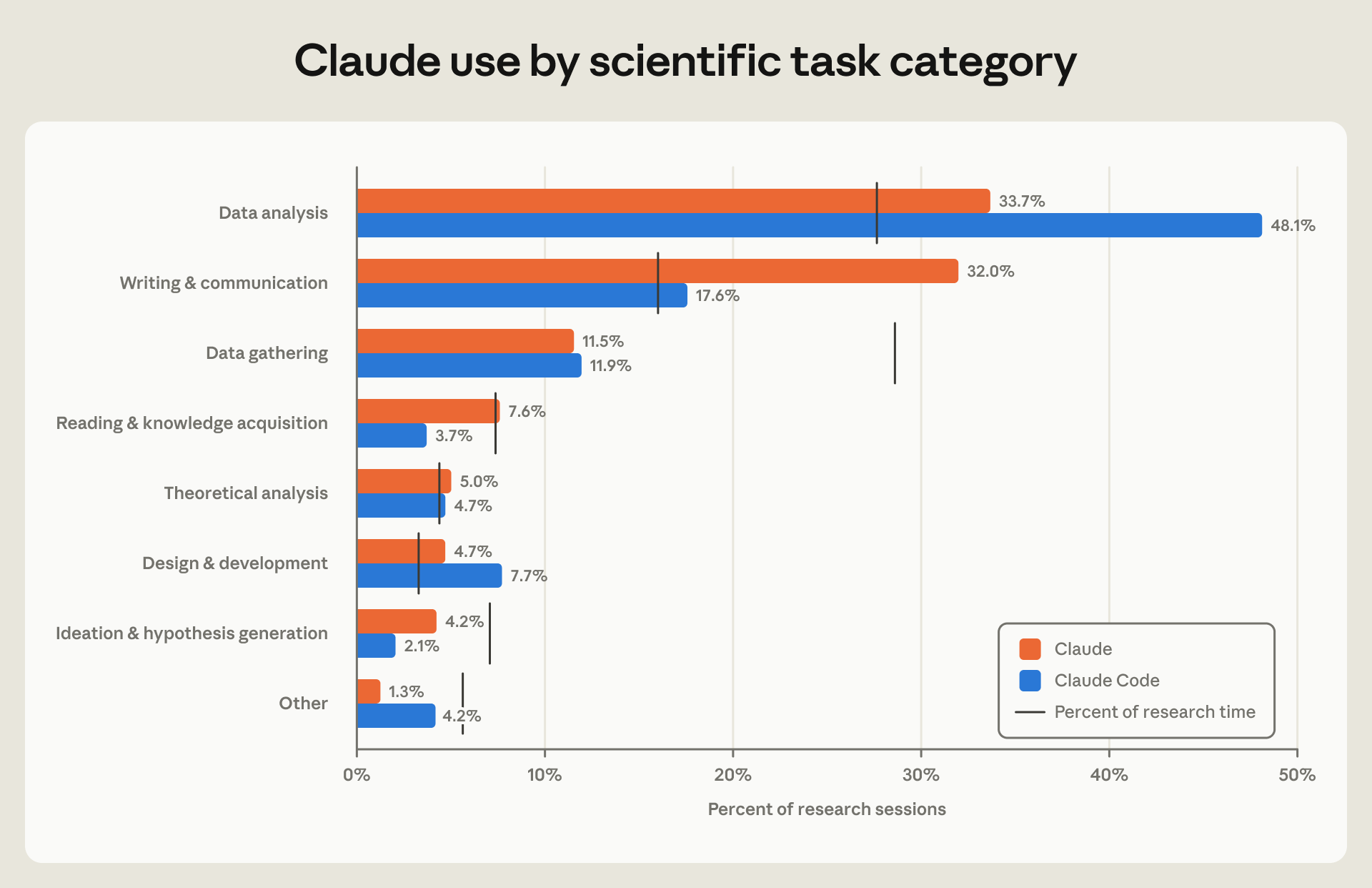
Across the eight research-task categories, two dominate. Data analysis is the single largest use on both interfaces — about a third of Claude sessions and nearly half of Claude Code sessions, against an estimated 27.6% of researchers' time. Writing and communication is second on Claude at 32.0% of sessions, double its 16.0% share of researcher time. On Claude Code, writing drops to 17.6% and design and development — building software, materials and creative works — reaches 7.7%, the profile of a tool used by people who work in code.
What comes out of the sessions differs by field in the same direction: written artifacts — documents, reports, papers — are more common in the social sciences and humanities, while technical artifacts such as code, software outputs and data are more frequent in the natural and formal sciences, and about twice as common on Claude Code as on Claude.
Below the two leaders, the pattern inverts. Data gathering consumes an estimated 28.6% of researchers' time — the largest single block — but takes only 11.5% of Claude sessions and 11.9% of Claude Code sessions, and the shortfall is steepest where gathering is physical, such as collecting clinical or biochemical data. Reading and knowledge acquisition takes 7.6% of Claude sessions, theoretical analysis 5.0%, design and development 4.7%. And ideation and hypothesis generation — formulating the question and the candidate answer — closes the table at 4.2% of Claude sessions and 2.1% of Claude Code sessions, against 7.1% of researcher time.
The two tasks at the bottom are the two that matter most
The survey is what turns the table into a tension. Asked which categories matter most for producing important research results, the scientists ranked ideation and hypothesis generation first and data gathering second — precisely the two categories where AI use runs furthest below the time researchers spend on them. Anthropic is careful about why. Much of data gathering is physical work that a language model cannot touch. Ideation is different: it is woven through other tasks and hard to classify, so the 4.2% may undercount it; scientists may also simply prefer to generate ideas themselves, or judge AI's ability there as limited. The report leaves the harder possibility open — AI may be genuinely weaker at high-level ideation, “such as choosing which research question to pursue and designing a study to answer it.”
That distinction is the study's real subject. The tasks AI absorbs are the ones with a checkable output: a cleaned dataset, a statistical test, a drafted section. The task it barely touches is the one that decides what the dataset should be about. Anthropic's own discussion puts it as a bottleneck: research questions largely determine a project's value, and AI's capacity to generate good questions remains unclear.
Use follows the map of what AI does well
The same pattern repeats across fields. Relative to their share of the world's researchers, the formal sciences use Claude most heavily — computer science is the largest field on Claude at 11.9% of sessions and takes 32.7% of all Claude Code sessions while representing just 4.3% of researchers worldwide; the artificial intelligence and machine learning subfield is 1.2% of researchers but 5.0% of Claude sessions and 15.2% of Claude Code sessions. Health and the lab-based physical sciences, where work happens at benches and with patients, sit at the other end.
Anthropic tested whether use tracks capability directly, building a score for how well AI can in theory perform each task. It does. Tasks in the top fifth of that score draw about twice as much Claude use, and about four times as much Claude Code use, as the time researchers spend on them would predict; tasks at the bottom, most of them physical, draw almost none. In the report's own summary line, “scientists appear to use AI where it works best.”
The exception built for the lab
One corner of the data points the other way. On Claude Science — the specialized workbench that connects Claude to the fragmented databases and tools of the life sciences — biology and biomedical research account for more than half of sessions, the work is longer and more advanced (over 80% of use is estimated to require doctoral-level training), and more than 70% of sessions run with a high degree of AI autonomy, against 23.7% on Claude. There, ideation and hypothesis generation reaches 8% of sessions — roughly twice its share on Claude, and about on par with the share of time researchers give it. Anthropic's reading is measured: tools built for scientific work may narrow the gap between what scientists use AI for and what they consider most important. It is evidence of direction, not yet of arrival.
Faster — but only up to the bench
The report closes with scenarios, and Anthropic labels them itself: illustrative, not forecasts. If today's capabilities were adopted everywhere, the model estimates AI could take on 27% to 52% of the researcher time behind a new study — a median of 38% — and lift research output by factors from 1.35× in the arts to 2.02× in statistics, with computer science at 1.96× and chemistry at 1.41×. Halfway there, at 75% automation of non-physical steps, the model puts computer science at about 8× and statistics at 7×, with bench and medical sciences at roughly 2–3×. In the most speculative case, where AI automates every non-physical step, fields without physical bottlenecks reach 15- to 16-fold output, while biology, chemistry, materials science and biomedicine — where roughly 40% of researcher time is physical — reach only three- or fourfold. The arithmetic rests on stated assumptions, including AI agent time at $30 an hour against $95 for a researcher, and it deliberately leaves out facility capacity, the cost of machinery and experimental inputs, and the quality of the ideas themselves.
The surveyed scientists, for their part, expect the curve to keep rising: 38% say AI already matches top researchers at data analysis, and by 2030, 94% expect it to match the best at data analysis, 89% at writing and 72% each at ideation and data gathering. About 40% expect AI to carry out full research projects on its own by 2030, and about 64% by 2035 — while 16% say it will never happen, and roughly half expect autonomously produced scientific breakthroughs only after 2035, if ever.
What the study cannot see
The boundaries are stated in the report and worth keeping attached to its numbers. The sample is consumer plans only: enterprise, institutional and API use — where much laboratory AI may actually run — are outside it. The classifications are a model's labels, not observed findings; the study measures where Claude was used, not whether the science got better. And the survey speaks for researchers already inclined toward AI. Within those limits, the measurement is unusually concrete — and its picture is consistent: AI has taken a large, real share of the laboratory's analytical and writing workload, and almost none of its deciding.
That is where the study leaves the matter. The sessions show a tool that speeds up the work scientists hand it — the analysis, the code, the draft — while the choice of what to investigate, the hypothesis worth a year of a career, remains the step researchers keep for themselves and rank above all others. Whether that is a permanent division of labor or a snapshot of 2026 is the thing the next study will have to measure.
𝐆𝐄𝐓 𝐅𝐑𝐄𝐄 𝐅𝐔𝐋𝐋 𝐌𝐀𝐆𝐀𝐙𝐈𝐍𝐄 𝐀𝐓 thebuyerspulse.com
Sources
- Anthropic (Nov 5, 2026), “AI for Scientific Discovery: How Researchers Use Claude” — Hermle, Jones, Althoff et al.: the classification of 207,049 consumer-plan sessions (Aug 2–Sep 30, 2026); the task and field shares; the survey of 528 scientists; the AI-capability analysis; the Claude Science results; and the acceleration scenarios with their stated assumptions and limits. anthropic.com/research/how-researchers-use-claude
- Photo: Pavel Danilyuk / Pexels — two researchers review data on a laboratory monitor in a modern laboratory; Pexels free license, via pexels.com (photo 8442372).
- Chart: Anthropic, Figure 3 of the report — Claude use by scientific task category.