
The racks are lit, the bill is larger: CoreWeave's US$132.5 billion backlog now carries US$846 million of interest in a single quarter
The photograph is the business: row after row of GPU racks running in a CoreWeave data center, liquid cooling plumbed into the machines. On November 10 the company reported third-quarter revenue of US$3.661 billion, up 168% year on year, and a record revenue backlog of US$132.5 billion — the contracted demand that fills halls like this one. The same release carries the other half of the story. Net interest expense for the quarter was US$846 million, against GAAP operating income of US$207 million. Demand is no longer the question CoreWeave has to answer. The cost of building for it is.
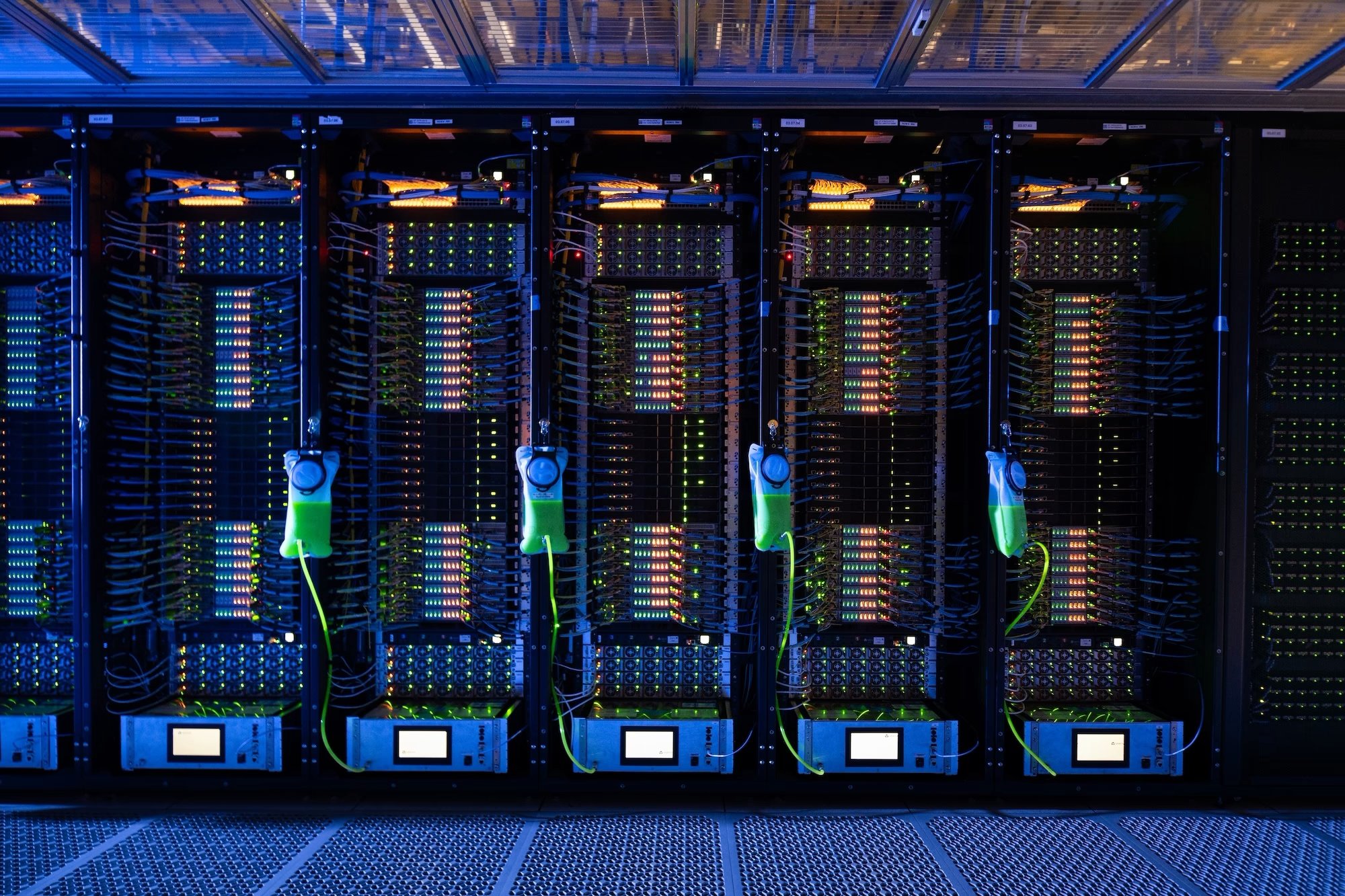
Photo: CoreWeave (official company imagery, CoreWeave blog: direct-to-chip liquid cooling in a CoreWeave data center).
Start with what the quarter settles. CoreWeave's third-quarter revenue was US$3.661 billion, up 168% from a year earlier. That is above the top of the company's own guidance range of US$3.450 billion to US$3.600 billion, and above the consensus of about US$3.550 billion compiled by LSEG and reported by Reuters. A company at this scale is not supposed to beat its own guide and the market's estimate in the same quarter while growing at 168% — and yet the revenue line is not even the largest number in the release. The revenue backlog — work contracted, not yet delivered — closed the quarter at a record US$132.5 billion, up 138% year on year and up from US$104.2 billion at June 30. In three months, the order book grew by more than US$28 billion. Whatever questions remain about this business model, whether customers want the capacity is not one of them.
Demand is settled. The argument has moved
A backlog of US$132.5 billion against quarterly revenue of US$3.661 billion is a ratio worth sitting with. It represents years of contracted work at the current run-rate, signed before the capacity to serve it fully exists. That is the structure of the AI infrastructure trade in one figure: customers commit first, at enormous scale, and the provider then has to build — halls, power, cooling and racks of the kind in the photograph — fast enough to convert commitments into delivered, billable service. CoreWeave's active power passed 1.7 gigawatts in the quarter, double where it stood at the start of the year, and its contracted capacity stands above 4.6 gigawatts. The gap between those two numbers, roughly 2.9 gigawatts of contracted-but-not-yet-active power, is the construction programme the backlog demands. Every gigawatt of it has to be financed before it earns.
What a backlog of this kind obliges is worth spelling out, because it is not a pipeline in the sales sense. These are signed contracts for capacity that, in large part, does not yet exist as delivered service: the customer has committed, the provider has committed back, and the space between the two commitments is filled with construction schedules, equipment deliveries and power connections. Converting backlog into revenue is therefore an operations problem before it is a market problem. Active power has doubled since the start of the year to more than 1.7 gigawatts — the pace of conversion is visible in the power figures — but the contracted total above 4.6 gigawatts says the conversion programme still has most of its distance to run. The backlog will keep growing revenue only as fast as halls can be lit, which is why the capex guide, not the sales guide, is the number that governs the story.
Management's guidance says the company intends to keep building at that pace. CoreWeave raised its 2026 revenue guidance to US$13.0 billion to US$13.3 billion, lifted adjusted operating income guidance to US$1.275 billion to US$1.375 billion — up 26% at the midpoint — and now targets an annualised revenue run-rate of US$20 billion to US$21 billion as it exits the year. The capital expenditure guide moved the same way: US$37 billion to US$39 billion for 2026, with the bottom of the range raised from US$35 billion, because capacity is being delivered to customers sooner than planned. In the third quarter alone, capital spending was about US$14.5 billion — nearly four times the quarter's revenue. That ratio, spending roughly four dollars of capex for every dollar of revenue recognised in the same period, is the physical reality underneath the growth rate.
The cost line: US$846 million against US$207 million
Now the other ledger. CoreWeave's GAAP operating income for the quarter was US$207 million. Its net interest expense for the same quarter was US$846 million — more than four times the operating profit the business generated, and the main reason a quarter of record revenue and a 62% adjusted EBITDA margin closed with a net loss of US$709 million. Adjusted operating income, which strips out items management treats as non-recurring, was US$379 million: a healthier figure, and still less than half the interest bill. Read the release as a manager and the shape is unmistakable. The operation itself, at the adjusted level the company prefers, is profitable and improving. The financing structure built to fund the operation costs more, each quarter, than the operation currently returns.
And the bill is scheduled to grow before it shrinks. The company's guidance for fourth-quarter interest expense is US$1.050 billion to US$1.150 billion — a further step up from US$846 million, reflecting the debt taken on to fund the build. Against that, management points to roughly US$9 billion in customer prepayments and deposits expected in the period ahead, money customers pay in advance that funds capacity without a lender in between, and to the backlog itself: US$132.5 billion of contracted revenue is, among other things, the collateral story that lets a company borrow at this scale at all. The company also said it will not issue unsecured debt at current yields — a line worth reading precisely. It is not a statement that CoreWeave will stop borrowing; it is a statement about which borrowing it refuses, at which price. On CNBC, analyst Nick Del Deo of MoffettNathanson noted that the holding company's bonds were yielding around 16% — his comment, offered as analyst commentary, not a company figure — which is the market price the company's refusal is answering.
Set the full-year guides side by side and the same shape repeats at annual scale. Adjusted operating income for 2026 is guided at US$1.275 billion to US$1.375 billion. Interest, at US$846 million in the third quarter and US$1.050 billion to US$1.150 billion guided for the fourth, is running at an annualised pace well above that full-year operating guide. That does not make the operation weak — adjusted operating income guidance was itself raised 26% at the midpoint — it makes the capital structure the dominant fact of the income statement. For a manager reading this release the way they would read a supplier's, the question is not whether CoreWeave can sell capacity. It is whether the spread between what the capacity earns and what its financing costs stays wide enough, for long enough, for the delivered halls to start paying down the machine that built them. The first half of 2028, management's own date for adjusted profitability, is when the company says that spread turns in its favour.
Power is the physical ledger
The photograph at the top of this article is not decoration; it is the asset register. Each rack in that hall is a capital decision: GPUs bought at the top of a supply-constrained market, liquid cooling fitted because air no longer removes the heat these machines produce, power contracted years ahead of delivery. CoreWeave ended the quarter with more than 1.7 gigawatts of active power and more than 4.6 gigawatts contracted. Doubling active power in ten months, as the company has done since January, means the halls behind the backlog figure are actually being built and lit — the 168% revenue growth is the delivered portion of that programme arriving on the income statement. It also means the depreciation, the power bills and the interest attached to those halls are now running costs, whether or not every contracted gigawatt behind them is yet earning revenue.
That is why the two guidance moves in this release belong in the same sentence. Revenue guidance rose, and the interest guide rose faster, from US$846 million in the third quarter to a guided US$1.050 billion to US$1.150 billion in the fourth. Growth at CoreWeave is currently purchased with borrowed money at a pace that makes the financing line grow ahead of the operating line. The company's own timeline acknowledges the crossing point is not imminent: it expects adjusted profitability in the first half of 2028. Between here and there, the model depends on three things staying true at once — customers continuing to sign and prepay, lenders continuing to fund contracted capacity, and the delivered halls converting backlog into revenue on schedule. The third quarter's numbers show the first and third working. The interest line is the price of the second.
How to read this quarter
For the reader who runs infrastructure rather than a portfolio, CoreWeave's quarter is the cleanest public x-ray of what building AI capacity actually costs in 2026. The demand side of the industry has been argued about for two years; a US$132.5 billion backlog, up 138% in a year, is what the demand side looks like when it is signed. The supply side is the rest of the release: about US$14.5 billion of capex in one quarter, a full-year capex guide of US$37 billion to US$39 billion, 1.7 gigawatts lit and 4.6 gigawatts contracted, and a quarterly interest bill of US$846 million that already exceeds GAAP operating income of US$207 million by a factor of four. None of those figures is hidden. All of them are in the same document, which is what makes the document worth reading whole.
The Buyer's Pulse does not offer investment advice, and nothing here is a recommendation to buy or sell CoreWeave shares. What can be said on the record is narrower, and sufficient. The question this industry used to ask — will anyone pay for all this compute? — has been answered by the backlog. The question the next two years will ask is the one in this quarter's cost lines: what does it cost, per quarter and in total, to build the capacity the backlog has already sold, and who carries that cost until the halls are earning? On November 10, CoreWeave published both halves of that answer at once: US$132.5 billion of demand, and US$846 million of interest in a single quarter — with US$1.050 billion to US$1.150 billion guided for the next one.
What the backlog proves
- Revenue of US$3.661 billion beat both the company's own guide (US$3.450–3.600 billion) and the LSEG consensus (~US$3.550 billion), growing 168% year on year.
- The backlog is contracted, not forecast: US$132.5 billion, up 138% year on year and up from US$104.2 billion at June 30 — more than US$28 billion added in one quarter.
- 2026 guidance rose across the board: revenue US$13.0–13.3 billion, adjusted operating income US$1.275–1.375 billion (+26% at the midpoint), exit run-rate US$20–21 billion.
- The build is physically arriving: active power above 1.7 GW, double the start of the year, with contracted capacity above 4.6 GW and ~US$9 billion of customer prepayments expected.
What to watch
- Net interest of US$846 million in Q3 was more than four times GAAP operating income of US$207 million, and Q4 interest is guided higher still, at US$1.050–1.150 billion.
- The quarter closed with a net loss of US$709 million despite a 62% adjusted EBITDA margin — the financing cost, not the operation, sets the bottom line for now.
- Capex runs at roughly four times quarterly revenue (~US$14.5 billion in Q3; US$37–39 billion guided for 2026), and adjusted profitability is not expected until the first half of 2028, on the company's own timeline.
- The company says it will not issue unsecured debt at current yields; analyst Nick Del Deo (MoffettNathanson, on CNBC) put the holding-company bond yield at around 16% — commentary, not a company figure.
The file
The quarter (Q3 2026, reported November 10, 2026)
| Field | Detail |
| Revenue | US$3.661 billion, up 168% year on year (own guide US$3.450–3.600 billion; LSEG consensus ~US$3.550 billion) |
| Revenue backlog | US$132.5 billion, a record — up 138% year on year, from US$104.2 billion at June 30, 2026 |
| Adjusted operating income | US$379 million |
| Adjusted EBITDA margin | 62% |
| GAAP operating income | US$207 million |
| Net interest expense | US$846 million in the quarter |
| Net loss | US$709 million |
| Capital spending | About US$14.5 billion in the quarter |
Guidance (2026, raised November 10, 2026)
| Field | Detail |
| Revenue | US$13.000–13.300 billion |
| Adjusted operating income | US$1.275–1.375 billion (+26% at the midpoint) |
| Capital expenditure | US$37–39 billion (previously US$35–39 billion) |
| Exit run-rate | Annualised revenue run-rate of US$20–21 billion exiting 2026 |
| Q4 interest | US$1.050–1.150 billion guided net interest expense |
| Profitability | Adjusted profitability expected in the first half of 2028 (company expectation) |
Power and financing
| Field | Detail |
| Active power | More than 1.7 GW — double the level at the start of the year |
| Contracted capacity | Above 4.6 GW |
| Customer prepayments | About US$9 billion in prepayments and deposits expected (per the release, attributed to management) |
| Unsecured debt | The company said it will not issue unsecured debt at current yields |
| Market colour | Holding-company bonds yielding ~16%: analyst comment by Nick Del Deo, MoffettNathanson, on CNBC — not a company figure |
Sources
- CoreWeave, Inc. — official third-quarter 2026 results release, November 10, 2026: revenue of US$3.661 billion (+168% year on year), record revenue backlog of US$132.5 billion (+138%; US$104.2 billion at June 30), adjusted operating income of US$379 million, adjusted EBITDA margin of 62%, GAAP operating income of US$207 million, net interest expense of US$846 million, net loss of US$709 million, quarterly capital spending of about US$14.5 billion, active power above 1.7 GW and contracted capacity above 4.6 GW, raised 2026 guidance (revenue US$13.0–13.3 billion; adjusted operating income US$1.275–1.375 billion; capex US$37–39 billion; exit run-rate US$20–21 billion), Q4 interest guidance of US$1.050–1.150 billion, about US$9 billion of expected customer prepayments and the expectation of adjusted profitability in the first half of 2028.
- Reuters, reporting on the November 10, 2026 results (consensus data via LSEG): the LSEG consensus for Q3 revenue of about US$3.550 billion against the company's own guidance of US$3.450–3.600 billion, and corroboration of the raised 2026 outlook.
- CoreWeave Q3 2026 earnings call, November 10, 2026 (transcript): management's statement that the company will not issue unsecured debt at current yields, and the funding role of customer prepayments against the build programme.
- CNBC, November 2026: analyst commentary by Nick Del Deo of MoffettNathanson putting the yield on the holding company's bonds at around 16% — analyst commentary, attributed as such wherever used in this article, not a CoreWeave figure.
- Photo: CoreWeave (official company imagery) — direct-to-chip liquid cooling in a CoreWeave data center, published on the company's official blog ("Liquid Cooling for AI Data Centers"). The photograph shows CoreWeave GPU racks in operation; it is company imagery of its own facilities, not a photograph of the earnings event.