
Voyager 1 reaches one light-day from Earth — and its orders now take a day to arrive
There is a distance at which a conversation stops being a conversation. On Wednesday, November 18, at 5:16:07 a.m. Eastern time, Voyager 1 crosses it: exactly one light-day from Earth — 25,902,068,356 kilometers, the distance light itself needs 24 hours to travel. From that moment, every order NASA sends the probe takes a full day to arrive, and every answer takes another day to come back.
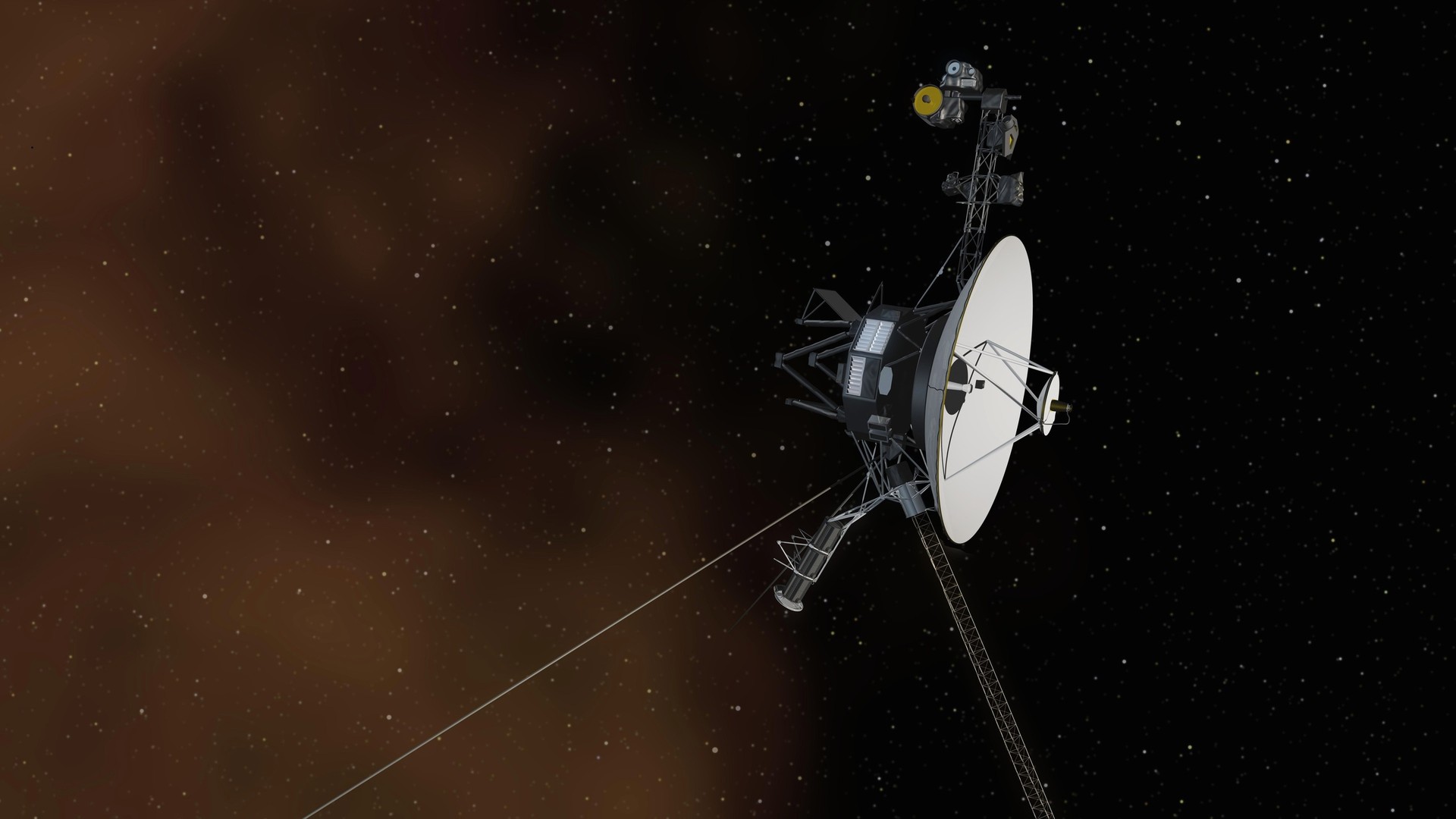
Image: NASA/JPL-Caltech — artist's concept of the Voyager spacecraft (PIA17462), official image.
Start with the clock, because NASA has timed this to the second. At 5:16:07 a.m. EST on Wednesday, November 18, 2026 — 10:16 UTC — Voyager 1 will be 25,902,068,356 kilometers from Earth. That is the distance a beam of light covers in exactly 24 hours, which makes the probe the first human-made object ever to stand one full light-day from home. Not the farthest by a little, on one particular morning: the farthest by the only yardstick that cannot be argued with, the speed of light itself.
Nothing breaks when the line is crossed. No alarm sounds on the spacecraft, no system changes state. What changes is on our side of the signal: the delay. A radio command leaving Earth on Wednesday morning reaches the probe on Thursday morning. Its confirmation — the probe's own voice, reporting back — arrives on Friday. Forty-eight hours for a single exchange, with the fastest messenger physics allows. Every mission ever flown has lived inside a delay; this is the first one whose delay is measured not in minutes, but in days.
What a light-day means, in practice
A light-day is not a metaphor, and it is not a record-office curiosity. It is an operating condition. The probe's radio signals travel at the speed of light — nothing can travel faster — so the 24-hour figure is not an engineering limitation that a better antenna could fix. It is the shape of the universe at that distance. From November 18 onward, Voyager 1 is, in the most literal sense, a day away: a day for our voice to reach it, a day for its voice to reach us.
That turns mission control's dialogue into correspondence. An instruction has to be right when it is sent, because the first chance to learn it was wrong comes two days later. There is no quick correction, no real-time reaction, no hand on the controls in any sense that matters. The team that runs Voyager has always worked ahead of the spacecraft — sending sequences to be executed on their own, far from supervision — but the light-day moves that discipline onto a new scale: every exchange with the most distant machine ever built is now planned the way letters were once planned, in days.
One order, told slowly
Put a single ordinary instruction through the new arithmetic and the abstraction becomes a schedule. A command leaves Earth at nine on a Monday morning — an adjustment, say, to something the probe is being asked to do. All day Monday it is in transit, crossing a distance so large that the fastest thing in the universe needs a day to cross it. At nine on Tuesday morning it arrives, and the probe does what it was told. The probe's answer — its telemetry, its confirmation, its own account of its state — sets off back across the same gulf. At nine on Wednesday morning, two full days after the question was asked, the answer reaches the people who asked it. Whatever they decide to do about it starts the clock again.
That is now the fastest possible conversation with Voyager 1, and it will never be faster. It also explains, better than any tribute, the kind of trust this mission runs on: a machine built in the 1970s, a full day of light away, executing instructions sent by people who cannot know — until two days later — whether the instructions were even the right ones.
Hold the scale of the number itself for a moment. 25,902,068,356 kilometers is roughly 16,090 million miles. In astronomical units — the Earth–Sun distance, the ruler of the solar system — it is 173.14 AU: the probe is 173 times farther from us than the Sun is. Light from the Sun reaches Earth in about eight minutes. Light from Voyager 1 now needs a day.
Forty-nine years, two months and eleven days
The probe that crosses the line on Wednesday was launched in 1977. When it reaches one light-day, it will have been traveling for 49 years, 2 months and 11 days — a working lifetime, spent entirely in flight, outbound, never turning back. It has been the farthest human-made object from Earth for decades, and the light-day is the moment that fact becomes a round, physical number: not "billions of kilometers," which the mind files away as abstraction, but one full day of light.
There is exactly one other machine on a comparable road, and the comparison shows how alone Voyager 1 is. Its twin, Voyager 2 — launched the same year, flying a different road outward — will not reach one light-day from Earth until November 2035. Nine more years. The second-farthest object human beings have ever made is nine years behind the first, and everything else we have ever launched is immeasurably closer. The frontier, at this distance, is a single spacecraft.
Consider what that nine-year gap says about the shape of this frontier. There is no fleet out there, no relay, no second act close behind the first. For nine years the light-day club has exactly one member, and it is a spacecraft older than most of the people who will read about it. When Voyager 2 finally crosses, in November 2035, it will be the same story told a second time: one machine, one signal, one full day of light between it and everyone it was built for.
The night before, the world flashes back
NASA is marking the approach with an invitation that fits the arithmetic. On Tuesday, November 17, after sunset — the night before the crossing — the agency's "Shine Bright for Voyager's Light-Day" celebration asks people everywhere to send flashes of light toward the sky: phone lights, flashlights, whole buildings blinking in the dark. The flashes carry a call sign in Morse code: V-G-R, for Voyager.
The call sign is short enough to learn in a minute. In Morse code, V is three dots and a dash (···−), G is two dashes and a dot (−−·), and R is a dot, a dash and a dot (·−·). A phone light can carry it; a building can carry it; a stadium could carry it. NASA is not asking for equipment or expertise — it is asking a planet to blink, in unison, on the night before its farthest machine crosses the line: the oldest electrical language human beings have, aimed at the newest distance they have ever reached.
It is a gesture, and everyone involved knows the physics: our flashes are a greeting, not a transmission the probe will ever notice. But as a piece of symmetry it is exact. The machine that now lives a full day of light away from us gets, the night before it crosses, a planet answering in the only language the distance respects — light itself, sent up by hand, one flash at a time.
Working with a two-day delay
What does the milestone change for the people who operate the probe? Formally, nothing about the spacecraft: it crosses an invisible line at constant speed and keeps going. Operationally, the number on the mission's clock changes its unit. Planning horizons that were already long become two-day minimums. Every command is a letter. Every confirmation is a reply that was written, from the probe's perspective, about a state of affairs already a day old when it arrives.
The arithmetic from here is simple, and a little solemn. The probe's speed does not change at the milestone, and neither does the speed of light; what changes is only the gap between the two, widening by the same amount every day. The 24-hour figure that makes headlines on Wednesday will, by Thursday, already be out of date — a minimum, not a measurement. Every future report on this spacecraft will carry a delay a fraction longer than the last, for as long as its voice keeps arriving.
And the line is not a finish. Voyager 1 does not stop at one light-day; it crosses it the way it has crossed every other marker of the last 49 years, silently and at speed, and every day after November 18 the light-time home is a little longer than a day. The milestone is a snapshot of a number that only grows. Somewhere out there, the probe's voice is already on its way — sent a day ago, arriving tomorrow, from a machine that has been flying since 1977 and is now, for the first time, a full day of light from everyone who built it.
The file
The milestone
| Field | Detail |
| Moment | Wednesday, November 18, 2026, 5:16:07 a.m. EST (10:16 UTC) — the first human-made object one light-day from Earth |
| Distance | 25,902,068,356 km — about 16,090 million miles; 173.14 AU |
| Light time | 24 hours one way; 48 hours for a command and its confirmation |
| The celebration | "Shine Bright for Voyager's Light-Day" — Tuesday, November 17, after sunset: flashes of light spelling V-G-R in Morse code |
The spacecraft
| Field | Detail |
| Launched | 1977 — in flight for 49 years, 2 months and 11 days at the milestone |
| Status | The farthest human-made object from Earth; still traveling outward after the crossing |
| The twin | Voyager 2 reaches one light-day from Earth in November 2035 |
Sources
- NASA Science — Voyager mission pages (science.nasa.gov/mission/voyager/): the one-light-day milestone on Wednesday, November 18, 2026, at 5:16:07 a.m. EST (10:16 UTC); the distance of 25,902,068,356 km (173.14 AU); the 24-hour one-way radio time and the 48-hour command cycle; and the "Shine Bright for Voyager's Light-Day" celebration on November 17.
- NASA Jet Propulsion Laboratory (JPL) — Voyager mission pages: the probe's 49 years, 2 months and 11 days of travel at the milestone, and Voyager 2's projected arrival at one light-day in November 2035.
- Image: NASA/JPL-Caltech — "Artist concept of Voyager 1 entering interstellar space" (PIA17462), from the official NASA/JPL image gallery; NASA/JPL imagery is in the public domain, credited per the JPL image-use policy.