
Mechazilla catches the ship: after 14 orbits and 22.5 hours, Ship 42 comes home to the tower
The photograph is the last seconds of a 22-hour flight: Ship 42, its steel scorched black by reentry, falling out of a cloudy Texas sky on a single engine, steering itself toward the tower it left on Friday evening. Moments after this frame, the tower's two arms closed around it. No ship had ever been caught before — every Starship upper stage in history had ended in the ocean. On Saturday, November 14, at 3:20 p.m. Central time, one came home instead.
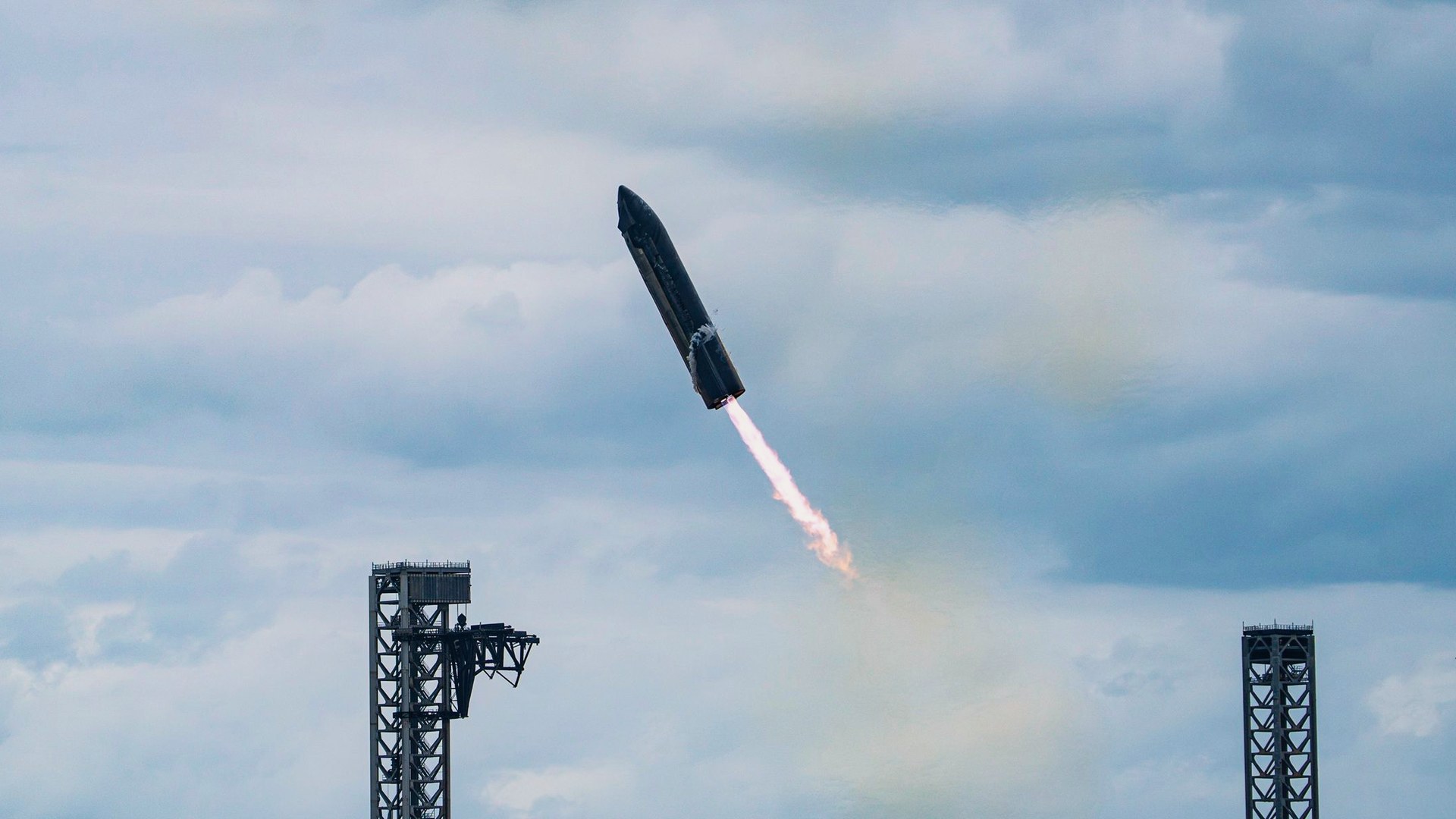
Photo: SpaceX (official image).
Start with the verdict, because this magazine published the preview of this flight on November 11 and the preview ended on a conditional: the ship would only be allowed to try if it earned it across a day in orbit. It earned it. Flight 15 — the fifteenth Starship flight, the second operational one — lifted off from Pad 2 at Starbase on Friday, November 13, at 4:47 p.m. Central, with the FAA license issued that same day. What followed was the longest Starship flight ever flown: 22 hours, 32 minutes and 32 seconds from liftoff to the moment the tower took the ship. SpaceX's own mission page gives the flight four words of summary: the ship returned "and changed everything."
Twenty-two hours earlier, the day had already gone half wrong
The plan, for the first time, was a double catch: the booster back at the tower minutes after liftoff, the ship a day later — the first full recovery of an orbital rocket on a single flight. The booster half failed in the flight's first minutes. After a clean ascent and hot-staging, Booster 22 relit 32 of its 33 Raptor engines for the boostback burn that steers it home. The burn ended early. SpaceX's post-flight account gives the reason in four words: low fuel mass. Elon Musk, in his own preliminary read, said the booster's engines had slightly underperformed, leaving it with too little propellant to attempt the catch — with the caveat, his own, that initial conclusions are often wrong and the full telemetry review is still owed.
What happened next is the part of the design that worked exactly as drawn. The booster's guidance, navigation and control system triggered an automated abort during the coast back, and diverted the vehicle to its designated contingency area over the Gulf of Mexico. There it lit 13 engines for a landing burn, slowed itself and hovered over the water — and when its engines cut off, its flight termination system was triggered and destroyed it just above the surface, about six and a half minutes after it had left the pad. No debris fell anywhere near the tower or the coast. The first V3 booster ever asked to come home did not come home, and the double catch — the flight's headline ambition — was gone before the ship had finished its first orbit.
Hold the two halves of that paragraph together, because Flight 15 is both of them. The system that was supposed to make the rocket fully reusable lost a booster to an engine-performance shortfall that is still under investigation. And the safety system wrapped around that failure — the automated judgment that a catch was unsafe, the diversion, the disposal at sea — performed flawlessly, in public, on its first real test with the new generation of hardware.
A day in orbit, with three doors out
The ship, meanwhile, flew a flight with no visible flaw. A single Raptor burn at 26 minutes put Ship 42 into an orbit of 276 by 278 kilometers, inclined 30.5 degrees. Over the following 42 minutes it deployed all 26 of its Starlink V3 satellites — each one, by SpaceX's accounting, adding about a terabit of capacity to the constellation — and SpaceX reports contact was made with every satellite as they began raising their own orbits. Three of those satellites carried cameras aimed back at the ship, photographing its heatshield: the shield was the one component that had to be certified in flight before anyone would let the ship try to come home.
Then came the long coast — more than 20 hours of it, the ship circling the Earth roughly once every 90 minutes while flight controllers read its systems. Built into the flight plan were three formal checkpoints, three doors out of the mission: an early return check over Hawaii at an hour and a half, a mid-flight check off Chile at seven hours, and a final Hawaii check at 20 hours and 42 minutes. At each one, the ship could have been waved off to a safe deorbit over empty ocean — the ending of every ship flight before this one. It passed all three. By Saturday morning, SpaceX had posted the sentence the whole flight had been building toward: pad and tower systems are go for catch.
Consider what that coast actually demonstrated, because it is easy to skip past it to the catch. A Starship ship stayed in orbit for the better part of a day — fourteen orbits, thermal cycles swinging between sunlight and shadow, propellant managed, systems monitored — and at the end of it was healthy enough, in its own telemetry and in the judgment of the flight control team, to attempt the most demanding landing maneuver ever asked of an orbital vehicle. The preview in this magazine noted that SpaceX had written the escape clause into the plan in plain language. Flight 15 is what it looks like when the clause is never needed.
The last sixteen minutes
At 21 hours, 35 minutes and 57 seconds into the flight, Ship 42 lit a single sea-level Raptor for ten seconds and left orbit. Reentry began at 22 hours and 11 minutes: the ship fell through the atmosphere belly-first on its tiles, crossed northern Mexico and southern Texas on a trajectory threaded around populated areas, swung out over the Gulf in a final swoosh, and lined up on the tower it had left the evening before. It broke through the clouds the way the photograph shows it — scorched, tilted, riding one engine's plume.
The landing burn began at 22 hours, 32 minutes and 16 seconds. Two seconds later the ship flipped itself upright — the bellyflop maneuver, performed this time not over an empty ocean but beside its own launch tower. The burn stepped down from three engines to two, then to one. And at 22 hours, 32 minutes and 34 seconds, the burn ended with the ship hanging in the closed arms of Mechazilla, a few hundred feet above the pad it had launched from. Mission elapsed time at the catch: 22 hours, 32 minutes, 32 seconds. The tower that had caught three boosters — all of them first-generation machines that never left the edge of the sky — had now caught a ship back from orbit. SpaceX's post on X was nine words of disbelief from the company that built it: "Mechazilla catches Starship!"
That evening, Musk went out to the pad to inspect the vehicle in person. "Ship 42 looks great!" he posted, with video of the returned ship in the tower; he later wrote that he had hugged Ship 42 upon its return. NASA's Administrator, Jared Isaacman, congratulated the company publicly — "making more believers by the day," he wrote — a sentence with weight behind it, because NASA is counting on a version of this ship to land its astronauts on the Moon.
Why catching the ship was the hard half
The tower had caught boosters before, and it is worth being precise about why this is a different thing. A booster returns from a suborbital arc minutes after launch, never reaching orbital speed, never enduring reentry. The ship does everything the booster does not: it circles the planet at some 17,500 miles per hour, soaks in orbit for a day, fires itself home, and converts that speed into heat against a skin of tiles — then, at the end of all of it, has to hold itself steady in the air, upright, at a precise point beside a tower, while two steel arms close on fittings near its top. It is the largest spacecraft ever recovered from orbit, and it was recovered not by landing gear, not by parachute, not by ocean — but by the same machine that launched it, at the same pad, in a condition that lets engineers walk up and inspect it.
The arithmetic underneath is the reason the tower exists. A ship that ends in the ocean is a ship you build again; a ship caught at the pad is hardware that stays in the fleet. Starship's entire economic case — deploying 26 heavy Starlink satellites at a time as routine operations rather than campaigns, flying at a cadence SpaceX compares to aviation — rests on that difference. Catching the booster made the case plausible. Catching the ship is the half that had never been demonstrated at all, and it is now demonstrated once.
What has not been proven yet
Once is the operative word, and the honest account of Flight 15 keeps its caveats in the same frame as its triumph. Ship 42 has been recovered; it has not been reflown, and recovery is not yet reuse — whether this particular ship, with a heatshield that has been through one reentry, flies again is a question SpaceX has not answered. The booster half of the system is, on the evidence of Friday, the weaker half: the V3 booster has yet to be caught at all, and its failure mode — engines underperforming just enough to starve the return — has to be understood and fixed. Musk's preliminary prescription, better engine consistency in the Raptor V3.2 line and shutting down most booster engines about a second earlier to protect the return propellant, is a plan, not a result.
Beyond recovery sit the larger unproven pieces of the program: refueling in orbit, which SpaceX plans to begin testing within the next several flights and on which the lunar architecture depends; the reliability record a crewed program requires; and the simple matter of repetition — doing all of this again, and then routinely. Flight 15 moved Starship from a vehicle that had reached orbit once to a vehicle that has come home from orbit once. The distance between "once" and "operational" is where the next several flights will be spent.
What happens next
The immediate sequel is already on the books. Flight 16 is expected to pair Ship 43 with Booster 23 — the next booster, which Musk says is almost ready to fly — and to be the first Starship launch from Launch Complex 39A in Florida, taking the program beyond Starbase for the first time. The tower in the photograph will not be the only catcher for long. And somewhere in the inspection queue at Starbase sits the ship itself: scorched, intact, and available to be read like a flight recorder — every tile, every fitting, every system that spent 22.5 hours in space and came back to be examined. Fourteen ships flew before it and ended in the sea, unread. The fifteenth came home, and it has a great deal to tell.
What Flight 15 proved
- An upper stage can return from orbit and be caught by its launch tower: Ship 42, 14 orbits, 22.5 hours, caught at Pad 2 on November 14.
- The ship's systems — heatshield included — stayed healthy through a full day in orbit and passed all three return checkpoints.
- The booster's automated abort worked as designed: diverted, disposed of at sea, no risk to the pad or the coast.
What remains unproven
- Reflight: Ship 42 has been recovered, not yet reused — and the V3 booster has still never been caught.
- The booster failure is unexplained: engines underperformed and starved the return; the investigation is open.
- Orbital refueling, crewed reliability and routine cadence all still lie ahead of the program.
The file
The mission
| Field | Detail |
| Liftoff | Friday, November 13, 2026, 4:47:36 p.m. CT (22:47:36 UTC) — Starbase, Texas, Pad 2; FAA license issued on launch day |
| The catch | Saturday, November 14, 2026, 3:20:03 p.m. CT — Ship 42 caught by the Mechazilla tower arms at Pad 2 |
| Duration | 22 hours, 32 minutes, 32 seconds — the longest Starship flight to date; ~14 orbits |
| Broadcast | SpaceX live webcast covered the flight through the catch |
The vehicles
| Field | Detail |
| Ship | Ship 42 "Don't Panic" (Block 3) — deployed 26 Starlink V3 satellites, returned from orbit and was caught; first ship ever caught |
| Booster | Booster 22 (Block 3 Super Heavy) — boostback ended early on low fuel mass; automated abort, diverted to the Gulf and destroyed ~6.5 minutes after liftoff |
| Payload | 26 Starlink V3 satellites (Starlink Group 31-2); three carried cameras that inspected the ship's heatshield in flight |
The record now
| Field | Detail |
| Ship catches | 1 — Ship 42, Flight 15: the first recovery of an upper stage from orbit |
| Booster catches | 3 — all V1 boosters on earlier flights; the V3 booster has yet to be caught |
| Next | Flight 16 expected: Ship 43 and Booster 23, the first Starship launch from Launch Complex 39A, Florida |
Sources
- SpaceX — Starship Flight 15 mission page (spacex.com/launches/starship-flight-15), post-flight account: liftoff from Pad 2, the boostback burn ending early on low fuel mass, the automated abort and Gulf diversion, the 26 Starlink V3 deployments, the deorbit burn and the catch — "changed everything" — with the full flight timeline (deorbit burn T+21:35:57; landing burn T+22:32:16; catch T+22:32:34).
- Reuters, via AAP — "SpaceX Starship returns to landing pad from orbit" (November 15, 2026): the catch at ~3:20 p.m. CT on Saturday, 14 orbits, 22.5 hours, the booster's loss and Musk's inspection of the returned ship.
- Wikipedia — "Starship flight 15" (read November 15, 2026; each line sourced): mission duration 22:32:32, orbit 276 × 278 km at 30.5°, the booster's 13-engine landing burn and destruction over the Gulf, Musk's preliminary account of the engine underperformance and the Raptor V3.2 fix, Isaacman's congratulations, and Flight 16's expected vehicles and Florida debut.
- Space.com live coverage of Flight 15, via Space Scout and NSS reporting (November 14–15, 2026): the heatshield camera checks, "pad and tower systems are go for catch," and the catch sequence.
- Photo: SpaceX — official image published on the Flight 15 mission page, showing Ship 42 on its final descent toward the Starbase tower.
- Background: this magazine's preview, "The ship comes home" (November 11, 2026) — the plan, the conditions and the escape clauses Flight 15 was flown against.