
VMware's vCenter, wide open: China-linked spies have been walking in as administrators — no password — since September
The entry came through a side door that was never supposed to answer. According to Google's Threat Intelligence Group and Mandiant, a China-linked espionage group tracked as Armory Castle — the actor formerly known as UNC5221 — has been exploiting a critical flaw in VMware's vCenter Server since early September, walking into the management heart of the world's virtualized data centers as [email protected] without ever being asked for a password. Broadcom published the fix on November 19. The hunters published their account a day later. Between those two dates sits the uncomfortable part of this story: for more than two months the door stood open, it was being used, and almost nobody knew.
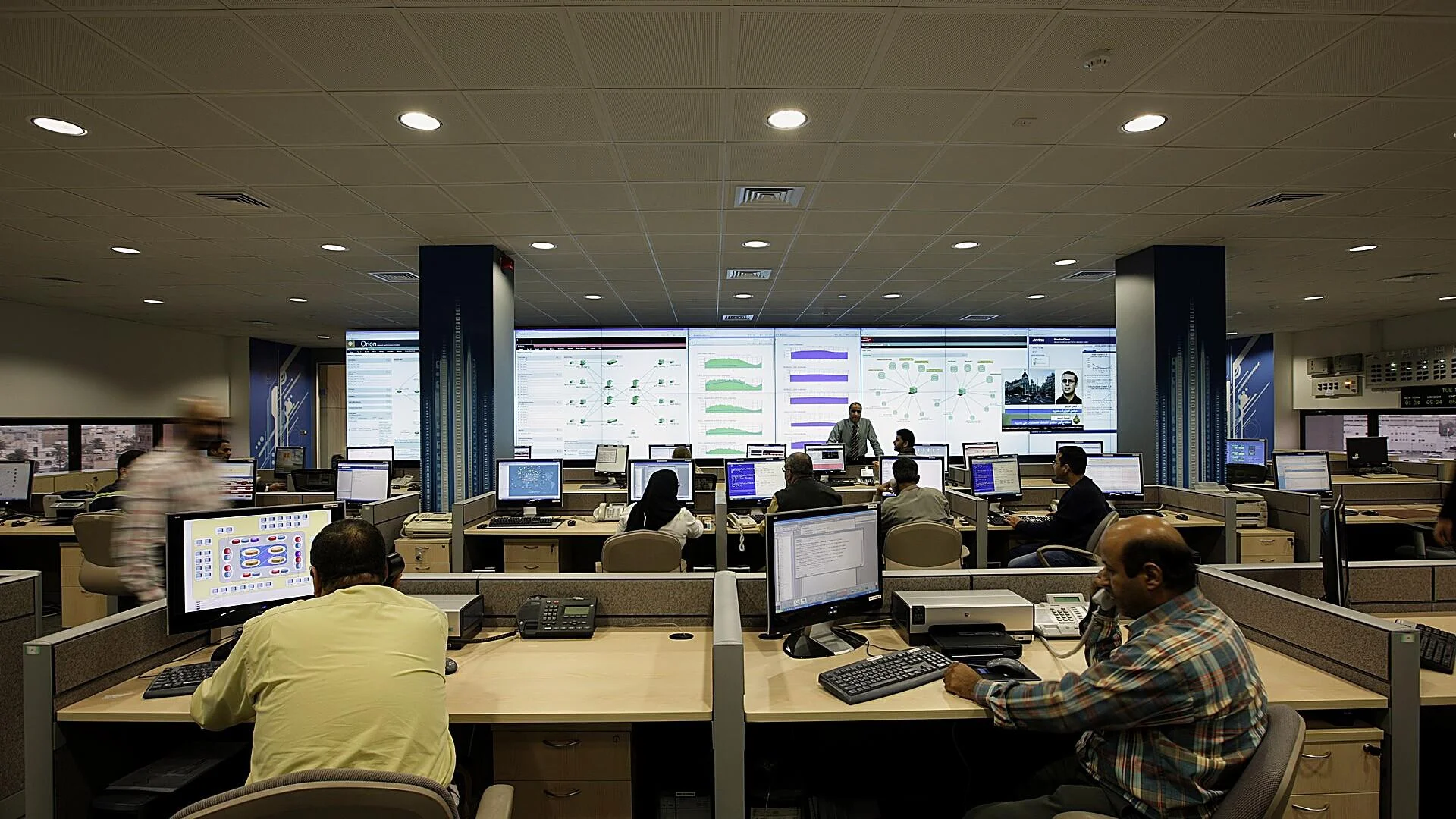
Photo: Masdestructive, CC BY-SA 3.0, via Wikimedia Commons. Batelco's network operations center (NOC): administrators at the consoles from which the infrastructure is run — file photo.
vCenter Server is not one more application on the network. It is the console from which administrators create, move, snapshot and delete the virtual machines that run a modern company — in many organizations, effectively all of them. A session as [email protected] is the master key to that estate: whoever holds it does not need to break into a hundred servers, because the hundred servers already answer to it. That is the seat Armory Castle has been taking, quietly, since the beginning of September.
The side door: a key handed over by the directory itself
The flaw, catalogued as CVE-2026-123890 with a severity of CVSS 9.8, lives in the VMware Directory Service (vmdir), the component that decides who is who inside vCenter. As Broadcom's advisory and the subsequent analyses describe it, the bug is an authentication bypass: an attacker with network access to the vCenter server can reach vmdir over its DCE/RPC interface on port 2012 and trigger the disclosure of the SRP-6a session key. With that key, the attacker completes the login ceremony as if they were the legitimate administrator — and the system opens a session as [email protected]. No password is guessed, stolen or phished. The directory itself hands over the means to walk in.
CISA's catalog entry classifies the weakness as an authentication bypass through an alternate path or channel (CWE-288), which is a precise way of describing the insult: the front door's locks were never picked, because a service entrance existed that the locks did not cover. Any organization exposing that interface to an untrusted network segment was, in practice, offering the master key to anyone who knocked in the right protocol.
The fix — and the map of who is exposed
Broadcom's advisory VMSA-2026-0009, published November 19, closes the flaw in VMware Cloud Foundation and vSphere Foundation 9.1.1.0200 and 9.0.2.0200, in vCenter Server 8.0 U3m, and in VCF 5.x through the 5.2.5 release. For vCenter 7.0, the fix exists only under extended support — a detail that will matter in the many estates still running it — and versions 6.5 and 6.7 are presumed affected, long past the end of their support. There is no workaround: the vendor's answer is the update, full stop. ESX hosts are not directly affected; the vulnerable seat is the vCenter that manages them, which is precisely the seat worth taking.
Washington's clock: three days
On November 20, CISA added CVE-2026-123890 to its Known Exploited Vulnerabilities catalog — the federal list reserved for flaws that are not theoretical but observed in real attacks — with a remediation deadline of November 23 for federal civilian agencies. The entry also flags the flaw for forensic triage under the current binding operational directive: agencies are not merely told to patch, but to examine whether the flaw was used against them. Three days, over a weekend, for the most sensitive console in the building: the calendar itself is a measure of how seriously the government reads the GTIG report.
The hunters who were already inside
The attribution comes from the Google Threat Intelligence Group and Mandiant, whose analysis of November 20 ties the exploitation to Armory Castle, the actor previously tracked as UNC5221, with a China nexus. This is not a smash-and-grab crew: the campaign ran as a zero-day from early September, weeks before any public description of the flaw existed, which means the group held the bug privately and spent it carefully. The tooling GTIG documents includes BONESAW and SAWSNAKE, the latter associated with Golden SAML — forged identity tokens that let an intruder keep presenting themselves as a trusted user. That detail decides what incident response looks like: an actor equipped to forge the identity layer is not necessarily evicted when the password changes or the patch lands.
The second door in the same wall
There is a pattern here that should worry every vSphere administrator. This is the second critical authentication failure in vmdir this year: the previous one, CVE-2026-59309, was disclosed on July 29. Twice in a matter of months, the component that guards the identity of the entire virtual estate has been the component that failed. Attackers read the same advisories defenders do, and the lesson they draw is economical: the directory service of the virtualization platform is where the keys live, and it rewards study. The concentration of power that makes vCenter convenient — one console, one administrator, everything — is the same concentration that makes its authentication bugs catastrophic.
Patching closes the door; it does not evict anyone
The work for defenders therefore splits in two. The first half is mechanical: apply the fixed versions now, prioritize any vCenter reachable from untrusted networks, and treat the 7.0 and 6.x estates as emergencies rather than migration projects. The second half is forensic, and it is the half that decides whether this story ends this week or next year: the exploitation window opened in early September, so the honest question for every estate is not "are we patched?" but "who has been signing in as administrator since September, and what did those sessions do?" Authentication logs, directory changes, new accounts and federation settings all belong in that review — the review CISA's triage requirement is pointing at.
A master key that answers to a network packet is a design failure; a master key that was quietly copied for two months is an incident. Most organizations will spend this weekend on the first problem. The ones that understand the story will spend it on the second.
Published on Sunday, November 22, 2026.
𝐆𝐄𝐓 𝐅𝐑𝐄𝐄 𝐅𝐔𝐋𝐋 𝐌𝐀𝐆𝐀𝐙𝐈𝐍𝐄 𝐀𝐓 thebuyerspulse.com
Sources
- Broadcom, security advisory VMSA-2026-0009 (November 19, 2026): CVE-2026-123890, authentication bypass in VMware Directory Service (vmdir) via DCE/RPC; fixed versions for VCF/vSphere Foundation 9.1.1.0200 and 9.0.2.0200, vCenter 8.0 U3m and VCF 5.x (5.2.5); vCenter 7.0 under extended support; 6.5/6.7 presumed affected; no workaround; ESX not directly affected.
- CISA, Known Exploited Vulnerabilities catalog (catalog version 2026.11.20): CVE-2026-123890 added November 20, 2026, federal remediation due date November 23, 2026; CWE-288; forensic triage flagged, with the Broadcom advisory as reference.
- Google Threat Intelligence Group / Mandiant (analysis of November 20, 2026): exploitation as a zero-day since early September 2026 by Armory Castle (formerly UNC5221), China nexus; tooling BONESAW and SAWSNAKE (Golden SAML).
- The Hacker News (November 19 and 20, 2026); Censys and SOCRadar analyses of the exposure; New York State ITS advisory 2026-140.