As much memory as Samsung: Terafab's reported plan to build a million wafers a month, according to Nikkei
The number reached the industry the way the industry's biggest numbers increasingly do: not in a press release, but in a purchasing meeting. According to a November 9 report by Nikkei, Terafab — the chip venture Tesla and SpaceX are building in Grimes County, Texas — has informally told semiconductor equipment makers this fall that it aims to produce one million silicon wafers a month from 2032. Some 700,000 of those wafers, according to the report, would be memory chips. That is roughly the entire estimated DRAM capacity of Samsung Electronics, the largest memory maker on Earth, matched by a single site run by a car company and a rocket company. Neither Tesla nor SpaceX has confirmed or commented on the plan.
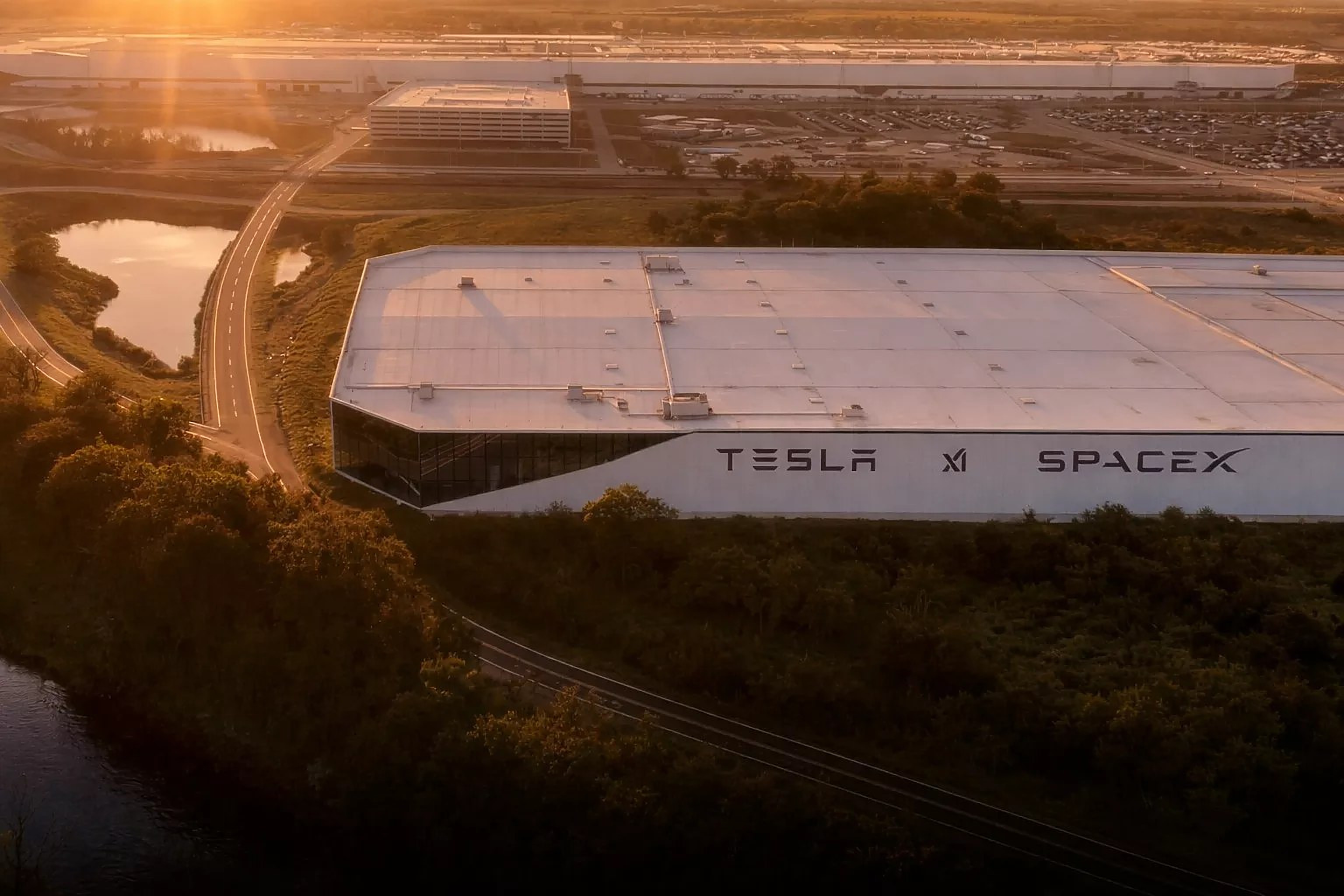
Illustration: official render published by the Terafab project (Tesla / SpaceX), March 2026 announcement visual. The facility is not built; this is a visualization, not a photograph.
Start with what kind of document this is, because it decides how much weight the numbers can bear. There is no Terafab press release with a wafer count in it. There is no Tesla or SpaceX statement confirming a production target. What exists, according to Nikkei — and echoed in parallel reporting by The Elec and Jiji Press — is a plan communicated informally this fall to the companies that sell the machines a fab runs on, followed in early November by a visit from Terafab procurement executives to Japan to coordinate orders and delivery schedules. In its own filings, SpaceX has said that Terafab's specific timeline, phases and capital spending are still under negotiation and not yet defined. Everything that follows is the plan as reported — attributed, because attribution is what the evidence supports.
A fab that is mostly a memory factory
The composition of the reported target says more than its size. Of the million monthly wafers from 2032, roughly 700,000 would be memory and more than 300,000 logic, according to Nikkei. On a wafer basis, that makes Terafab primarily a memory factory with a logic line attached — the opposite of how the industry usually builds. Memory is the business of three companies: Samsung, SK hynix and Micron, who between them supply essentially all of the world's DRAM and the high-bandwidth memory (HBM) stacks that AI accelerators cannot run without. The reported memory volume alone would sit at the scale of Samsung's whole estimated DRAM operation — 650,000 to 700,000 wafers a month, a figure that comes from third-party industry estimates tracked by TrendForce, not from Samsung itself, and that Samsung built over decades.
The logic share is not small either. More than 300,000 wafers a month of computing silicon would put Terafab in territory no single customer fab has occupied, and the total target is roughly forty times the 25,000 wafers a month planned at Rapidus, the state-backed venture Japan is building in Chitose, Hokkaido, to re-enter advanced chipmaking. Numbers at this scale are normally announced with a head of government's signature on a subsidy package. This one surfaced because the buyers of lithography and etch tools started comparing notes.
The suppliers got the schedule before the public did
The most concrete part of the reporting is not the 2032 target but the calendar pressure underneath it. Elon Musk said last month that he wants volume production to begin in the second half of 2028. Terafab's procurement team visited Japan earlier this month and, according to Nikkei, asked several equipment makers for deliveries within a matter of months — a timeline one manufacturer described to the newspaper as unreasonable, while saying the company would try to comply. Suppliers privately express caution: the requested schedules are tight, and the yield engineering Terafab needs is unproven. Running advanced HBM and sub-3-nanometre logic under one roof is among the hardest manufacturing problems in the industry, and it consumes capital at a rate measured in tens of billions of dollars.
The supporting cast, as reported, is a map of where the know-how actually lives. Intel is participating with manufacturing technology — its Intel 14A process for the logic chips, according to the reports. TSMC's chairman and CEO, C. C. Wei, said last month that the two sides are in talks about using Terafab's production facilities — a conversation about capacity, not an agreement. And in October, Douglas Lefever, the CEO of Japanese test-equipment maker Advantest, told his earnings call that Terafab was moving from the conceptual stage into implementation and could become significant business, without offering details. Musk has also said publicly that even if existing suppliers such as Samsung and TSMC expand, they will struggle to produce the volumes he will need — which is, in one sentence, the entire argument for building Terafab at all.
Why memory is the argument
The logic of the project is the logic of the current AI build-out, where the scarce resource has quietly changed. The industry spent three years treating advanced logic — the GPU, the AI accelerator — as the bottleneck, and it was. But every accelerator ships with memory attached, and the HBM stacks and DRAM that feed it are made by three suppliers whose capacity is booked years out: SK hynix has said its DRAM and HBM output is effectively sold forward deep into the decade. A company that plans to deploy AI compute at the scale Musk describes — in cars, in humanoid robots, in orbit — and that buys its memory on the open market is a price-taker at the worst possible table. Terafab, as reported, is an attempt to stop being one: to own the two inputs, logic and memory, under a single roof.
That is also what makes the reported plan different from a normal gigafactory announcement. Tesla and SpaceX are not proposing to assemble somebody else's chips. They are proposing to enter the most concentrated, capital-intensive layer of the entire technology stack — memory fabrication — at a scale that would match its largest incumbent, from a standing start, in rural Texas. The ambition is the story. Whether it survives contact with yield curves, equipment lead times and the industry's memory cycle is a question the suppliers in Japan are now pricing in private.
The county, the lawsuit and the sealed file
The local record adds a second, quieter tension to the story. The main Terafab site sits in Grimes County, Texas, with a first phase estimated at US$16.8 billion. Residents have raised concerns about water, power and land use — the three inputs a fab consumes in industrial quantities. And in September, SpaceX sued to keep its tax abatement application, and records of its negotiations with county officials, sealed, after the Texas Attorney General's office said in July that the records should be released. The result is an unusual information gap: the most detailed production figures for the largest chip project in America have emerged through what the company told equipment makers in Japan, while the application filed with its own county remains under court seal.
How to hold this story
The honest way to hold it is in two parts. The direction is not in doubt: Terafab exists, it is hiring and ordering, its owner has said on the record that supplier capacity will not meet his demand, and the heads of Advantest and TSMC are discussing it by name on earnings calls and in public remarks. The scale is what remains reported rather than confirmed. A million wafers a month, 700,000 of them memory, production in the second half of 2028 and full scale in 2032: every one of those numbers traces to a single Nikkei report about what suppliers were told, and the companies at the center of it have chosen not to comment. If the plan holds even halfway, the memory industry gains a fourth power built by two companies that have never made a memory chip. If it doesn't, the reporting will still have told the truth about something real: the demand at the top of the AI stack is now large enough that its biggest customer would rather build Samsung's equal than keep standing in Samsung's line.
The earliest observable test is already on the calendar. Equipment deliveries on the compressed Japanese schedule would be the first physical signal that the 2028 date can hold; a court order releasing the Grimes County abatement file would be the first documentary one. Until then, the million-wafer fab is a plan told to the people who sell the machines — reported here as exactly that.
What the reported plan would change
- Memory supply: a fourth volume producer of DRAM/HBM would loosen the three-supplier structure that sets prices and allocation for the whole AI industry.
- Vertical integration: Tesla and SpaceX would hold both logic and memory inputs for their AI compute — cars, robots and orbital systems — instead of buying both at market prices.
- Supplier order books: equipment makers in Japan, Korea and the U.S. are being asked for deliveries within months, years ahead of the 2032 target — multi-billion-dollar orders if the schedule holds.
What to watch
- Nothing is confirmed: neither Tesla nor SpaceX has commented on the Nikkei report, and SpaceX filings describe Terafab's timeline, phases and spending as still under negotiation and undefined.
- The 2028 volume target precedes the 2032 scale target by years, and suppliers privately doubt the delivery schedules and Terafab's unproven yield engineering for advanced HBM and sub-3nm logic.
- The public terms are sealed: the Grimes County tax abatement file is under litigation, local opposition cites water, power and land, and the Samsung comparison rests on third-party estimates, not Samsung disclosures.
The file
The reported plan
| Field | Detail |
| Source | Nikkei, November 9, 2026: plan informally communicated to equipment makers this fall; parallel reporting by The Elec and Jiji Press |
| Companies | Terafab — the Tesla and SpaceX chip venture (with xAI in the project's branding) |
| Site | Grimes County, Texas (main site); research fab in Austin, per reports |
| Target (2032) | 1 million silicon wafers a month from 2032: ~700,000 memory, >300,000 logic — according to the report |
| Interim target | Volume production in the second half of 2028, as stated by Elon Musk last month |
| Confirmation status | NOT confirmed — neither Tesla nor SpaceX has commented; SpaceX filings call timeline, phases and capex still under negotiation |
The comparison
| Field | Detail |
| Samsung Electronics | Estimated total DRAM capacity of 650,000–700,000 wafers a month — third-party estimates (TrendForce), not a Samsung disclosure |
| Rapidus (Japan) | Planned 25,000 wafers a month at Chitose, Hokkaido — the reported Terafab target is ~40× that |
| The market | DRAM and HBM supply concentrated in Samsung, SK hynix and Micron; SK hynix has said its output is sold forward for years |
The partners, as reported
| Field | Detail |
| Intel | Participating with manufacturing technology; logic chips expected to use the Intel 14A process (per reports) |
| TSMC | In talks about using Terafab capacity, per chairman C. C. Wei's remarks last month — a conversation, not an agreement |
| Advantest | CEO Douglas Lefever, October earnings call: Terafab moving from concept to implementation; no details given |
| Suppliers | Procurement officials visited Japan in early November; some makers asked for deliveries within months (Nikkei) |
Sources
- Nikkei — November 9, 2026: Terafab informally told equipment makers this fall of a target of 1 million wafers a month from 2032 (~700,000 memory, >300,000 logic); procurement officials visited Japan in early November and asked some suppliers for deliveries within months; a manufacturer called the schedule unreasonable but said it would try to comply. Samsung comparison in the same reporting: estimated DRAM capacity of 650,000–700,000 wafers a month (third-party estimates, via TrendForce); ~40× Rapidus' planned 25,000 a month.
- The Elec and Jiji Press — parallel reporting on the Terafab equipment orders and the 2032 target, cited alongside Nikkei in regional coverage.
- Business Insider (via press coverage) — Grimes County phase 1 estimated at US$16.8 billion; SpaceX sued in September to keep its tax abatement application sealed; the Texas Attorney General's office said in July the records should be released; local concerns over water, power and land.
- Public statements — Elon Musk, October 2026: volume production targeted for the second half of 2028; existing suppliers such as Samsung and TSMC would struggle to meet his volumes. TSMC chairman C. C. Wei, last month: talks about using Terafab's production facilities. Advantest CEO Douglas Lefever, October earnings call: Terafab moving from concept to implementation, no details.
- SpaceX filings, as reported: Terafab's specific timeline, phases and capital spending are still under negotiation and not yet defined. Neither Tesla nor SpaceX has confirmed or commented on the Nikkei report.
- Illustration: official render of the planned Terafab facility published by the project (March 2026 announcement visual, with the Tesla, xAI and SpaceX wordmarks on the facade). It is a visualization of an unbuilt facility — not a photograph. Master 1536 × 1024 px, served at or below native size.