
The ship comes home: on Friday, SpaceX will try to catch Starship itself with the tower for the first time
The photograph shows the whole ambition in one frame: a Starship stacked on its booster, held by the tower at Starbase, at sunrise over the Gulf of Mexico. Until now, that tower's arms have only ever caught the bottom half of the rocket. On Friday, if the regulatory approval that is still outstanding comes through, SpaceX intends to use them to catch the top half too — the ship itself, falling back from orbit after a flight of more than 22 hours. It would be the first time any orbital rocket has come home in one piece, both stages caught by the machine that launched them.
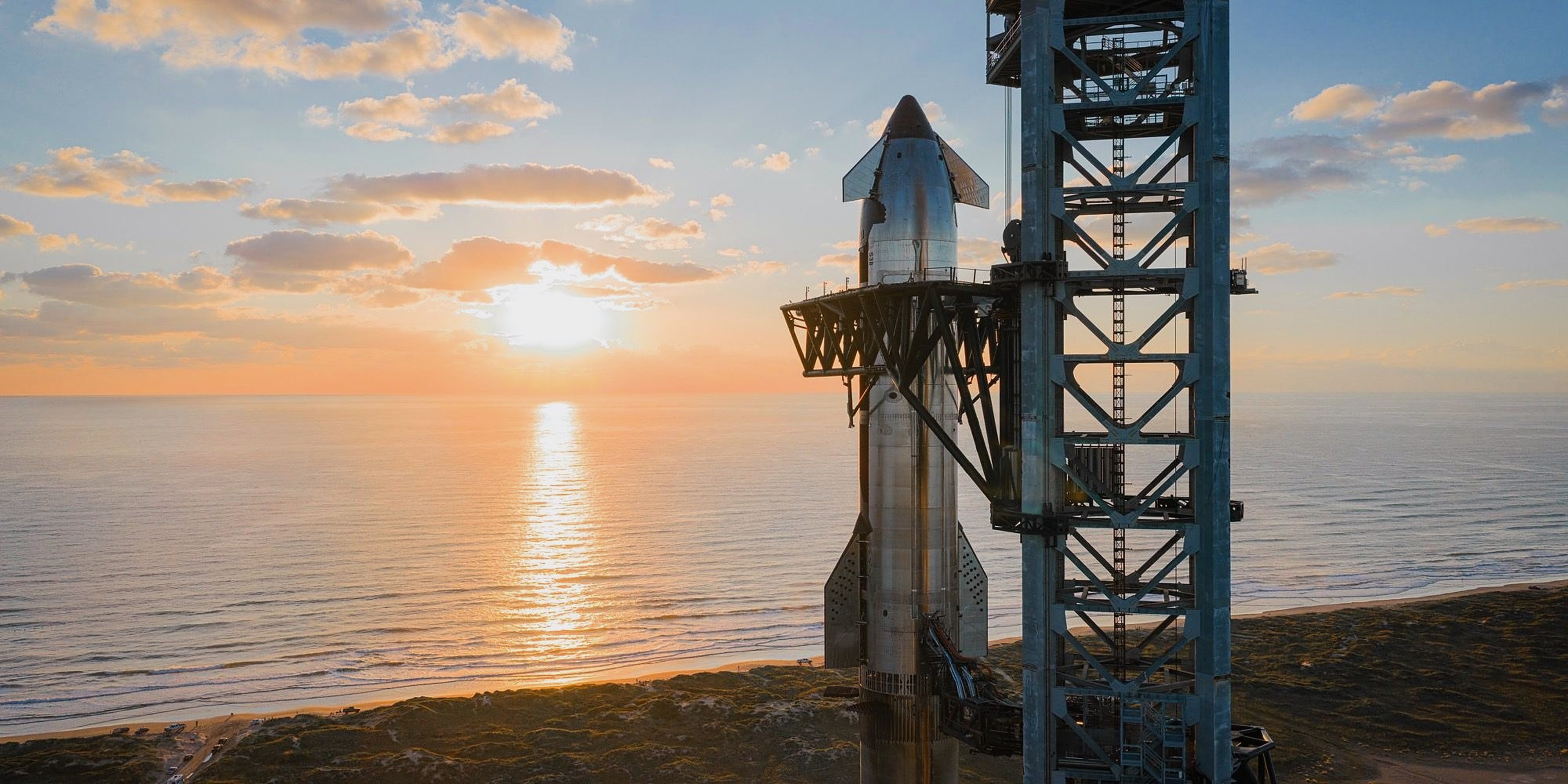
Photo: SpaceX (official image).
Start with what has already happened, because Friday's attempt only makes sense against it. The tower at Starbase — the Mechazilla, with its two mechanical arms — has caught a returning Super Heavy booster three times. All three were first-generation V1 boosters, and two of them later flew again: the catch is not a stunt anymore, it is a procedure with a track record. What the tower has never done is catch the ship. Every Starship upper stage that has flown has ended its flight the old way, in a controlled splashdown in the ocean.
Flight 15 is planned to change both halves of that sentence in a single mission. It would be the first return and catch attempt for a booster of the new V3 generation — and, a day later, the first return and catch attempt for a ship, ever. If both work, SpaceX says, it will mark the first full recovery of an orbital launch system: a rocket that goes to orbit and comes back entire, to the same tower, ready in principle to fly again.
The booster goes first
The booster flies the profile that is becoming familiar. Its primary objectives, in SpaceX's own list, are a successful launch, ascent, stage separation, boostback burn, and return to the launch site for catch. Minutes after liftoff, if the flight goes to plan, the V3 booster arcs back toward Starbase and settles between the tower arms — a maneuver the V1 boosters have already performed three times.
The word to hold onto is V3. This is a new generation of the booster, and new generations of this rocket have a history of teaching their lessons in public. The catch itself may be a demonstrated procedure, but Friday would be the first time it is asked of this hardware. The preparations are visible: according to SpaceX's posts on X, the booster flying this mission is Booster 22, moved to the launch pad on November 10 for final catch testing, and the ship, named in late October, is Ship 42.
The ship takes the long way home
The ship's flight is the longer story — literally. After separation it climbs to an orbit of about 275 kilometers (roughly 171 miles) and stays there: approximately 14 orbits of the Earth across a flight of more than 22 hours. On the way, it has work to do. Its primary objectives include the deployment of 26 Starlink V3 satellites, each of which adds a terabit of capacity to the constellation — all 26 together equal about ten launches of Starlink V2 Mini satellites on Falcon 9, the workhorse rocket Starship is meant to relieve.
Three of those satellites carry a suite of cameras built to scan the ship's heatshield and send the imagery down to operators. That is not decoration. The heatshield is the part of the ship that has to survive the return, and SpaceX has been reading its condition in flight on previous missions to judge whether a ship is ready to come back to the tower. Flight 15's shield carries the improvements made after Flight 14: additional retention mechanisms on tiles in the areas judged at highest risk of coming off during ascent, work on the paths that let plasma get behind the tiles, and a curved tile design across much of the shield that reduces heating in the gaps between tiles.
Then comes the part that has never been done. A booster returns from the edge of the sky, a few minutes from home. The ship returns from orbit — from a full day of circling the planet at orbital speed, through a reentry that turns that speed into heat against its shield — and then has to fly the same final act as the booster: flip upright, light its landing burn, and hold itself steady between the arms of the tower while they close. No ship has ever attempted it. Until now, the maneuver has only ever been performed over water, ending in the ocean.
The condition attached
SpaceX has written the escape clause into the plan in plain language, and it is worth reading exactly: the ship will only execute a return to the launch site if the flight control team has ensured that the vehicle systems critical for reentry maneuvers, the final landing burn and the tower approach are healthy. If they are not — if the shield reads wrong, if anything in the chain is off — the flight profile offers other endings: insertion into a passively safe suborbital trajectory, or a safe deorbit at one of several pre-determined areas over the ocean. The ocean splashdown, the ending of every ship flight so far, remains on the table until very late in the mission.
There is also the paperwork. The mission is planned for Friday, November 13, in a 75-minute window that opens at 4:45 p.m. Central time — and it is, in SpaceX's words, pending regulatory approval. In a safety update published on November 7, SpaceX said the conditions for the ship's return to the launch site have been approved by the FAA; the launch authorization itself had not been announced as granted when the mission page was last updated. SpaceX also warns, as it always does, that the schedule is dynamic and likely to change. A preview of this flight is a preview of an intention, with the signatures still outstanding.
Why the catch matters
It is easy to file the tower catch as spectacle, and it is spectacular. But the arithmetic underneath it is the reason SpaceX built the tower at all. A booster that lands in the ocean is a booster you build again; a booster — and a ship — caught at the pad is hardware that stays in the fleet. Starship's entire economic case rests on that difference: this is the vehicle meant to fly often enough, and carry enough, that deploying 26 heavy Starlink satellites at a time becomes routine rather than a campaign. Catching one stage made that case plausible. Catching both is what would make it a system: for the first time, a complete orbital rocket, home in one piece.
That is also why the conditions matter as much as the attempt. SpaceX is not promising a catch; it is promising to try one if — and only if — the ship earns it across 22 hours of flight. The booster catch, three for three so far with an older generation, gets its hardest test yet in the first minutes. The ship gets a day in orbit to prove it should be allowed to come home. Both verdicts will be delivered by the same tower in the photograph.
What happens on Friday
The window opens at 4:45 p.m. Central on Friday, November 13 — 2:45 p.m. on the Pacific coast — and runs for 75 minutes. SpaceX's live webcast begins about 30 minutes before liftoff, on its site and on X, and coverage is planned to continue through the ship catch, with hours of live views from the ship as it orbits, powered by Starlink. If the flight lifts off near the opening of the window and flies its full profile, the booster's moment comes within minutes — and the ship's return falls on Saturday afternoon, Texas time. Two catches, one tower, a day apart: the first act on Friday evening, the second, if the ship is cleared to try, the following day.
Everything about Flight 15 is a first wearing the clothes of a routine: a new booster generation flying a proven maneuver, an old splashdown waiting in reserve for a maneuver nobody has ever tried. By Saturday, one way or another, the picture will be complete — either a ship hanging in the arms of the tower that launched it, or another quiet splashdown in an empty stretch of ocean, and a lesson filed for Flight 16.
What has to go right
- The booster must repeat a proven maneuver on unproven hardware: the first catch ever asked of a V3 booster.
- The ship's heatshield — strengthened after Flight 14 — must come through reentry in a condition the cameras and the data can certify.
- Across more than 22 hours and some 14 orbits, every system the return depends on must still read healthy when the decision comes.
What to watch
- The launch is still pending regulatory approval, and SpaceX warns the schedule is dynamic and likely to change.
- The ship's return is conditional: if its systems do not check out, SpaceX will wave it off to a safe deorbit and an ocean splashdown.
- No ship has ever been caught: the final approach has only ever been rehearsed over water.
The file
The mission
| Field | Detail |
| Target date | Friday, November 13, 2026 — as soon as that date, pending regulatory approval |
| Window | 75 minutes, opening 4:45 p.m. CT (2:45 p.m. PT), Starbase, Texas — Pad 2 |
| Objective | First flight planned to return both Starship and Super Heavy to the launch site for catch |
| Broadcast | Live webcast from ~30 minutes before liftoff; coverage planned through the ship catch |
The vehicles
| Field | Detail |
| Booster | Super Heavy V3 — identified by SpaceX on X as Booster 22; first return and catch attempt for a V3 |
| Ship | Starship upper stage — identified by SpaceX on X as Ship 42; heatshield carries the Flight 14 improvements |
| Payload | 26 Starlink V3 satellites; three carry cameras to scan the ship's heatshield |
The record so far
| Field | Detail |
| Booster catches | 3 — all V1 boosters on earlier flight tests; two later flew again |
| Ship catches | 0 — every ship flight so far has ended in a controlled ocean splashdown |
| Ship return conditions | FAA-approved, per SpaceX's November 7 safety update; return only if critical systems are healthy |
Sources
- SpaceX — Starship Flight 15 mission page (spacex.com/launches/starship-flight-15): target date and window, both stages' objectives, the ship's return conditions, the Starlink V3 deployment and the heatshield changes.
- SpaceX — update on the testing, mission design and safety measures for the first planned Starship catch (November 7, 2026): the ship's return-to-launch-site conditions are FAA-approved; the launch itself remains pending regulatory approval.
- SpaceX on X — the flight's vehicles identified as Booster 22 and Ship 42 (posts of October 28 and November 10, 2026).
- Photo: SpaceX — official image of a Starship stacked at the Starbase launch tower, served via Space Explored. Production note: it is a file image of the tower and a stacked Starship, not of Flight 15's own vehicles (Booster 22 and Ship 42).