
Every pair of glasses gets inspected: South Korea's exam day declares war on AI smart glasses
This Thursday, at some 1,300 test centers across South Korea, the most consequential morning in a Korean student's life begins with a new ritual: before the College Scholastic Ability Test starts, every pair of eyeglasses worn into the building gets inspected. Not just the smart ones — all of them, because the smart ones are built to look exactly like the ordinary ones. The exam that stops a country has added a checkpoint, and the checkpoint is on your face.
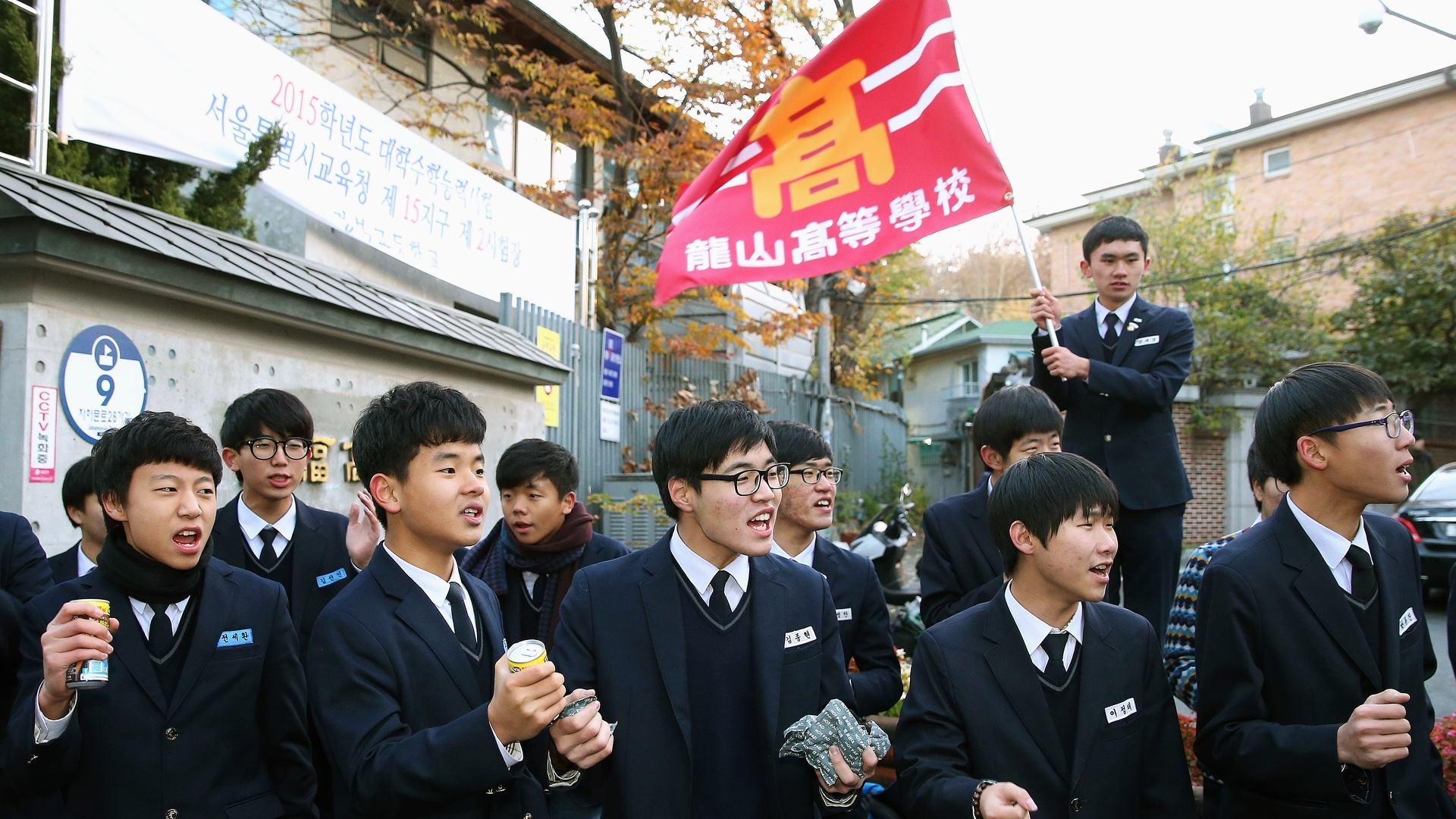
Photo: Korean Culture and Information Service (KOCIS), Republic of Korea, via Wikimedia Commons (CC BY-SA 2.0).
South Korea will inspect the eyeglasses of every student who sits the College Scholastic Ability Test this week, in a direct attempt to stop cheating with AI-powered smart glasses. Education Minister Choi Kyo-jin announced the measure at a parliamentary hearing on Monday, Reuters reported, days before the exam — known in Korean as the Suneung — is held on Thursday, November 19.
The CSAT is the national university entrance examination, the single day that decides admissions across the country, and it is already one of the most tightly policed events in Korean public life. Smart devices have been banned from it since July: phones and wearables were contraband long before this week. Eyeglasses were the exception, for the most obvious of reasons — a large share of the test-takers need them simply to read the questions on the page.
That exception is what closes on Thursday. A modern pair of smart glasses carries a camera, a microphone and an AI assistant inside a frame designed to pass as ordinary eyewear. There is no reliable way to pick the smart pair out of a line of students by looking at it — so the ministry has stopped trying to pick. It will inspect the category itself: every pair, on every face, at the door.
Four students got there first
The ministry is not legislating against a hypothetical. The measure follows a fraud scandal in the examination for certified public accountants and a ministry investigation that confirmed four cases of cheating with smart glasses in school exams this year, KBS reported on November 9. Four cases are enough: in an exam taken under identical conditions by an entire country's cohort, a tool that photographs a question and whispers back an answer is not an edge case — it is a breach in the wall the whole system stands on.
That is why the response is built like an operation rather than a reminder. Rules against smart devices already existed; what did not exist was a way to enforce them against a device that sits on the face and looks like a medical necessity.
A device proctor in every building
Each of the roughly 1,300 test centers will have a proctor dedicated specifically to devices, backed by a direct hotline to the Education Ministry's control room, so that a suspicious pair of glasses found at any door in the country can be escalated in minutes. Prime Minister Han Seong-sook has announced an emergency team for the exam, a signal of how seriously the government is taking a threat that, a few years ago, would have read as science fiction.
The design of the measure is the story. Previous exam contraband — a phone, a smartwatch, an earpiece — could be confiscated at the door because nobody needs it to sit the test. Glasses cannot be confiscated from a student who cannot read without them. So the ban becomes an inspection: the state does not take the device away; it examines it, pair by pair, and lets it through.
Annulment now, a decade on the table
The penalties match the machinery. A student caught cheating faces annulment of their results and a ban from sitting the exam the following year — in CSAT terms, the loss of an entire year of a young life. The ministry wants to go much further: it is seeking to extend the ban to between three and ten years, a punishment that would effectively end a student's conventional path to university.
And the inspection regime is only the first layer. For next year's exam, the ministry is studying radio-signal detectors — equipment that would listen for the transmissions a connected pair of glasses cannot hide, however ordinary it looks. The visual check at the door is this year's answer; the electronic one is already being designed.
Why glasses break the rulebook
Every previous wave of exam technology could be handled with a single word: no. No calculators beyond the approved kind, no phones, no wearables. Smart glasses are the first device for which "no" is not available, because the same object is both the cheat's tool and the honest student's eyesight. The ministry's answer — inspect everything — is an admission that the category has merged: there is no longer a visible line between eyewear and electronics, so the line has to be drawn by hand, one student at a time.
The cost of that admission falls on everyone in the line. The student with a plain prescription, who has never asked an AI anything, will hold still for the same inspection as the one the measure was written for. That is not a flaw in the policy; it is the policy. Universality is the only version of the check that works, and the ministry has chosen to say so out loud.
And on December 10, the same glasses go on sale
Three weeks after the exam, the story completes its circle. On December 10, Samsung and Google's Intelligent Eyewear goes on sale in South Korea — AI glasses as a mainstream consumer product, launched into the same country that will have just inspected every pair of glasses at its exam doors. The device category is, at the same moment, contraband at the threshold of the CSAT and the season's flagship launch on the high street.
Both things are true because both are the same fact: glasses have become computers. The exam authorities are simply the first institution forced to act on it at national scale, with a proctor, a hotline and a hand on every frame. On Thursday morning, in the lines outside 1,300 test centers, the smart-glasses era gets its defining ritual — not a product launch, but an inspection.
𝐆𝐄𝐓 𝐅𝐑𝐄𝐄 𝐅𝐔𝐋𝐋 𝐌𝐀𝐆𝐀𝐙𝐈𝐍𝐄 𝐀𝐓 thebuyerspulse.com
Sources
- Reuters (Nov 16, 2026): South Korea will inspect all eyeglasses at this week's College Scholastic Ability Test, announced by Education Minister Choi Kyo-jin at a parliamentary hearing; the proctor dedicated to devices in each of ~1,300 test centers and the direct hotline to the ministry's control room; annulment of results and the one-year ban; the push to extend the ban to 3–10 years; radio-signal detectors under study for next year; the emergency team announced by Prime Minister Han Seong-sook.
- KBS (Nov 9, 2026): the Education Ministry investigation that confirmed four cases of cheating with smart glasses in school exams this year, following the fraud scandal in the certified public accountant examination.
- Photo: Korean Culture and Information Service (KOCIS), Republic of Korea — schoolmates cheering outside Kyungbock High School, Seoul, on the morning of the College Scholastic Ability Test (November 2014), via Wikimedia Commons, CC BY-SA 2.0.