
The network that fixes itself mid-training: Oracle Acceleron rebuilds OCI's AI networking
AI training advances at the speed of its slowest connection: one congested or failed path taxes thousands of synchronized accelerators at once. Oracle's answer, announced October 27 at AI World, is Oracle Acceleron — RDMA that watches congestion, several planes instead of one path, and a collective library that keeps the conversation going when hardware fails.
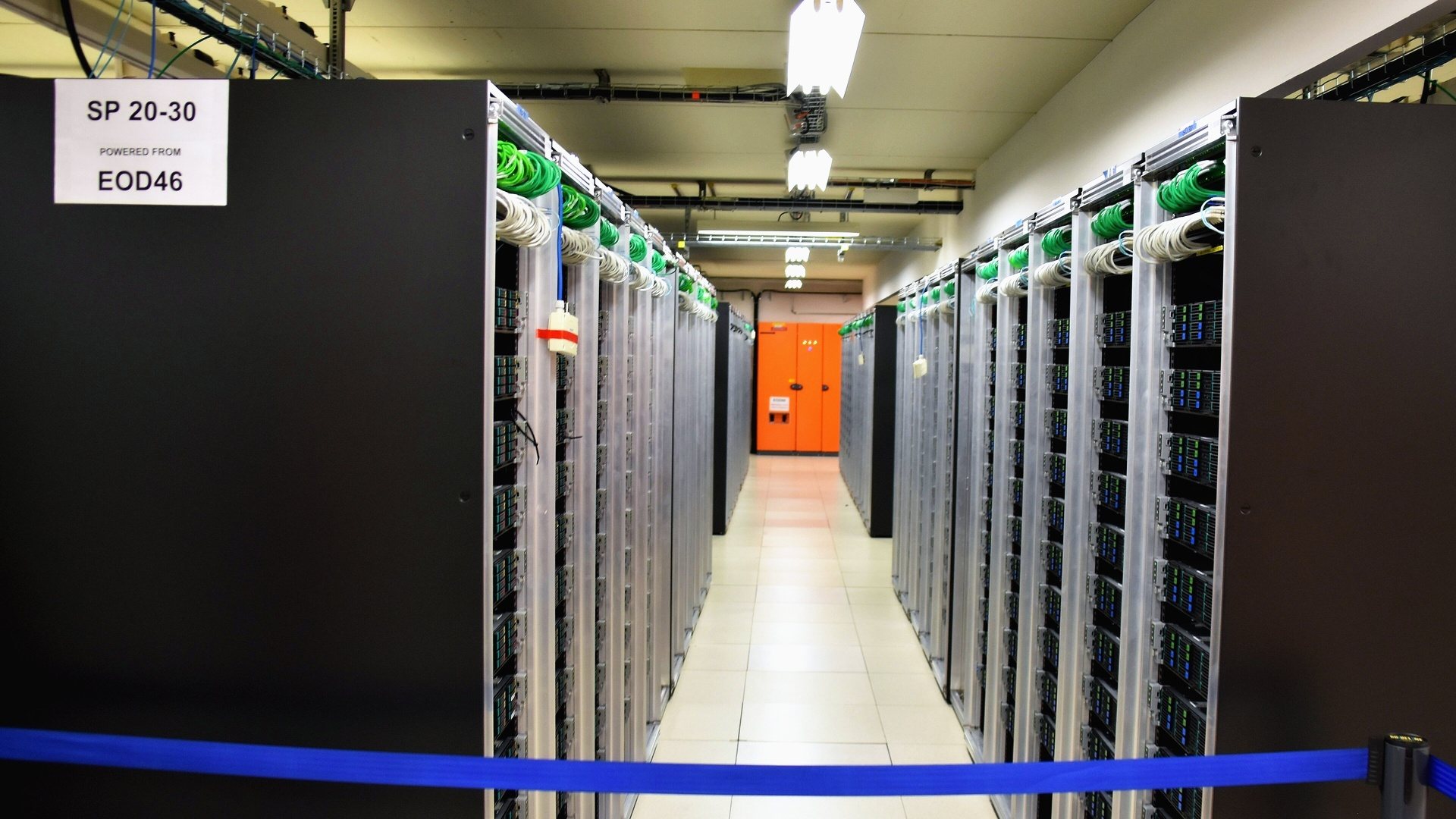
Photo: SimonWaldherr, “CERN Computer Center 02” (September 15, 2019) — CC BY-SA 4.0, via Wikimedia Commons. File photo of the CERN Computer Center; it is NOT an Oracle/OCI facility.
An AI training run is a convoy. Thousands of accelerators work through the same calculation in lockstep, exchange what they have computed, and only then move on to the next step — which means the whole fleet advances at the speed of its slowest connection. One congested path does not slow one machine. It slows all of them, while the most expensive hardware in the building sits idle waiting for data that is stuck in the network. That is the problem Oracle set out to solve on October 27 at Oracle AI World in Las Vegas, when it announced the new capabilities of Oracle Acceleron, the suite of networking and infrastructure technologies inside Oracle Cloud Infrastructure (OCI). The pitch, in one line: a network that notices trouble, reroutes around it and recovers — in the middle of the training run, not after it.

Video: Oracle (official YouTube channel). Embedded through YouTube’s official player; Oracle is a red-rated source for redistribution in this magazine’s legal map, so the video is embedded, never downloaded or re-uploaded.
Why AI training dies on the network
Most cloud networking was designed for traffic that tolerates delay: a web request that arrives a few milliseconds late is a rounding error. Distributed AI training is the opposite. The accelerators in a cluster repeatedly perform collective operations — every participant sends and receives data so the group can agree on the next step — and the operation finishes only when the last participant’s data arrives. Congestion, a dropped link or a failed network card therefore does not degrade the job gracefully; it taxes every step that follows, thousands of times a day.
Pradeep Vincent, Oracle’s executive vice president of Compute and AI Infrastructure for OCI, put it this way in the October 27 announcement: “AI infrastructure can be unforgiving when it comes to network friction. When thousands of accelerators are working together, one congested or failed path can have consequences far beyond a single connection. With Oracle Acceleron, we are building a network that can respond by rerouting traffic, recovering from failures, and helping customers scale securely.”
Acceleron, as Oracle describes it, combines dedicated network fabrics, more direct data paths and a converged network interface card (NIC), with host-level zero-trust routing and multi-planar designs, on a programmable software foundation that unifies networking, storage and security across hardware. The October 27 additions — the subject of this story — are three networking capabilities aimed squarely at the convoy problem. A note on dates, because this magazine prints them straight: the announcement is from October 27, 2026, at Oracle AI World; Oracle later promoted the official explainer video with Vincent, Jag Brar and Joy Ganguly on its social channels on November 9. This is a close reading of that announcement and of Oracle’s technical explanation — not news from today.
1 · High-Performance Fabric: RDMA moves to the front end
The first addition is the Oracle Acceleron High-Performance Fabric, which brings RDMA connectivity — remote direct memory access, the low-latency technique that lets one machine read another’s memory without involving its processor — to OCI’s front-end compute: the network that serves inference, storage and high-performance computing workloads, not just the dedicated back-end network inside training clusters. According to Oracle’s technical explanation, the fabric supports all queue-pair types and RDMA verbs, so existing RDMA applications run unchanged. That compatibility point matters more than it sounds: a faster network that requires customers to rewrite their applications is a migration project, not an upgrade.
The hard part is that the front end is shared. The same fabric carries RDMA traffic and ordinary TCP traffic, and the two do not naturally share fairly: RDMA flows are intolerant of delay, TCP flows are elastic, and a burst of many senders converging on one receiver — the incast pattern — can swamp the path. Oracle’s technical blog explains that the Acceleron SmartNIC solves the sharing problem with hierarchical token buckets for each traffic class: queues within queues, so each class of traffic gets its share and no single class can starve or flood the others.
Congestion control that measures the right delay
The second mechanism is subtler, and it is the detail that best shows what “congestion-aware RDMA” means in practice. A congestion controller has to decide when the fabric — not the destination, not the return path — is actually congested. If it reacts to the wrong signal, it slows senders unnecessarily; if it reacts too late, queues build and the convoy stalls. Oracle explains that Acceleron’s congestion control inside the fabric measures one-way delay: the time traffic takes to travel in one direction. Measuring one-way delay avoids false congestion signals when only the return path is busy — the sender is not punished for congestion its data never met. In the official video, Oracle adds that Acceleron SmartNICs can probe alternate paths and signal senders to slow down when congestion persists: sense, reroute if possible, throttle if necessary.
2 · OCCL: the collective library that keeps working when parts fail
The second announcement is the Oracle Collective Communications Library (OCCL). If the fabric is the road, the collective library is the traffic system for the convoy itself: it manages the collective operations through which accelerators exchange data during training. Oracle says OCCL spreads collective traffic across OCI’s backend multiplanar network — several independent network planes instead of one — and steers traffic toward healthier paths. When links, ports or network cards fail, OCCL helps workloads recover, in Oracle’s wording, “instantaneously”, keeping distributed AI workloads running instead of restarting them.
Specialist technical coverage of Oracle’s explanation describes OCCL as a plug-in at the level of the collective-communications libraries the industry already uses — NCCL and RCCL — which is the same compatibility logic as the fabric’s: the intelligence sits in a layer customers already run, and applications do not have to change to benefit. The design principle is worth naming, because it recurs across the whole announcement: put the resilience inside the infrastructure, and make it transparent to the workload. The training job does not handle the failure. The network already has.
3 · Multiplanar networking reaches the front end — transparently
The third addition, Transparent Front-End Multiplanar Networking, takes the multiplanar idea — multiple independent planes, so no single plane’s failure or congestion is fatal — and brings it to front-end networks. Oracle lists three built-in behaviours: transparent path selection, transparent failover, and transparent congestion control for front-end RDMA traffic. “Transparent” is the operative word three times over: the customer’s traffic gets the benefit of several paths without the customer having to design for several paths.
Read together, the three announcements form one argument at three depths. The fabric gives front-end workloads RDMA speed. The SmartNIC’s queues and one-way-delay control keep that speed honest on a shared network. OCCL keeps the collective conversation alive across a multiplanar back end when hardware fails. And the front end gets the same multiplanar resilience, without new work for the customer. Underneath all of it sit the standing elements of Acceleron that Oracle restated in the announcement: dedicated fabrics, more direct data paths, a converged NIC, and host-level zero-trust routing as part of the security design.
The storage claim — printed with its caution
The same announcement includes expanded NVMe block-storage attachment options across Acceleron bare-metal and virtual-machine shapes, with performance improving “up to 3×”. That figure is Oracle’s, and Oracle publishes no base for it in the announcement — no starting configuration, no workload, no test conditions. This magazine therefore prints it exactly as what it is: a vendor claim, attributed, unverified against any published benchmark. It is not the headline of this story, and readers evaluating OCI for storage-sensitive AI or database work should ask Oracle for the configuration behind the number before treating it as a comparison.
What Oracle has not shown — and what to watch
Three honest limits apply to the whole package. First, this is an announcement, with the vendor’s own future-product disclaimer attached: features, timing and pricing can change at Oracle’s discretion, and the release itself says it is not a commitment to deliver. Second, the mechanisms described here — token-bucket fairness, one-way-delay congestion control, collective-level failover — are explained by Oracle in its blog and video; independent benchmarks of the fabric and of OCCL under real training failures are not part of the announcement, and they are the evidence that will decide whether “recovers instantaneously” is engineering or adjectives. Third, resilience claims are only testable the hard way: what a buyer can do today is ask how failover behaves in their own failure drills, on their own shapes, before the fleet depends on it.
None of that diminishes the direction of travel, which is the real story for enterprise readers. For years, the AI infrastructure race was run on accelerators — who had the most, the newest, the fastest. Acceleron is an argument that the race has moved: at the scale of thousands of synchronized accelerators, the network is no longer plumbing underneath the product. It is the product’s weakest point and, Oracle is betting, its next differentiator — a network expected to notice a bad path, move the traffic, absorb the failure and keep the convoy at speed, all without waking the application up to deal with it.
𝐆𝐄𝐓 𝐅𝐑𝐄𝐄 𝐅𝐔𝐋𝐋 𝐌𝐀𝐆𝐀𝐙𝐈𝐍𝐄 𝐀𝐓 thebuyerspulse.com
Sources
- Oracle, press announcement, Oracle AI World, Las Vegas (October 27, 2026): the Acceleron suite; the Vincent quote; High-Performance Fabric (RDMA on front-end compute); Oracle Collective Communications Library across the backend Multiplanar Network, recovering when links, ports or NICs fail; Transparent Front-End Multiplanar Networking; expanded NVMe block-storage options 'improving performance up to 3x' (Oracle's claim; no base published in the announcement). https://www.oracle.com/middleeast/news/announcement/ai-world-oracle-unveils-new-cloud-networking-innovations-for-ai-2026-10-27/
- Oracle, official video, 'First Principles: Oracle Acceleron Networking for AI at Scale' (Oracle's official YouTube channel, 22:46; promoted by Oracle Cloud on its social channels on November 9, 2026): Pradeep Vincent with Jag Brar and Joy Ganguly — congestion-aware RDMA, hierarchical virtual queues/token buckets, one-way-delay congestion measurement, SmartNIC path probing, OCCL and multiplanar failover. https://www.youtube.com/watch?v=PIK6_KgH1xg
- Oracle OCI technical blog on the Acceleron networking innovations, as explained by Oracle and covered by specialist technical press: the shared front-end problem (RDMA and TCP on one fabric), hierarchical token buckets per traffic class in the Acceleron SmartNIC, one-way-delay congestion control avoiding false signals from a congested return path, and OCCL as a plug-in at the NCCL/RCCL level.
- Photo: SimonWaldherr, 'CERN Computer Center 02' (2019), Wikimedia Commons, CC BY-SA 4.0 — file photo of a data-center network corridor; not an OCI facility. https://commons.wikimedia.org/wiki/File:CERN_Computer_Center_02.jpg