He signs chips for fans. Now 115,000 people have signed to bring Jensen Huang back
The photograph is from April: Jensen Huang, in the leather jacket, signing a computer chip for a Stanford student while others wait their turn with hardware in their hands. This weekend, the signatures ran the other way. An open letter demanding that Nvidia's board reinstate its founder passed 115,000 signatures by Saturday afternoon — 5,965 of them current employees, and Elon Musk's name near the top of the list — three days after the resignation took effect, and two days before the first earnings report in the company's history that Huang will not lead.
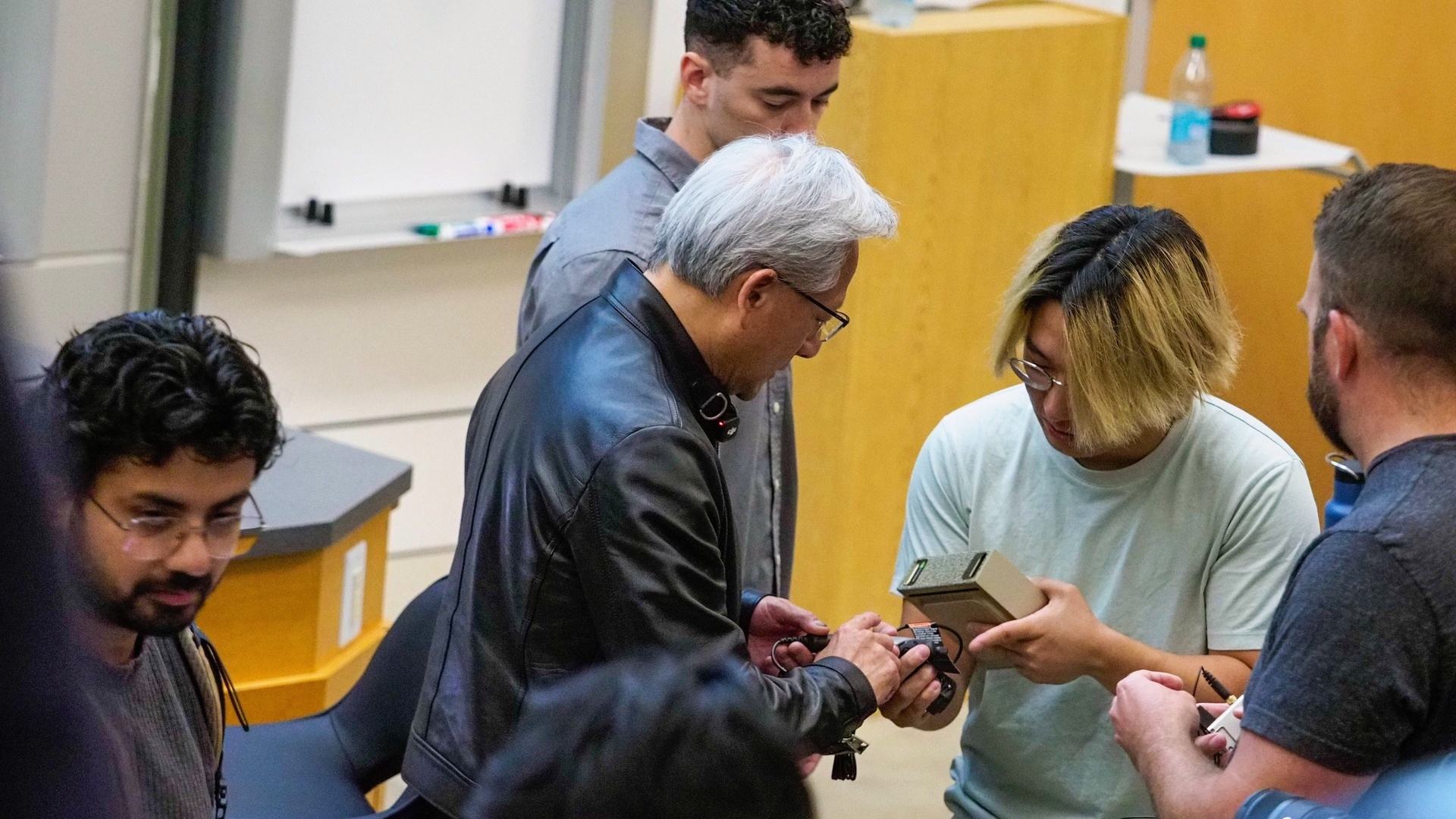
Photo: Anders Eidesvik — CC BY-SA 4.0, via Wikimedia Commons.
Corporate founders are removed quietly, with a thank-you paragraph and a transition plan. What is happening at Nvidia is the opposite of quiet. The campaign at standwithjensen.com — an open letter addressed to the board of directors — became, over a single weekend, the largest public referendum ever held on the leadership of the world's most valuable chip company. TechCrunch reported on Saturday that the petition had attracted more than 115,000 signatures as of that afternoon. By Sunday night, the campaign's own public list ran to 107,474 names, and its counter of self-identified current employees had climbed to 8,189 — 19.50% of a workforce of roughly 42,000. One in five of the people who work at Nvidia has now signed, in public, with their name attached, a letter asking the board to undo its own decision.
Three demands, one sentence
The letter is not a fan page, and it does not ask for the allegations to disappear. Its headline is a sentence of its own: "Thirty-three years deserve an answer." The signers — who describe themselves as current and former employees, partners, shareholders and supporters — state their concern plainly: that Huang "was removed without meaningful due process," possibly without "even a few days to make his case." They concede the limits of what they know: "We do not have access to the Board's private deliberations. We have not been shown evidence substantiating the allegation that the woman at the center of this controversy was a spy. Suspicion or association alone is not a sufficient basis for ending Jensen's leadership."
From that premise, the letter makes three demands. First, reinstate Huang as chief executive while an independent investigation establishes the facts — or, if the board believes his absence is necessary, provide "a specific, evidence-based explanation of why it serves NVIDIA's best interests." Second, guarantee that the investigation is independent and fair: disclose its scope, its independence and its expected timeline, and give Huang "a meaningful opportunity to respond before reaching a final decision." Third, provide a timely public explanation — the concerns, the evidence, and how the interests of employees and shareholders were weighed. The letter's most quoted line is its shortest: "Jensen deserves due process, not mob justice." The campaign notes, on its own page, that the letter is independent and is not endorsed by Nvidia or by Huang.
The names on the list
Petitions become news when the names do. TechCrunch identified the four that turned a website into a headline: Elon Musk, the chief executive of Tesla and SpaceX; Tim Sweeney of Epic Games; Amjad Masad of Replit; and Garry Tan of Y Combinator. The public list kept lengthening through the weekend. Travis Kalanick, the former Uber chief executive now running Atoms, signed with a statement attached: "Jensen is one of the great builders of our time. We cannot starve the future of his innovation and industrial breakthroughs." Shopify's Tobias Lütke signed on Sunday. So did Steve Chen, a co-founder of YouTube; Gavin Baker of Atreides Management; Aidan Gomez of Cohere; David Heinemeier Hansson; and Julien Chaumond of Hugging Face.
The shareholder letters carry their own register. Prince Khaled bin Alwaleed Alsaud of KBW Ventures wrote to the board that removing Huang is "the corporate equivalent of Apple firing Steve Jobs in 1985 — a self-inflicted wound that history proved costly," and argued that a change of this consequence should not have been made without a shareholder vote. Thomas Lee of Fundstrat signed as a supporter with a strategic frame: Huang is "among one of only a handful of people critical to enabling the US to lead AI development," and his departure "creates critical risk for USA's leadership." And the list is not only outsiders. Jim Fan, a director at Nvidia itself, signed as a current employee: "Jensen is the reason I get to do my life's work in robotics." The campaign's own level breakdown counts 26 signers at senior-vice-president or vice-president level, 49 senior directors and 129 directors — self-identified titles, as the site itself cautions, but names and titles published for the board, and for everyone else, to read.
One in five, in public
The number that matters most is not the largest one. A total of 115,000 signatures measures the internet; the employee count measures the company. On Saturday, the site put current-employee signers at 5,965. By Sunday night its counter read 8,189 — 19.50% of approximately 42,000 employees. These are not anonymous clicks: the campaign publishes names, and its signers write in the first person. One senior distinguished engineer: "Jensen is an essential part of NVIDIA, I joined the company with his leadership as one of the main reasons." A senior director of autonomous driving: "Without his unwavering support, the autonomous driving and physical AI industry would suffer from years of setback. Please do humanity and autonomy a favor and bring Jensen back." Another signer kept it to two short sentences: "Nvidia is nothing without its people. We need Jensen back."
The discipline matters here: the site itself states that affiliations are self-reported and not verified, and that each signer speaks for themselves. The counts above are the campaign's own, reported by TechCrunch on Saturday and read directly from the site on Sunday night. Even with that caution, the direction is a fact: the counter rose by more than two thousand employees in roughly a day, during the very weekend the company was preparing its first earnings report without its founder. Public, named dissent by a fifth of the workforce is not a communications problem. For a board that has opened a search for a permanent chief executive, it is an operating condition.
The sequence the letter wants reversed
The timeline is short and brutal. On Sunday, November 8, Huang admitted to his own employees that he had been unfaithful to his wife, and the board announced an independent investigation — the inquiry this magazine has documented in full in its investigation of the Huang file, now run by independent directors with Wachtell, Lipton, Rosen & Katz and led by former federal prosecutor Joon Kim. On Thursday, November 12, Nvidia announced that Huang had resigned as president, chief executive and board member, effective immediately; Colette Kress, the finance chief since 2013, became interim chief executive, and director Harvey Jones became the board's first chair and took charge of the search for a permanent successor. Huang has agreed to testify before Congress, TechCrunch reported, and a closed-door congressional briefing is requested for November 18.
The petition does not dispute the board's right to investigate. It disputes the order of operations. The investigation the board announced has not concluded — the campaign's letter notes that an outside investigation "has been announced but has not yet concluded" — yet the sentence, in the signers' reading, has already been carried out. Their demand is to reverse the sequence: restore the chief executive first, and let the independent process reach its findings with the founder in his chair and able to answer. Whether a board can do that — reinstating a chief executive it accepted the resignation of, mid-investigation, without prejudging the inquiry — is precisely the governance question the letter forces into the open, in earnings week, with the whole industry watching.
The market held its own vote
There were two ballots this week, and they were counted in different currencies. The market's closed on Friday: Nvidia's shares fell 12.7% across the five sessions, erasing about $573 billion of market value — the stock's worst week since April 2025, on the Wall Street Journal's tally — while the S&P 500 rose. The shares closed Friday at $162.85, with the company's market value below $4 trillion for the first time since July 2025. Measured from the record close of $239.24 on October 6, the stock is down roughly 30%. On the day of the resignation itself, the shares opened 13% lower and recovered to close down 4.3% — a session that priced the founder's exit in real time.
Read together, the two votes are not as contradictory as they look. The sellers were pricing key-person risk: a company synonymous with one man, now run by an interim chief executive, under investigation, eight days before earnings. The signers are making the same observation from the other side: if the risk is the man's absence, the remedy they propose is his presence. What neither ballot can price is the finding that has not yet been made. The investigation's conclusion — whenever it lands, and Nvidia has given no timeline — is the only document that can settle what the petition asserts and what the market fears.
Tuesday, then Wednesday
The calendar now does the arguing. On Tuesday, November 17, after the market closes, Nvidia reports its third-quarter results — the first earnings report of the post-Huang era, and the first investor call since the company's 1999 listing that its founder will not lead. Analysts expect revenue of approximately $109.3 billion, according to S&P Global Market Intelligence, against the company's own guidance of $108 billion; Colette Kress, who signed the company's financial statements for more than a decade as chief financial officer, now presents them as its chief executive. On Wednesday, November 18, the requested closed-door congressional briefing would put the founder's file before the House committees that asked for it. Earnings, Congress, and an unfinished investigation, in that order, inside 48 hours.
Into that week lands the letter's third demand: a timely public answer. The board had made no public response to the petition in the coverage available as the weekend closed, and the letter does not set a deadline — but the calendar sets one for it. Every day the counter climbs, the question the signers are asking gets louder in the one forum the board cannot adjourn: the company's own workforce, signing by name. The founder in the photograph signs chips one at a time, for whoever queues up. The reply, this time, is being collected the same way — one name at a time, 115,000 and counting.
What is established
- The count: more than 115,000 signatures by Saturday afternoon (TechCrunch), including 5,965 current employees, 1,108 former employees and 63,063 self-identified shareholders (petition site).
- The demand: reinstatement pending the independent investigation — due process and a public explanation, not the abandonment of the inquiry.
- The counter kept climbing: 8,189 self-identified current employees — 19.50% of ~42,000 staff — on the campaign's own counter by Sunday night.
- The market's week: NVDA −12.7% in five sessions, ≈$573 billion gone, the worst week since April 2025; ≈30% below the October 6 record close.
What to watch
- The board's answer: the letter demands a timely public explanation; none had appeared in the coverage available as the weekend closed.
- Nov 17: earnings after the close — expected revenue ≈$109.3 billion vs. $108 billion guidance (S&P Global); Kress leads her first call.
- Nov 18: the requested closed-door congressional briefing, the day after earnings.
- The employee share: whether the counter passes one in five employees — and whether the board can run a succession search over a public list of dissenters.
The file
The chronology
| Field | Detail |
| Nov 8, 2026 | Huang admits the affair to employees; the board announces an independent investigation (later: Wachtell Lipton, led by Joon Kim) |
| Nov 12, 2026 | Nvidia announces Huang's resignation as president, CEO and director, effective immediately; Colette Kress becomes interim CEO; Harvey Jones becomes the board's first chair and leads the succession search |
| Nov 13, 2026 | The standwithjensen.com letter opens; Musk, Masad and Tan are among the first day's named signers |
| Nov 14, 2026 | TechCrunch reports more than 115,000 signatures: 5,965 current employees, 1,108 former employees, 63,063 shareholders |
| Nov 15, 2026 | The campaign's counters keep climbing: 8,189 current employees (19.50% of ~42,000) and 107,474 public signers listed on Sunday night |
| Nov 17–18, 2026 | Earnings (Nov 17, after the close); requested closed-door congressional briefing (Nov 18) |
The people
| Field | Detail |
| Jensen Huang, 63 | Co-founded Nvidia in 1993 and led it for 33 years; resigned Nov 12; the petition demands his reinstatement pending the investigation; has agreed to testify before Congress (TechCrunch) |
| Colette Kress | Chief financial officer since 2013; interim chief executive; leads the Nov 17 earnings call |
| The signers | Elon Musk, Tim Sweeney, Amjad Masad, Garry Tan (per TechCrunch); also Travis Kalanick, Tobias Lütke, Steve Chen, Thomas Lee, Khaled bin Alwaleed Alsaud and thousands of named Nvidia employees |
| The board | Harvey Jones, first chair in company history, leads the search for a permanent chief executive — while the letter asks the board to bring the founder back |
Sources
- TechCrunch (Nov 14, 2026), 'Elon Musk, other tech execs sign petition calling on Nvidia to reinstate Jensen Huang': more than 115,000 signatures as of Saturday afternoon; the breakdown of 5,965 current employees, 1,108 former employees and 63,063 shareholders as published by the petition site; the named signers Musk, Sweeney, Masad and Tan; the demand to bring Huang back while an independent investigation establishes the facts; Kress as interim CEO; Huang's agreement to testify before Congress.
- Stand With Jensen — standwithjensen.com (read Nov 15, 2026): the open letter's full text and three demands ('due process, not mob justice'; 'Thirty-three years deserve an answer'); the campaign's own counters — 8,189 self-identified current employees, 19.50% of approximately 42,000 employees, and 107,474 public signers listed on Sunday night; signer statements by Travis Kalanick, Khaled bin Alwaleed Alsaud, Thomas Lee, Jim Fan and Nvidia employees; the site's own caution that affiliations are self-reported and not verified, and that the letter is independent and not endorsed by Nvidia or by Huang.
- AInvest (Nov 14, 2026), 'Nvidia's Bad Week Was a Concentration Test, Not an AI Verdict': the shares fell 12.7% over five sessions, losing $573 billion of market value while the S&P 500 rose 2.6%; Friday's close at $162.85; the stock down more than 30% from its October 6 closing high. CryptoBriefing (Nov 13, 2026): the week's loss of approximately $573 billion per the Wall Street Journal, the worst weekly decline since April 2025; analysts' expectation of approximately $109.3 billion in revenue (S&P Global Market Intelligence) against guidance of $108 billion.
- This magazine's investigation of the Huang file — 'Jensen Huang resigns: the founder leaves Nvidia and Colette Kress takes over as interim CEO' (The Buyer's Pulse, Nov 2026): the November 8 confession and investigation, the Wachtell Lipton inquiry led by Joon Kim, the November 12 resignation, the succession machinery and the requested November 18 congressional briefing.
- Photo: Jensen Huang signs a computer chip at Stanford University after his CS 153 talk, April 30, 2026 — photo by Anders Eidesvik, CC BY-SA 4.0, via Wikimedia Commons.