
Ten days to explain: Bessent puts Nvidia's board on the clock over China chip sales
Three days after Jensen Huang resigned, the US Treasury Secretary went on Sunday television and gave Nvidia's board a deadline: within ten days, the board and its outside lawyers must explain whether the company built a culture of complying with US export controls — or whether its most powerful chips were routed to China through shell companies.
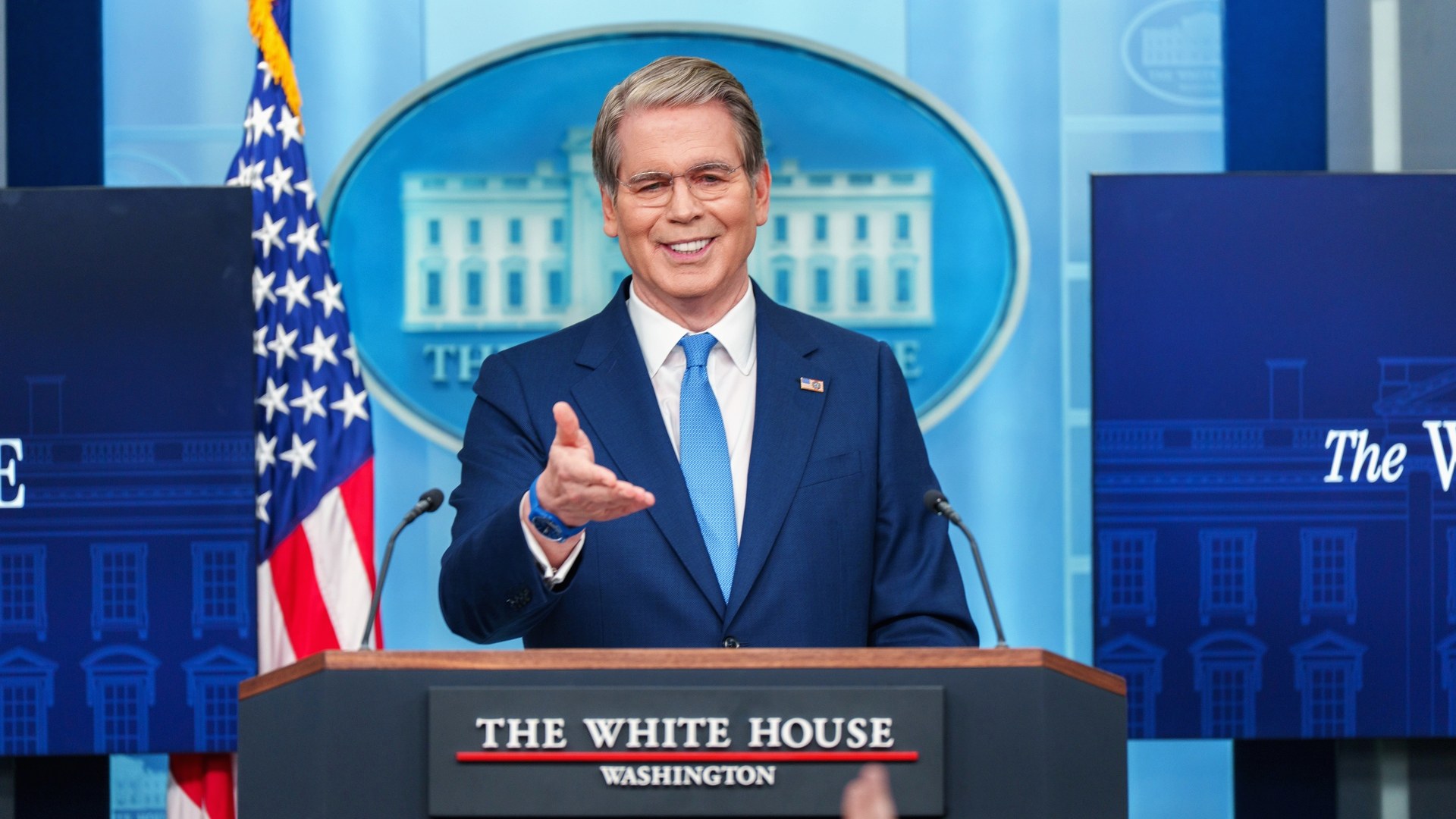
Photo: The White House (official photo by Abe McNatt) — Secretary Bessent holds a press briefing in the James S. Brady Press Briefing Room, May 28, 2026. Public domain, via Wikimedia Commons. File photo.
The demand was delivered on television, which is part of what it was. On Sunday, November 15, three days after Jensen Huang stepped down as chief executive, Treasury Secretary Scott Bessent sat for Fox News' "Sunday Morning Futures" and addressed himself, in public, to the board of the world's most valuable chipmaker. Nvidia's directors and the outside counsel they have hired, he said, need to answer — within the next ten days — for the company's culture of compliance with US export restrictions. Not eventually. Not in the next quarterly filing. In ten days, a window that closes around November 25 and that contains, in its middle, the most scrutinized earnings report in the company's history.
The timing is the message. Huang resigned on Thursday, November 12, after admitting an extramarital affair with a businesswoman US officials suspect of spying for China, and after the New York Times reported a second relationship with one of his direct reports. A petition demanding his reinstatement has passed 115,000 signatures. And on Tuesday, November 17, Nvidia reports quarterly results for the first time without its founder — with Colette Kress, the longtime finance chief, serving as interim chief executive. Into that week, the Treasury Secretary inserted a countdown.
The question is the culture, not the scandal
Bessent was explicit about what he was not asking. Huang's personal conduct — the affairs, the suspected spy — he treated as the founder's own business, a corporate-governance problem for the board. What the Treasury wants examined is colder and larger: whether the company that sells the world's most sought-after AI accelerators built a culture that respected the rules governing where those accelerators may go. "What's more important here," he said, "is to examine whether Nvidia had a culture of compliance around the US export restrictions."
He returned to the point in the form of a question about motive. "I want to keep coming back to what was the culture at Nvidia," Bessent said, "and were they pressing these seemingly illicit sales to goose their revenues and their earnings?" It is the sharpest formulation yet from the administration: not whether individual shipments broke the rules, but whether the pressure to grow — at a company whose revenue depends on insatiable demand for its chips — pushed the institution toward looking away. He reached for a banking comparison: had a regulated bank behaved this way, he argued, the Office of the Comptroller of the Currency would have moved in and taken over. Nvidia is not a bank. The comparison was the point — in Bessent's framing, the company now sits inside the perimeter of national-security enforcement, and it will be judged by the standards of institutions that live there.
The Megaspeed file
The allegations at the center of the demand have a name: Megaspeed, a Singapore-based data center operator. US authorities suspect the company bought Nvidia chips ostensibly for its data centers in Southeast Asia and then transshipped them to China, helping Chinese firms obtain hardware they are barred from buying directly. The Justice Department is running a criminal investigation. Bessent alluded on Sunday to the companies linked to Megaspeed — and to the fact that Alice Huang, the businesswoman at the center of the espionage allegation against the former chief executive, once worked there.
The figures reported so far describe a flow, not a shipment. According to data obtained by The Wall Street Journal, Megaspeed arranged the supply of nearly $12 billion worth of Nvidia chips to Chinese firms between March 2024 and June 2025 — though the records cannot confirm that all of those chips were actually delivered. The Information has reported that at least $7.5 billion in Nvidia hardware moved over two years through Megaspeed and a Malaysian subsidiary. Both figures are reported as arrangements and movements alleged by investigators and journalists; no court has ruled on them, and Megaspeed has not been found to have violated the rules.
Megaspeed, for its part, has answered. In a statement reported by The Times, the company said Alice Huang left it in August 2025 — two months before the first reports that it was under US investigation — and that it conducted "legitimate and lawful business", has hired external legal counsel to conduct a thorough internal investigation, and complies with "all applicable laws and regulatory regimes, including United States export control requirements". China has denied the espionage allegation itself. Nvidia's answer is on the same record: the company said late last month that it had investigated these allegations last year and refuted them, and that it remains committed to preventing chip smuggling.
The fact sheet
Bessent's ten days, in brief
| Field | Detail |
| The demand | Explain Nvidia's export-control compliance culture, and its internal investigation |
| Issued by | US Treasury Secretary Scott Bessent, on Fox News' "Sunday Morning Futures" |
| Date | Sunday, November 15, 2026 — three days after Huang's resignation |
| Addressed to | Nvidia's board of directors and its outside legal counsel |
| Deadline | 10 days — expiring around November 25, 2026 |
| Named intermediary | Megaspeed (Singapore), under a Justice Department criminal investigation |
| Reported scale | ~$12 billion arranged (WSJ); at least $7.5 billion moved (The Information) |
| The red line | No chip more advanced than the H200 may be sold to China |
| Also demanded | A "dramatic shake-up"; the next CEO recruited from outside the company |
| Nvidia's reply | It investigated the allegations last year and refuted them |
| Inside the window | Quarterly earnings, Tuesday, November 17, 2026 |
"A dramatic shake-up" — and a chief executive from outside
The compliance demand was only half of what Bessent said. The other half was about who runs Nvidia next. "This makes me think that as the board conducts a search for a new leader that they need to go outside the company," he said, "that just (with) what was going on inside the company, they need a dramatic shakeup." It is an extraordinary intervention: a Treasury Secretary publicly instructing the board of a listed company on where to recruit its chief executive, and ruling out, by implication, every insider — including the generation of executives Huang built over 33 years.
The board's search is already moving. The Financial Times reported on Friday that the directors have approached Rene Haas, the chief executive of British chip designer Arm Holdings, as a potential replacement — a candidate who is, precisely, an outsider. Against that current runs another one, flowing the opposite direction. A petition to reinstate Huang, organized through a website called standwithjensen.com, has collected more than 115,000 signatures, including current and former employees and self-identified shareholders, and prominent names in technology have signed it. The Financial Times has reported that Silicon Valley allies are preparing to press the board to bring the founder back, and that Huang himself is weighing a comeback. Washington is pushing the company away from its founder; a visible part of its own ecosystem is pushing it back toward him. The board Bessent gave ten days is the board caught between those two forces.
The red line is a chip called H200
To understand what Nvidia is accused of letting slip, it helps to know where the legal line actually runs. The United States forbids the sale of its most advanced AI chips to China, a policy built over several years to preserve an American lead in artificial intelligence. The line is not a total embargo. Late in 2025, President Trump authorized sales of Nvidia's H200 — a powerful but not top-tier accelerator — to approved Chinese customers, on the condition that the US government take a 25 percent cut of the revenue. Everything above the H200 remains barred: the most capable chips, the ones that train frontier models, may not be sold to China at all.
That architecture is what makes the Megaspeed allegations serious rather than merely embarrassing. A chip sold legally to a data center in Singapore or Malaysia becomes a violation only when it is diverted — shipped onward to China, or put to work for Chinese customers in defiance of the rules. Enforcement therefore depends on knowing where hardware ends up, and on the culture Bessent named: whether the seller asks hard questions about its intermediaries, or prefers not to. It is also why the demand was addressed to the board and its outside counsel rather than to a compliance department: the question, as Bessent framed it, is institutional.
On Monday, Washington closed the cloud loophole
The administration did not wait for Nvidia's answer to act on the wider route. On Monday, the Commerce Department's Bureau of Industry and Security issued an interim final rule — RIN 0694-AK50, drafted, BIS said, at the direction of the Treasury Department and the National Security Council — aimed at the remote-access path: until now, a company barred from buying advanced US chips could still rent their computing power from a data center in a third country. Under the rule, a license is required to export advanced chips to a data center anywhere in the world that provides more than 12 million in aggregate processing performance to companies headquartered in China, Macau or other restricted destinations; operators already serving such customers have 90 days from the rule taking effect to obtain one.
The same rule adds a destination-based license requirement for advanced-chip exports to Indonesia, Malaysia, Singapore, Thailand and Brazil, which it identifies as presenting a higher-than-normal risk of diversion — Singapore and Malaysia being the two jurisdictions named in the Megaspeed reporting. And it formally rescinds the previous administration's AI Diffusion Rule, which was never enforced. The rule names neither Nvidia nor Megaspeed. It does something more durable: it writes the suspicion at the heart of the allegations into the export-control code, so that the route itself — chips to a third-country data center, compute to China — now requires Washington's permission in advance.
A deadline that crosses an earnings report
The ten days will not pass quietly. On Tuesday, inside the window, Nvidia publishes its quarterly results — the first since Huang's departure, with Kress leading the call — and every figure in it will now be read against Bessent's question about whether illicit sales were pressed to "goose" revenues and earnings. Congress is moving on its own track: the Senate Banking Committee has summoned both Huang and Commerce Secretary Howard Lutnick to testify, and Huang has also agreed to appear behind closed doors before House committees before Thanksgiving, according to the chairman of the House select committee on China. Bessent, meanwhile, pointed a finger inside the administration itself: at least four federal agencies had urged the Commerce Department to add Megaspeed to the export-control entity list, the Financial Times reported, and the decision rested with Lutnick's department, which did not act.
What the board owes, by around November 25, is an explanation: of the investigation it is running into its former chief executive's conduct, and of the compliance culture that investigation is uncovering. Whether that explanation arrives as a public statement, a filing, or a private accounting to the administration is the board's choice. The deadline is not. Ten days, counted from a Sunday television studio, across an earnings report and two congressional summonses — that is now the calendar of the most valuable chip company in the world.
𝐆𝐄𝐓 𝐅𝐑𝐄𝐄 𝐅𝐔𝐋𝐋 𝐌𝐀𝐆𝐀𝐙𝐈𝐍𝐄 𝐀𝐓 thebuyerspulse.com
Sources
- AFP (November 16, 2026): Bessent on Fox News' "Sunday Morning Futures" — the ten-day demand to Nvidia's board and outside counsel; the "culture of compliance" formulation; the shell-company question; the H200 red line and its late-2025 authorization with a 25% US government cut; the "dramatic shake-up" and outside chief executive; the Megaspeed suspicion and the Justice Department's criminal probe; Nvidia's reply that it investigated the allegations last year and refuted them.
- Reuters (November 15–16, 2026): the "go outside the company" and "dramatic shakeup" quotes; the Financial Times report, cited by Reuters, that Nvidia's board approached Arm chief executive Rene Haas; the FT reports of a possible Huang comeback and of allies preparing to press for his reinstatement.
- The Wall Street Journal (as reported by AFP, The Times and others): transaction records indicating Megaspeed arranged the supply of nearly $12 billion in Nvidia chips to Chinese firms between March 2024 and June 2025, without confirming that all were delivered. The Information: at least $7.5 billion in Nvidia hardware moved through Megaspeed and its Malaysian subsidiary over two years.
- The Times (November 16, 2026): Megaspeed's statement — Alice Huang left the company in August 2025; the company conducted "legitimate and lawful business", hired external legal counsel for a thorough internal investigation, and complies with all applicable laws including US export controls; the "goose their revenues and their earnings" quotation.
- US Bureau of Industry and Security (November 16, 2026): interim final rule RIN 0694-AK50 and accompanying press release — the remote-access licensing control (12 million aggregate TPP threshold), the 90-day window for existing operators, the new license requirement for Indonesia, Malaysia, Singapore, Thailand and Brazil, and the rescission of the AI Diffusion Rule.
- Photo: The White House (official photo by Abe McNatt), May 28, 2026 — public domain, via Wikimedia Commons. File photo; the briefing pictured is unrelated to Sunday's interview.