
300,000 connections in one match: the invisible network inside Everton's new stadium
The best technology in Everton's new home is the kind fans never notice: a wireless-first network, built on HPE Aruba Networking, that recorded more than 300,000 concurrent connections at a single match — in a stadium of 52,769 seats. This is what sustaining that number actually takes.
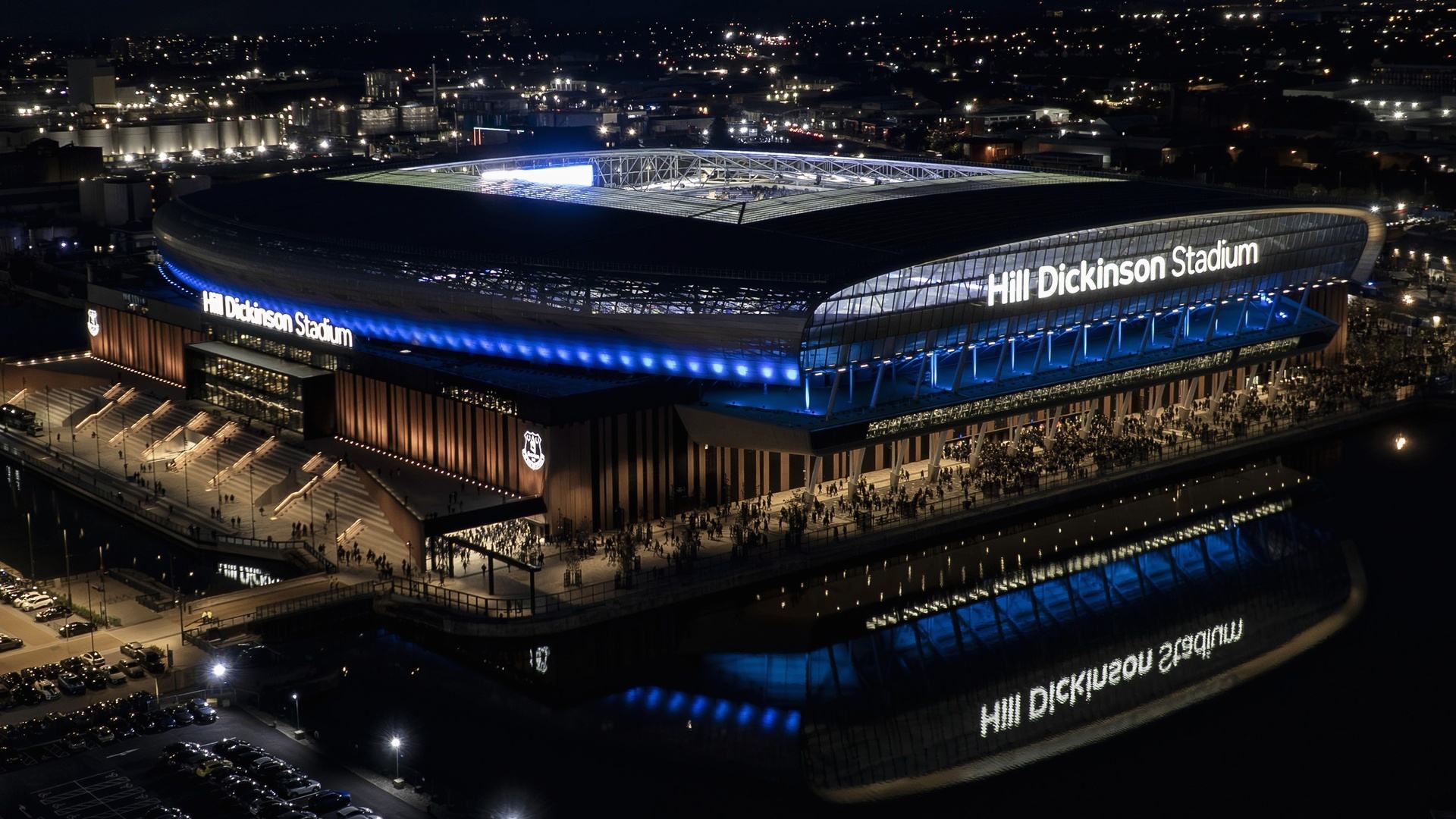
Photo: HPE — official customer story “Building football's new field of dreams” (a50014200enw), press material published by HPE. Night aerial of Hill Dickinson Stadium.
The most important technology inside Everton Football Club's new home is the one nobody is supposed to notice. Hill Dickinson Stadium, the 52,769-capacity ground the club moved into in August 2025, was designed wireless-first: more than 750 hardened access points sit hidden under the seats of the bowl, and at the most recent match in HPE's customer story, the network recorded more than 300,000 concurrent connections — in a stadium that holds fewer than 53,000 people. This is the story of what it actually takes to sustain that number, told from the primary source: HPE's official customer story on the deployment (document a50014200enw), which HPE reshared on LinkedIn last week, on November 11, 2026.
A note on timing, because this magazine prints it rather than implying a launch that did not happen today: the stadium opened in August 2025, when Everton's men's team relocated from Goodison Park. HPE's customer story — created in late October 2025, during the stadium's first season — documents the deployment as built. HPE published the case video on its official YouTube channel and brought the story back to its social channels this month: the video circulated on HPE's Facebook, Instagram and Threads on November 6, and the written case was reshared on HPE's LinkedIn on November 11. What follows is not a product announcement. It is a documented, operating network, one full season of matchdays deep — which is precisely why it is worth reading closely.
A stadium that opened with the network already inside
Everton's previous home, Goodison Park, was built in 1892. It had wooden stands, obstructed views and a shrinking capacity of under 39,000. The new stadium, built on the site of Liverpool's Bramley-Moore Dock — the dock itself preserved underneath, repaired, sealed and filled with 480,000 cubic metres of sand dredged from the Irish Sea — raises capacity by roughly a third, to 52,769. But the club did not treat the move as a construction project with Wi-Fi added at the end. “The site is wireless first,” the HPE story states, and the building was conceived as a year-round, flexible event space: football stadium on Saturday, concert venue, tour destination or conference centre during the week, with cafés, bars and restaurants open all year and a plaza outside the East Stand that can host 17,000 people on its own.
That brief changes the network's job description. A matchday-only network can be a fixed installation, tuned once. A venue that reconfigures itself between a Premier League match, a concert and a corporate conference needs connectivity that can be reconfigured as fast as the seating plan — and Everton's director of IT, Phil Davies, frames the whole design around change: “We've spent a great deal of time considering how different users will interact with the stadium. Not just fans, but operations teams, security, broadcasters, the media, and visitors. We know this experience will change over time. We want to capture the data to help us understand these changes.”
Under every seat, a radio
The seating bowl is where stadium networks go to die. Tens of thousands of human bodies — each one mostly water, each one an excellent absorber of radio signals — pack shoulder to shoulder, and nearly every one of them is carrying a phone that wants to upload video at the exact moment a goal goes in. The conventional answer, a few powerful access points mounted high on the roof or the fascia, asks each radio to serve thousands of clients through a forest of bodies. Everton and HPE Aruba Networking chose the opposite geometry: put the radios under the seats.
In the bowl, more than 750 HPE Aruba Networking 518 Series Hardened Access Points are installed under seats, delivering what the story calls high-density, low-latency connectivity “even at peak times”. The physics are the point: a phone is never more than a few metres from its access point, the signal path crosses one or two bodies instead of five thousand, and each cell stays small enough that the same spectrum can be reused a few rows away. Indoors, away from the bowl, 635 Series Campus Access Points maintain coverage through the concourses and hospitality areas; outdoors, 575 and 577 Series Outdoor Access Points light up the fan plazas and the temporary structures that appear and disappear around events.
The air interface is Wi-Fi 6E, deployed extensively. Where regulation allows, Everton uses the full 6E spectrum; where it does not, the story says the network falls back on comprehensive 5 GHz coverage, with expansion planned for future events and additional fan zones. Fans join through a portal managed by HPE Aruba Networking Central's guest capability, designed for easy onboarding and quick reconnection — the unglamorous detail that decides whether 18,000 people register on the network or give up and crowd the cellular bands instead.
The number: 300,000 connections is not 300,000 people
The headline figure deserves a careful reading, because it is easy to misprint. Davies, in the HPE story: “There were more than 300,000 concurrent connections recorded at the most recent game.” Connections, not people, and not devices either. A single phone can hold several connections at once; a point-of-sale terminal, a turnstile, a security camera and a staff tablet each hold their own. The story lists the population explicitly: “thousands of concurrent devices — from spectators' phones to digital ticketing, turnstiles, security cameras, staff tablets, and point-of-sale terminals.”
Set against it, the human number: at a recent game, 18,000 fans were registered on the Wi-Fi network, and Davies expects that figure to rise over the season. Both numbers matter, and they measure different things. The 18,000 tells you how far fan adoption of the stadium Wi-Fi has travelled in the first season. The 300,000 tells you what the infrastructure actually carried at its peak — the sum of every association, session and stream the venue's systems opened at once, most of them invisible to the crowd. A network designed only for the registered fans would have been built roughly an order of magnitude too small for the building it serves.
That is the first lesson this deployment offers anyone designing for density — in a stadium, a campus, a hospital or a big-box store: design for connections, not for seats. The seat count is the number marketing prints. The connection count is the number the network feels.
One pane of glass over all of it
At the heart of the architecture sits HPE Aruba Networking Central, the cloud-managed platform that gives Everton unified oversight of the wireless infrastructure across the entire stadium. Running on HPE Aruba Networking Wireless Operating System 10, it streamlines provisioning, monitoring and troubleshooting from a single pane of glass. The story stresses what that buys operationally: rapid deployment, dynamic reconfiguration for different event profiles, and real-time analytics for optimising network performance.
Central is also where the wired and wireless halves of the design meet the club's cloud strategy. Everton keeps its most critical workloads on-premises — building management systems, CCTV and player performance analytics — while systems such as CRM and ERP run in the cloud. “We're trying to embrace the cloud as much as we can,” says Davies, “with the assurance that we can retain maximum control over sensitive data. Again, HPE Aruba Networking Central allows us to see what's happening in real time.” One management plane, two hosting models, and a single operational picture of a building in which, as Davies puts it elsewhere in the story, there is very little that is not connected.
The wired spine underneath
Wireless-first does not mean wireless-only; it means the wireless layer is where users live, on top of a wired core built for failure. In each of the stadium's two on-site data centres, Everton deploys two HPE Aruba Networking CX 8400 Switch Series chassis switches as the resilient backbone, connected to CX 6300 Switch Series access switches distributed through communications rooms around the venue. Outdoors, ruggedised CX 4100i Switch Series units serve 12 outdoor cabinets — a detail the story itself links, dryly, to the winter weather on the banks of the River Mersey.
The stadium reaches the internet through four 10 Gb circuits, and the roadmap in the story points outward: future overlays are planned to unify remote sites — including the Finch Farm training ground — into a single private network. “We're moving away from MPLS,” Davies says. “HPE Aruba Networking EdgeConnect SD-Branch enables us to take security very seriously. We have around 5,000 endpoints on the network, and SD-WAN allows us to move quickly, at scale, with the right security controls in place.” Five thousand managed endpoints is the wired reality behind the wireless headline: the bowl's radios are the visible edge of a switched, segmented, centrally managed estate.
The data layer that runs the matchday
The network's second product is not connectivity. It is visibility. “One of the big things for any venue — particularly of this size — is to know what's going on at any given time,” Davies says. “Through the wireless network, we have the ability to see, in real time, what is going on in every corner of the stadium.” HPE's LinkedIn retelling of the case names the three feeds plainly: crowd flows at the turnstiles, how many people are connected to the network, and sales at every concession point. The case video shows what those feeds are for: deciding, while the match is still running, whether a given corner of the stadium needs more pies, more beer or more stewards.
That is the operational loop the whole design feeds. Digital ticketing brings fans into the Everton app; the app carries the loyalty programme; fast, ubiquitous Wi-Fi supports frictionless retail, including just-walk-out stores; more than 800 TVs hang on the network; nearly 5,500 premium seats (against 1,500 at Goodison) carry tiered digital services ready for future rollout. Real-time data helps operations manage crowds, attack waiting times and reallocate service teams while there is still time for the change to matter. The fan experiences the sum of it as nothing at all — which is the design goal, stated in the case video's best line: the best technology is the technology fans never notice. Davies tells the story of a supporter who reported that the Wi-Fi was so good he had booked a holiday from his seat — and of the counter-complaint, from other fans, that people should be watching the match instead of their phones.
Segmentation is the security story
A network that carries fans, tills, cameras, turnstiles, police and broadcasters on shared infrastructure is a security design before it is a convenience. Everton and HPE Aruba Networking segment traffic with multiple virtual routing and forwarding instances (VRFs), separating data for fans, operations and third parties — explicitly including emergency services, police and broadcasters. HPE Aruba Networking ClearPass Policy Manager authenticates staff devices, and the story records plans to expand certificate-based security and dynamic segmentation for IoT and operational technology. The wired core's hybrid split does the rest: the most sensitive workloads never leave the building, while the cloud carries the systems that benefit from it.
What a high-density designer should steal from this
Read as a design document rather than a trophy case, the Everton deployment reduces to a short list of decisions that transfer to any dense venue — an arena, a convention centre, a university campus, a flagship retail floor:
Design for connections, not seats. The peak the network carried — 300,000-plus concurrent connections — was roughly six times the seat count. Put the radios where the bodies are. More than 750 under-seat access points trade a large number of small cells for a small number of heroic ones, and win on latency at peak. Use every band the regulator gives you. Full Wi-Fi 6E spectrum where allowed, comprehensive 5 GHz where not — planned as one design, not two. Centralise the management plane. One platform provisions, monitors and reconfigures the whole estate per event profile; the alternative is a building full of individually tended boxes. Treat the data as a product. Turnstile flows, connection counts and concession sales feed decisions during the event, not a report after it. Segment by trust from day one. Fans, operations and third parties share hardware, never a trust zone. And build the spine for failure: duplicated core chassis in two data centres, ruggedised switching outdoors, four diverse 10 Gb exits.
“There's very little in this stadium that's not connected,” Davies concludes. “The network is driving everything. We're probably the most frictionless stadium in the UK.” The claim is a vendor case study's claim, and this magazine prints it as one — attributed, from HPE's own story. But the architecture underneath it is documented in unusual, checkable detail: named hardware, named counts, a named manager willing to put a number on the peak. In a category of technology that succeeds by being invisible, Everton's network has done something rarer than working. It has been measured.
Published November 17, 2026. All figures, hardware models and quotations are from HPE's official customer story, “Building football's new field of dreams” (a50014200enw), and HPE's official posts of November 6 and 11, 2026; no figure in this piece comes from any other source.
𝐆𝐄𝐓 𝐅𝐑𝐄𝐄 𝐅𝐔𝐋𝐋 𝐌𝐀𝐆𝐀𝐙𝐈𝐍𝐄 𝐀𝐓 thebuyerspulse.com
Sources
- HPE, official customer story (PDF a50014200enw, created October 30, 2025): “Building football's new field of dreams — Everton applies digital layer to create new standards in matchday experience — Everton Football Club.” All figures, hardware models and quotations in this piece are from this document: capacity 52,769; move in August 2025; more than 750 under-seat 518 Series hardened APs; 635 Series campus APs; 575/577 Series outdoor APs; Wi-Fi 6E full spectrum where regulation allows, comprehensive 5 GHz elsewhere; 18,000 fans registered on Wi-Fi at a recent game; “more than 300,000 concurrent connections recorded at the most recent game” (Phil Davies, director of IT, Everton); HPE Aruba Networking Central on AOS 10; two CX 8400 chassis in each of two on-site data centres; CX 6300 access; CX 4100i in 12 outdoor cabinets; four 10 Gb internet circuits; ~5,000 endpoints; VRF segmentation; ClearPass; EdgeConnect SD-Branch; 800+ TVs; ~5,500 premium seats; Budweiser Plaza capacity 17,000.
- HPE, official YouTube channel: “The Technology Behind Matchday | Everton FC + HPE” (video ID 7R4EroyX-00, 2:26) — the case video embedded in this article, with the “best technology is the technology fans never notice” line and the turnstile/concession/steward decision examples.
- HPE, official social posts: case video shared on HPE's Facebook, Instagram and Threads on November 6, 2026; written case reshared on HPE's LinkedIn on November 11, 2026 (“More than 300,000 concurrent connections in a single game… Real-time data shows crowd flows at the turnstiles, how many people connect to the network, and sales at every concession point”).
- Photo: HPE press material from the same customer story (see credit under the hero image). The Commons alternative could not be downloaded in this run — upload.wikimedia.org returned HTTP 429 throughout; see paquete.md, Deviations.