
Baidu's ERNIE 5.5 Flash activates 14 billion of its 280 billion parameters — and its weights go open on November 25
At Baidu World 2026 in Beijing on November 12, Baidu released ERNIE 5.5 Flash Preview: a 280-billion-parameter foundation model that activates only 14 billion parameters per token, reads a million tokens of context, and is priced at ¥1 per million input tokens on Qianfan. It arrived with two application models, a Token Exchange for buying model services — and a promise to open-source its weights by November 25.
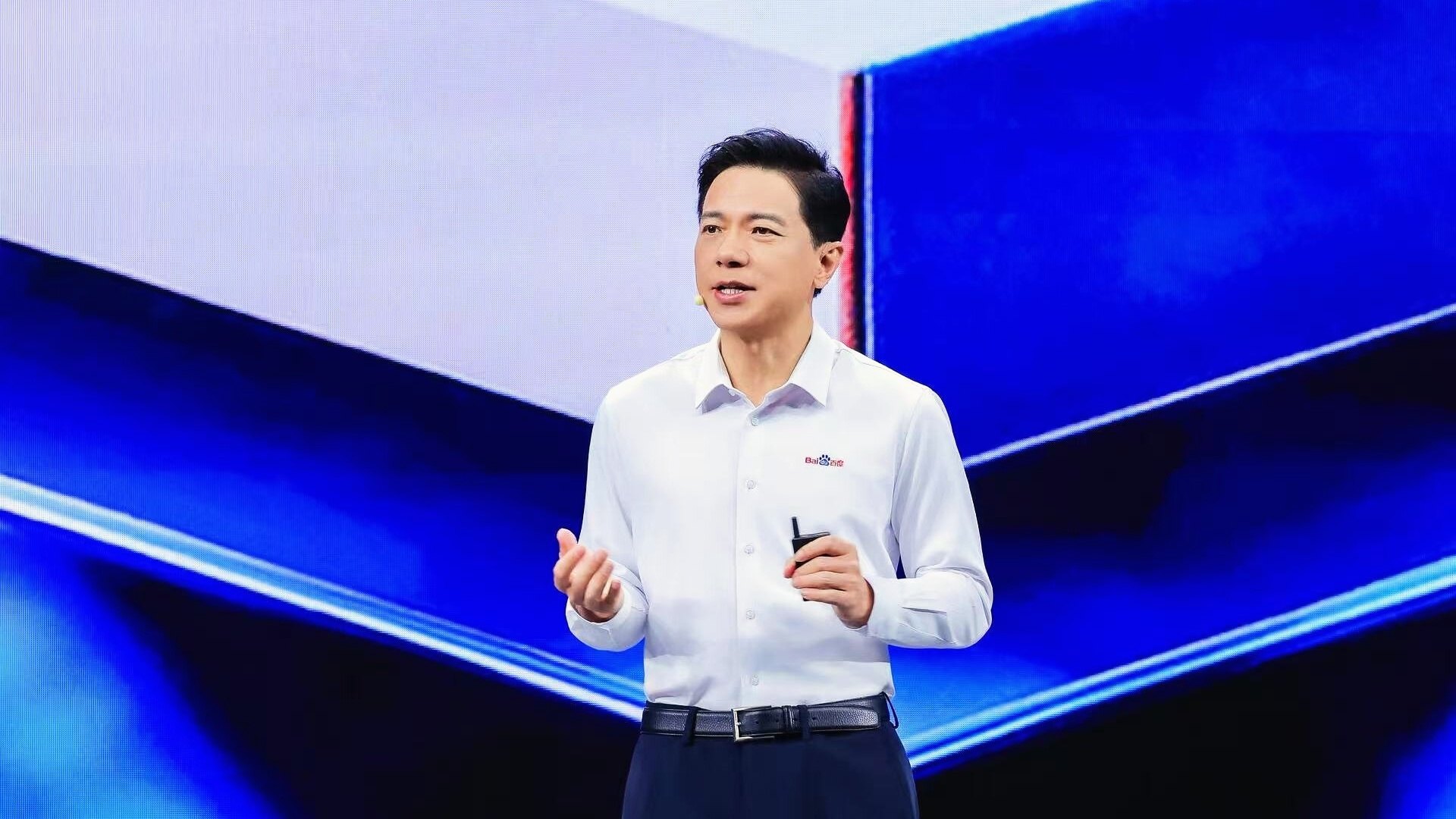
Photo: Baidu via PR Newswire — official press photo distributed with the November 12 Baidu World 2026 release. Native master 1,920 × 1,280 px.
The announcement: a model built to be cheap at scale
At Baidu World 2026, its annual conference in Beijing, Baidu used November 12 to present the next version of its foundation model line — and the headline is an exercise in restraint. ERNIE 5.5 Flash Preview carries 280 billion parameters in total, but activates only 14 billion of them for each token it processes: a sparse mixture-of-experts design that aims to deliver frontier-class capability at the inference cost of a far smaller model. It supports a context window of one million tokens, and Baidu says it performs strongly in coding, 3D modelling, knowledge work and content creation.
The company was explicit about the trade the model is making. ERNIE 5.5 Flash Preview "balances intelligence with inference efficiency": across benchmarks including Terminal-Bench and AutomationBench — tests of coding and automation work — Baidu reports competitive scores while maintaining extremely fast decoding speed. The model is tuned with ERNIE Evolve, Baidu's proprietary recursive self-improvement technology, aimed squarely at inference efficiency and cost. All benchmark claims are Baidu's own, published in its launch release; independent evaluations had not appeared at the time of writing.
Preview means preview
The name carries a qualification the company did not hide. "Preview" designates an intermediate stage of post-training: coverage of the launch in the trade press, citing Baidu's own release notes, notes that some capabilities may still fall short and that further improvements are expected in an official version. The API, however, is not a preview artefact — it is live now on Baidu AI Cloud's Qianfan platform, and the model is also available free on OpenRouter, an unusual dual move that puts the same weights in front of Chinese enterprise customers and the global developer crowd at once. The open-sourcing of the weights is promised by November 25 — a date the industry will hold Baidu to, because an open ERNIE at this scale would be the largest Chinese foundation model released for anyone to run.
Two specialists ride along
The foundation model did not arrive alone. ERNIE Wizshot Micro-Expression is an application model for highly expressive video creation: it processes text, images and speech together, accepts long-form input of up to 4,000 Chinese characters, and Baidu says it leads the industry for podcasts and short animated dramas at half the typical cost. ERNIE Light Deep Thinking, originally developed for multimedia search, is built for complex requests and tool calls at search-scale speed: a fast-thinking model serves users while a slow-thinking model continuously refines it in a closed loop, and a proprietary Baidu Sparse Attention mechanism compresses historical memory during decoding to cut inference cost. The pattern across all three releases is the same — the frontier Baidu is competing on this year is not raw capability but capability per yuan.
A marketplace for tokens themselves
The second launch of the day may outlast the model. Token Exchange is a marketplace where model service providers list their capacity and customers compare services side by side with pricing and performance data — described by Robin Li, Baidu's co-founder and CEO, as an exchange for foundation models. Its trust machinery has two pillars: verification, which compares model fingerprints and tests capability, performance and availability of each listed resource; and credit rating, built from regular spot checks and real-time monitoring of calls end to end.
One month in, Baidu says, the exchange has onboarded more than 100 model resources and handles a daily average of more than 50 million calls and over 700 billion tokens. Those are company-reported figures with no independent audit — but the strategic logic is legible without them. If models commoditise, the durable business is the exchange: the neutral venue where supply and demand meet, with the trust layer as the product.
The intelligent organisation, demonstrated at home
Li's keynote framed the launches inside a thesis about companies themselves. "If AI is the new electricity, then the intelligent organisation is the new factory of the AI era, where productivity truly happens," he said, laying out three principles: break down job boundaries, because organisations will be built around tasks rather than jobs — "Jobs won't disappear, but they will converge into roughly two types: Builders, who create new things, and Sellers, who connect with people"; capture tacit knowledge as a shared asset — "a capability that competitors can't copy, hire away, or buy. That's what a real moat looks like"; and design closed-loop processes, on the formula that measurability plus looping equals continuous evolution.
Baidu offered its own operations as the evidence. Over the past year, daily active agents inside the company rose from 5,000 to 37,000; agents now complete more than one million tasks a week, up from 84,000; the company has built 4,300 workspaces and captured more than 20,000 organisational skills. Its agent lineup was upgraded in step: DuMate became the unified gateway to Baidu's specialised agents, with its Harness engine and Agent API fully opened — DuMate's team reports more than 160 iterations in six months, with 90% of its code generated by DuMate itself. KOOKO, the document and creative workspace, draws on 1.8 billion professional resources and 750 million academic papers. Famou 3.0, the self-evolving operations agent, now counts customers in 25 of China's 41 industrial categories. And beneath the agents, the silicon: Baidu AI Cloud launched the Tianchi 1024-card Supernode with all-optical interconnect, while its Kunlunxin chip unit confirmed the M100 inference chip has shipped and the flagship M300 is expected in 2027.
The full-stack framing extended to the road. Apollo Go, Baidu's autonomous ride-hailing service, now covers 28 cities worldwide and has logged more than 350 million autonomous kilometres, over 240 million of them fully driverless; it has launched fully driverless commercial operations in Abu Dhabi and Dubai, and partnered with CAR Inc. in Hainan on what Baidu describes as the world's only driverless car-rental model. "Embodied AI is now at a stage comparable to where autonomous driving stood in 2016," Li said — a claim that, like the rest of the keynote's figures, is the company's own, offered here as the clearest available map of where Baidu intends the models to end up: not in a chat window, but in organisations and machines.
What thrills
- Efficiency as the spec: 14 billion active parameters against a million-token window, priced at ¥1 per million input tokens — a frontier bid aimed at cost per task, not leaderboard height.
- Open weights, dated: a public commitment to open-source the weights by November 25, with the API already free to try on OpenRouter.
- The exchange idea: Token Exchange attacks the discovery and trust problem of a fragmenting model market — 100+ resources and 700 billion tokens a day in its first month, by Baidu's count.
What to watch
- Preview caveats: Baidu's own notes concede incomplete capabilities; the benchmark story is the vendor's until independent tests land.
- Company-reported scale: the Token Exchange volumes and Baidu's internal agent figures are unaudited claims from the seller of both.
- The November 25 test: the open-weights promise is the launch's most checkable claim — its licence terms and completeness will decide how the release is remembered.
China's frontier, priced for volume
Read against the week's other launches, ERNIE 5.5 Flash Preview completes a pattern. In the same seven days, Google shipped a model that only scores and a model priced flat for everyone; Baidu's answer is a model engineered to activate a twentieth of itself per token, sold through an exchange designed to make tokens a traded commodity. The competition among frontier labs is visibly migrating from who has the largest model to who can serve intelligence at the lowest marginal cost — and Baidu, which operates one of the largest AI workloads on earth inside its own company, is betting that the operator's seat is the one that wins.
Whether the bet pays off turns on the two promises now on the calendar: an official, non-preview version that closes the capability gaps Baidu itself flagged, and open weights in public hands by November 25. Both are verifiable within weeks — which, for a launch built on efficiency claims, is exactly the right kind of accountability.
𝐆𝐄𝐓 𝐅𝐑𝐄𝐄 𝐅𝐔𝐋𝐋 𝐌𝐀𝐆𝐀𝐙𝐈𝐍𝐄 𝐀𝐓 thebuyerspulse.com
The data sheet
ERNIE 5.5 Flash Preview (Baidu)
| Field | Detail |
| Announced | November 12, 2026 — Baidu World 2026, Beijing |
| Architecture | Sparse mixture of experts — 280B total parameters, 14B activated per token |
| Context | 1,000,000 tokens |
| API price | ¥1 per million input tokens; ¥4 per million output; cached input ¥0.04 (Qianfan) |
| Availability | Qianfan API (live); free on OpenRouter |
| Open weights | To be open-sourced by November 25, 2026 (Baidu) |
| Tuning | ERNIE Evolve — proprietary recursive self-improvement (RSI) for inference efficiency |
| Launched alongside | ERNIE Wizshot Micro-Expression; ERNIE Light Deep Thinking; Token Exchange; Tianchi 1024-card Supernode |
Sources
- Baidu, Inc., press release via PR Newswire (November 12, 2026): 'Baidu Unveils Latest ERNIE Models Amid Broader Full-Stack AI Lineup, and Debuts Token Exchange to Power Intelligent Organizations' — ERNIE 5.5 Flash Preview's parameters, context, benchmarks and pricing; the two application models; Token Exchange's verification system and first-month figures; Robin Li's keynote and the three principles; Baidu's internal agent figures; DuMate, KOOKO, Famou 3.0, Tianchi Supernode, Kunlunxin and Apollo Go.
- Launch coverage and Baidu release notes as reported November 12–14, 2026 (Unite.AI; AI trade press): the 'Preview' designation as an intermediate post-training stage, with some capabilities possibly incomplete.
- Photos: Baidu via PR Newswire — Robin Li at Baidu World 2026, official press photos distributed with the November 12 release.