
AMD, Nvidia's biggest rival, accused of leaving its server code running inside blacklisted Chinese servers
The accusation is specific, and it is aimed at the second-biggest name in AI chips. According to an investigation published on Thursday by Hunterbrook Media, the server firmware of AMD — the base code that makes its chips run inside servers — keeps appearing in software updates from IEIT Systems, a Chinese server manufacturer placed on the US Entity List in March 2025. At least six new versions since the blacklisting, the most recent dated October 19, 2026. AMD says the claims misrepresent its practices and that it complies with US export controls. Hunterbrook itself says its material does not directly prove a violation. The market, on Thursday, did not wait for the distinction: AMD lost 7.72% of its value in a single session.
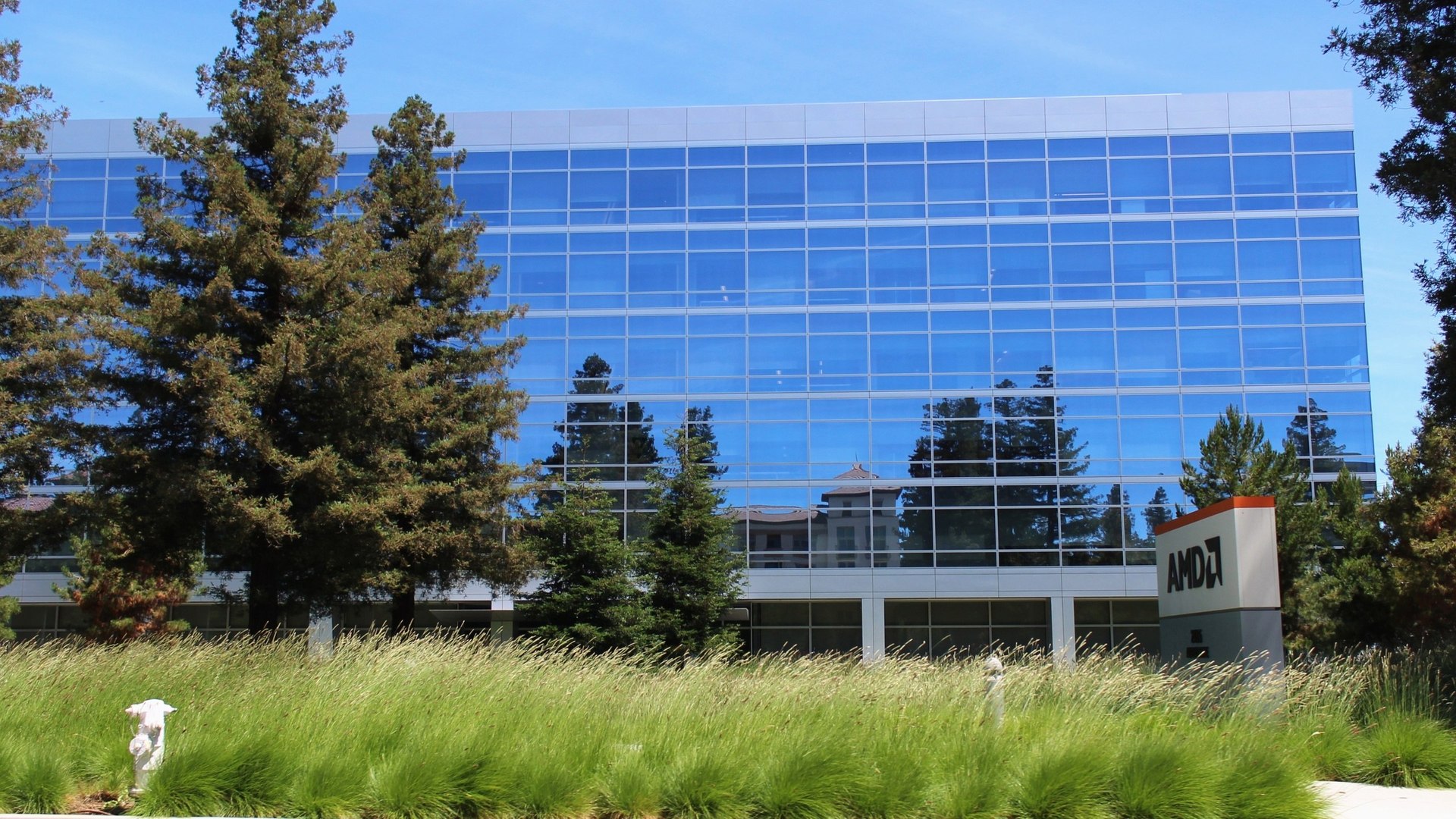
Photo: Coolcaesar — “2485 Augustine Drive headquarters in Santa Clara, California”, CC BY-SA 4.0, via Wikimedia Commons. File photo of the company's headquarters.
The report is titled “AMD Has Its Own China Problem”, and Hunterbrook Media published it on Thursday, November 19, 2026. Its central claim is narrow and checkable: the server firmware of AMD — the base code that makes AMD's chips run inside servers — continues to appear in the software updates of IEIT Systems, a Chinese server manufacturer. IEIT was placed on the Entity List of the US Department of Commerce in March 2025: the blacklist that restricts a foreign company's access to American technology. According to Hunterbrook, the firmware did not stop at the listing. It kept shipping.
The count the investigation puts on the record is at least six new versions of the firmware since IEIT entered the list, the most recent dated October 19, 2026 — a month before the report appeared. And the trail, according to Hunterbrook, does not end at IEIT itself. Three companies linked to IEIT — Maginfra, in China; Kaytus, in Singapore; and Aivres, in California — sell servers running firmware that is 99.94% identical to IEIT's. On the report's own terms, the code at issue is not a stray fragment: it is, in substance, the same code, in machines sold on three sides of the Pacific.
What the report does not prove — in its author's own words
The most important paragraph of the Hunterbrook investigation is the one that limits it. Hunterbrook states, in its own reporting, that it does not know how IEIT obtained the code, and it does not know whether a license existed covering it. Its material, by its own declaration, does not directly prove a violation of US export controls. This magazine prints that limit at the same size as the accusation, because without it the story reads as a verdict, and it is not one.
What the limit means in practice is this: code travels. It travels through licenses, through partners, through agreements signed before a blacklist entry and through channels that a document trail — not a firmware comparison — has to establish. Hunterbrook has shown, on its account, where the code is. It has not shown how the code got there, and it says so. The distance between those two findings is exactly the distance between a scandal and an open question, and on Thursday that distance was worth watching in real time, because the stock market priced the scandal first.
AMD's answer: the claims “misrepresent” its practices
AMD denies the accusation. In its response, the company said the claims misrepresent its practices and its relationships, and stated its position in the terms that matter for an export-control story: “AMD complies with applicable US export control laws and regulations.” The denial is part of the verified record of this story, and it travels with the accusation everywhere this magazine reports it: what exists today is a documented claim by an investigative outlet, an explicit denial by the company accused, and a central fact — the route by which the code reached a blacklisted manufacturer — that neither side has yet established in public.
That is also why the story is published as a developing one. If the code's route turns out to be a license, the accusation deflates. If it turns out to be something else, the consequences run in the opposite direction. Neither outcome is in the record yet, and this magazine will not pretend otherwise: the follow-up lines at the end of this article state plainly what is known and what is not.
The accuser profits if the stock falls
One more fact belongs in the open, because it shapes how the report should be read. Hunterbrook Capital, the investment fund affiliated with Hunterbrook Media, disclosed a short position in AMD when the investigation was published: it makes money if AMD's shares fall. That disclosure is the outlet's own, made at publication, and it does not make the reporting false — the firmware findings stand or fall on the code. But a reader weighing an accusation is entitled to know who profits from its impact, and on Thursday the impact was immediate and enormous.
The same day, The Bear Cave — a newsletter owned by Hunterbrook Media — published separate doubts about “circular financing” between AMD and its customers, of the kind that have also weighed on Nvidia. Two fronts, one owner, one day: that is the context in which AMD's shareholders absorbed the report, and it is recorded here for the same reason the short position is. The accusation deserves to be examined on its evidence. It also deserves to be examined whole.
One session, about $67 billion gone
The market's reading took hours, not weeks. AMD opened at 542.17 on Thursday, touched a high of 555.01 and a low of 470.56, and closed at 489.19 — down 7.72% from the previous close of 530.14. Reuters described an 8% fall on the day; The Wall Street Journal put the market value erased in the session at about US$67 billion. It was the kind of move usually reserved for a proven regulatory blow, delivered instead on an attributed accusation and a denial.
The number that traveled furthest on Thursday was not the verified one. Posts on LinkedIn spoke of a 13% fall in thirty minutes, over a chart that showed the stock down 9.87% at one intraday moment. Those figures describe a screenshot at a moment of the session; they are not the session. The hard number, the one this magazine prints as its own, is the close: −7.72%. In a story whose entire subject is the difference between a claim and a proof, the distinction is not a detail.
Why “China” is the heaviest word in AMD's accounts
The reason an accusation joining three terms — AMD's code, Chinese servers, the Entity List — lands the way this one did sits in AMD's own numbers. In its fiscal 2025, AMD billed US$7.75 billion to customers in China and Hong Kong: about 22% of its revenue, against 9.1% for Nvidia. It billed a further US$4.28 billion to customers in Singapore — the same Singapore where, according to Hunterbrook, one of the three IEIT-linked companies sells servers running firmware 99.94% identical to IEIT's.
That exposure cuts both ways, and the cut is the story's real tension. A company with a fifth of its revenue billed into China and Hong Kong has the most to lose from any genuine export-control problem — and the most to lose from an unproven one that the market treats as genuine for a session, or for longer. AMD's denial is categorical; Hunterbrook's limit is explicit; the route of the code is unknown. What happens next depends on evidence that has not yet been produced in public, by anyone.
What is known so far
- Hunterbrook Media published the investigation “AMD Has Its Own China Problem” on Thursday, November 19, 2026.
- IEIT Systems, a Chinese server manufacturer, was placed on the US Department of Commerce's Entity List in March 2025.
- According to Hunterbrook, at least six new versions of AMD's server firmware appeared in IEIT updates after the listing; the most recent is dated October 19, 2026.
- According to Hunterbrook, three companies linked to IEIT — Maginfra (China), Kaytus (Singapore) and Aivres (California) — sell servers with firmware 99.94% identical to IEIT's.
- AMD denies the claims: it says they misrepresent its practices and relationships, and that it complies with applicable US export control laws and regulations.
- Hunterbrook Capital, the fund affiliated with Hunterbrook Media, disclosed a short position in AMD when the report was published.
- AMD closed Thursday at 489.19, down 7.72% on the day; The Wall Street Journal put the market value erased in the session at about US$67 billion.
What is not known
- How IEIT obtained the code — Hunterbrook says it does not know.
- Whether a license covered the code's presence in IEIT's updates — Hunterbrook says it does not know that either.
- Whether any export-control violation occurred — Hunterbrook's material does not directly prove one, and AMD says it complies with the applicable laws and regulations.
- Any response from US authorities — none appears in the reporting verified for this story.
This story remains under active follow-up. We are watching for any further word from AMD, from Hunterbrook, or from the US authorities.
Published Friday, November 20, 2026.
𝐆𝐄𝐓 𝐅𝐑𝐄𝐄 𝐅𝐔𝐋𝐋 𝐌𝐀𝐆𝐀𝐙𝐈𝐍𝐄 𝐀𝐓 thebuyerspulse.com
Sources
- Hunterbrook Media (November 19, 2026): “AMD Has Its Own China Problem” — the investigation: AMD server firmware appearing in updates from IEIT Systems after its March 2025 Entity List inclusion; at least six new versions, the most recent dated October 19, 2026; Maginfra, Kaytus and Aivres selling servers with firmware 99.94% identical to IEIT's; and its own declared limit — it does not know how IEIT obtained the code or whether a license existed, and its material does not directly prove a violation of export controls.
- AMD (statement, November 19, 2026): the claims misrepresent its practices and relationships; “AMD complies with applicable US export control laws and regulations.”
- Reuters (November 19, 2026): AMD's 8% fall on the day and coverage of the report and the company's denial.
- The Wall Street Journal (November 19, 2026): about US$67 billion of market value erased in Thursday's session.
- Barron's · Investor's Business Daily · Motley Fool (November 19, 2026): same-day market coverage and session data — open 542.17, high 555.01, low 470.56, close 489.19 (−7.72%), previous close 530.14 — and AMD's fiscal 2025 billing to customers in China and Hong Kong (US$7.75 billion, about 22% of revenue, against Nvidia's 9.1%) and Singapore (US$4.28 billion).
- Hunterbrook Capital: short position in AMD disclosed at the report's publication. The Bear Cave, a newsletter owned by Hunterbrook Media (November 19, 2026): “circular financing” doubts about AMD and its customers.
- Photo: Coolcaesar — “2485 Augustine Drive headquarters in Santa Clara, California”, CC BY-SA 4.0, via Wikimedia Commons. File photo of AMD's headquarters.