No wheel, no pedals — just a screen that says Cybercab: Tesla opens orders at $29,990, plus $299 a month to move
Tesla invited select customers on Friday night to order the two-seat Cybercab for personal use at $29,990 before taxes, with a $1,000 non-refundable deposit and December 2026 delivery in Austin. The car has no steering wheel or pedals — and it will not operate without a $299-a-month Autonomy Subscription, inside eight geofenced cities in Texas and Florida.
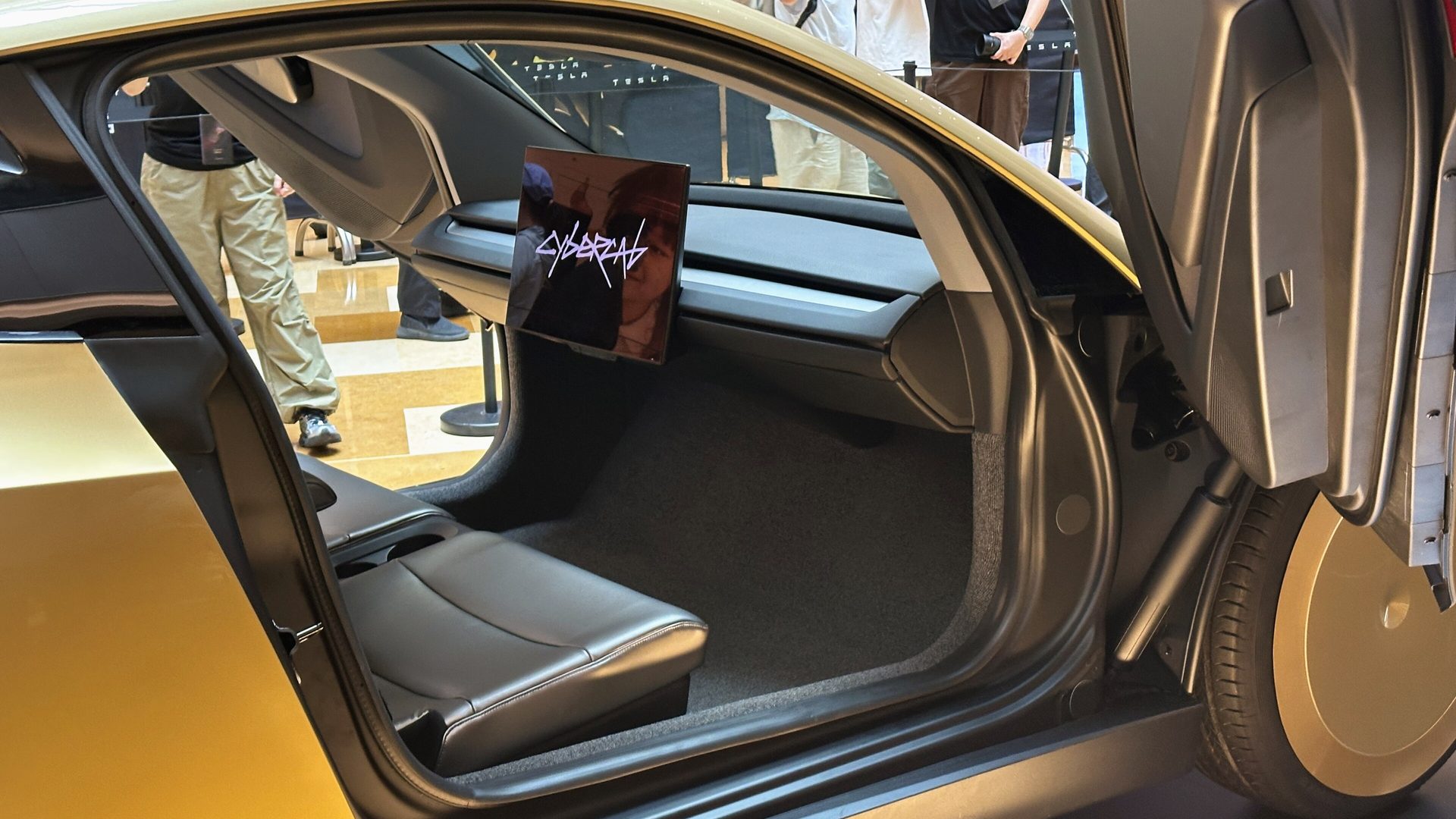
Photo: JustAnotherCarDesigner, Wikimedia Commons (CC0). Cropped and colour-graded.
The photograph at the top of this article is the whole story in one frame. A gold two-seater stands with its butterfly door raised. Where a driver would sit, there is nobody and nothing to drive with: no steering wheel, no brake pedal, no accelerator. The footwell is empty carpet. In the middle of the dashboard a single screen is lit, and the word on it is the name of the car itself — Cybercab. Everything Tesla announced on Friday night follows from that empty footwell. A car with no controls cannot be driven by its owner at all. It can only be operated by software — and Tesla has now put a monthly price on that software, and made it a condition of the car moving.
On Friday evening, November 13, Tesla's official Robotaxi account on X announced that “select customers” were being invited to purchase the Cybercab for personal use, posting screenshots of the invitation email and the order page. It is the first time the dedicated robotaxi Tesla unveiled at its “We, Robot” event in October 2024 has been offered to private owners. The opening is limited: Tesla has not said how many invitations went out, how recipients were chosen, or when — or whether — orders will open to the general public. The invitation email itself carries the limits in its fine print, as Electrek reported: “Only available in supported service areas. Subscription required for operation.”
The order page, line by line
The terms, as reported by TechCrunch on November 14 and confirmed in Electrek's and The Verge's readings of the order page and the invitation, are specific. The price is $29,990 before taxes — ten dollars under the under-$30,000 figure Elon Musk promised at the 2024 unveiling. Ordering requires a $1,000 deposit, and the deposit is non-refundable. The estimated delivery date is December 2026, in Austin, Texas; reporting by TechCrunch, citing tech reviewer Marques Brownlee's account of the order flow, adds that buyers must accept delivery in one of a handful of Texas cities. Purchases are limited to one vehicle per customer, according to the terms reported by TeslaNorth and others.
Then comes the line that turned a car launch into a business-model story. Pre-checked on the order page is an “Autonomy Subscription” at $299 a month, with the first month included. The order page's own fine print reads: “Subscription and regular vehicle maintenance required to operate.” A copy of Tesla's Autonomy Subscription Agreement — version 20261112, shared on X the day orders opened and reported by Electrek and TeslaNorth — states the consequence in one sentence: the Cybercab “will not operate without an active Autonomy Subscription.” The Verge reported that the subscription covers autonomous driving, maintenance and towing, but not insurance, and that Tesla can change the price with 30 days' notice.
A car that is also a service
That structure is what makes this launch different from every previous Tesla sale. Tesla's other cars are sold complete: their driver-assistance software, Full Self-Driving, is an optional extra, and the car drives without it because a person drives it. The Cybercab removes the person from the equation by design. There is no fallback mode in which an owner simply takes over, because there is nothing to take over with. The autonomous system is not a feature of the car; it is the car's only way of moving. A subscription that can lapse, be suspended or be repriced therefore sits between the owner and any use of the vehicle at all — a relationship closer to a connected service than to a conventional purchase, even though the purchase itself is real: a $29,990 car, a non-refundable deposit and a delivery window.
The arithmetic follows directly from the order page's own numbers. At $299 a month, the subscription adds $3,588 a year. Over five years — with the first month included, so 59 paid months — it adds $17,641, bringing the five-year total for car plus subscription to $47,631 before taxes, insurance and charging, as Electrek calculated. The Verge's five-year calculation lands in the same place, at roughly $47,600. None of those figures includes the taxes and fees the purchase agreement warns can add 10 percent or more to the vehicle's price.
Eight cities, and a fence inside the fence
The second limit is geographic. The Cybercab will operate only inside the geofenced areas where Tesla already runs its Robotaxi service. Tesla's head of AI, Ashok Elluswamy, put it this way: the car will work “unsupervised inside all the same geo locations as @robotaxi, just serving the owners' needs.” Those locations, as Electrek, The Verge and Engadget all report, are eight cities: Austin, Dallas, Houston, Fort Worth and San Antonio in Texas, and Miami, Orlando and Tampa in Florida. The Autonomy Subscription Agreement, as reported, reserves Tesla's right to expand, shrink or relocate those areas, and states that coverage for a privately owned car may not match the Robotaxi service exactly.
Even the advertised fences are larger than the service inside them, according to independent testing cited by Electrek. Tracker Koby Pierce tested thousands of addresses in the Robotaxi app and found that the zones where Tesla actually accepts pickups and drop-offs cover only 59 to 78 percent of the advertised geofences in the six cities checked — about 59 percent in Austin, the city where the first customer deliveries are scheduled. Musk, replying on X, framed the map as a starting point: the Cybercab “will be available nationwide, as we receive regulatory approval.” For the December 2026 launch, however, the operating map on record is the eight-city one.
The commercial ban — a robotaxi that cannot take fares
The third limit is the one that closes the economic loop. The order terms, as The Verge reported, “explicitly prohibit owners from using the vehicle for commercial purposes — meaning no Uber, no DoorDash, and no putting it on Tesla's own Robotaxi network.” Electrek's reading of the subscription agreement says the same: owners are barred from putting the car on the Robotaxi network or using it for ride-hailing. The vehicle designed from a blank sheet as a robotaxi therefore cannot, under its launch terms, earn the fares a robotaxi exists to earn; the monthly fee cannot be offset by putting the car to work. The Verge reported that Elluswamy has floated the second quarter of 2027 as a possible point at which customer-owned cars might join the network — a possibility mentioned by an executive, not a date Tesla has formally confirmed.
Musk against his own price — and the bet about a haircut
The most quoted reaction to the launch came from Tesla's own chief executive. Marques Brownlee — MKBHD, the tech reviewer with one of the largest audiences in consumer technology — posted his reading of the order page on Friday night and then argued, in a post headed “My hair is safe for several reasons,” that the launch does not settle a famous bet. Musk replied directly to Brownlee's breakdown: the Cybercab “will be available nationwide, as we receive regulatory approval. But the monthly fee is too high. Should match the cost of Tesla FSD and connectivity for other models, which is more like ~$115/month.” The sentence does two things at once: it concedes that the headline condition of the car — the $299 fee — is, in the chief executive's own words, too high, and it names the level he says it should match, roughly $115 a month. It is a statement of intent about a future price, not a price change: the order page still lists $299.
The bet behind the exchange dates to October 2024. After the “We, Robot” unveiling, Brownlee said there was no way Tesla would deliver a Cybercab to a customer for $30,000 or less before 2027 — and that if it did, he would shave his head on camera. Musk has returned to the bet repeatedly: in February, when the first production Cybercab came off the Giga Texas line, and again in September, when Brownlee doubled down and Musk answered, “I guess he really wants to shave his head.” Brownlee's position this weekend is that the bet turns on delivery to regular customers, and that an invite-only order page, with no deliveries yet made and delivery limited to Texas cities, is not that. Musk, in a separate reply about Brownlee's hair, answered: “He's a chicken.” Electrek, which reported the exchange on November 15, noted the calendar pressure underneath it: Tesla has about seven weeks to get a Cybercab into a customer's hands for under $30,000 before 2027. Brownlee, for his part, posted a screenshot of his own confirmed Cybercab order — “I'm tryna see something.” The bet will be settled, one way or the other, by whether a car is delivered in December, not by the order page.
What is not settled yet
Several open questions sit around the launch, and the reporting is careful about which are facts and which are processes still running. The December 2026 delivery date is an estimate printed on an order page, not a delivery; no customer Cybercabs had been delivered when orders opened. The Verge reported that the National Highway Traffic Safety Administration has opened a formal audit into how Tesla self-certified a vehicle built without a steering wheel, pedals or side mirrors, and that the review is pending; Engadget reported the audit query was opened shortly after the Cybercab entered commercial service as a robotaxi. Tesla's path beyond the eight launch cities runs through regulatory approval, in Musk's own formulation. And the subscription price itself is now publicly contested by the company's chief executive, while remaining, for anyone ordering today, $299 a month.
What Friday night established is narrower and, for the industry, more consequential than any of those open questions. The first purpose-built robotaxi offered for private ownership has arrived as a bundle: a $29,990 vehicle, a non-refundable $1,000 deposit, an eight-city operating map, a ban on commercial use — and a monthly subscription without which, by the terms of Tesla's own agreement, the car will not operate. The empty footwell in the photograph is the design. The $299 line on the order page is the business model built on top of it. Which of the two defines the Cybercab will be decided by what Tesla delivers in December — and by whether the fee on the order page is still $299 when it does.
𝐆𝐄𝐓 𝐅𝐑𝐄𝐄 𝐅𝐔𝐋𝐋 𝐌𝐀𝐆𝐀𝐙𝐈𝐍𝐄 𝐀𝐓 thebuyerspulse.com
Sources
- Tesla Robotaxi account on X (Nov 13, 2026): the invitation announcement, with screenshots of the invitation email and the order page.
- TechCrunch (Nov 14, 2026, 12:04 PT): “Tesla opens Cybercab pre-orders 'for personal use,' with geo restrictions and a $299 monthly fee” — delivery in Texas cities, the geofence and the December 2026 estimate.
- Electrek (Nov 13, 2026): “Tesla Cybercab orders open at $29,990 + $299/mo, only in Robotaxi zones” — order-page terms, the eight Robotaxi cities, the Koby Pierce coverage tests and the five-year arithmetic.
- Electrek (Nov 15, 2026): “Is Tesla rushing out a half-baked Cybercab just to shave MKBHD's head?” — the Musk–Brownlee exchange, the “chicken” reply and the bet's history.
- The Verge, as reported Nov 14–15, 2026: the $1,000 non-refundable deposit, the commercial-use prohibition, what the subscription covers, the 30-day repricing notice and the NHTSA audit.
- Tesla Autonomy Subscription Agreement (version 20261112), as reported by Electrek and TeslaNorth: “will not operate without an active Autonomy Subscription.”
- Elon Musk on X (Nov 14, 2026), replying to Marques Brownlee: “the monthly fee is too high… more like ~$115/month”; “will be available nationwide, as we receive regulatory approval.”
- Photo: JustAnotherCarDesigner, “Tesla Cybercab” (Sep 19, 2026), Wikimedia Commons, CC0.