
The racks behind China's open frontier model: LongCat-2.5 runs on Huawei, not Nvidia
Meituan has released the full weights of LongCat-2.5, a 1.6-trillion-parameter model for long-horizon agents, under the MIT license. Its own documentation describes training on Chinese accelerators and a sample deployment on 194 Huawei Ascend Atlas A2 chips — with no Nvidia GPU anywhere in the official path.
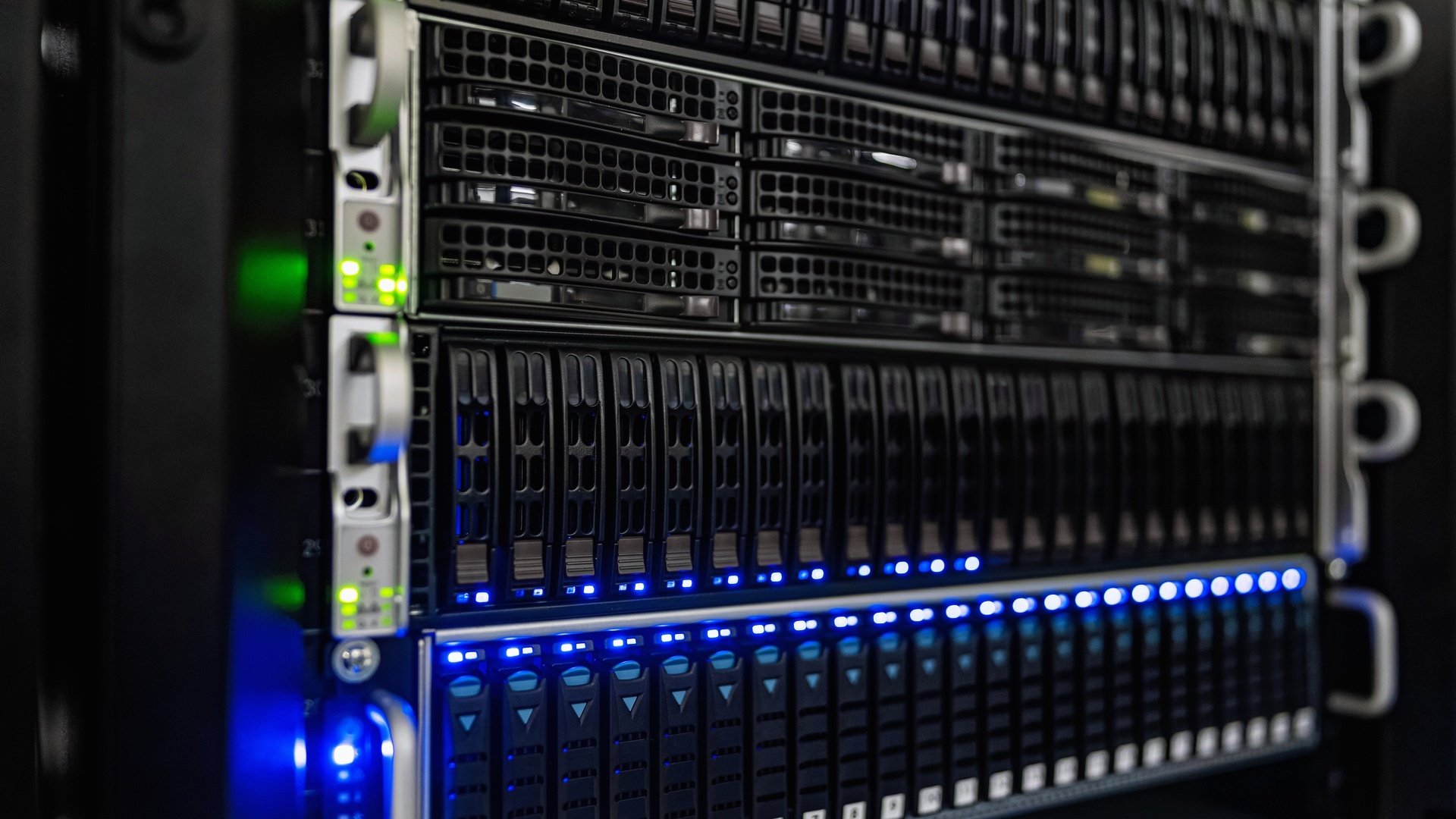
Photo: NOIRLab/NSF/AURA/T. Slovinský — “NOIRLab HQ Server Racks” (2022), CC BY 4.0, via Wikimedia Commons.
The photograph above is a close-up of the machines themselves: powered server units stacked in a rack, numbered drive bays, ventilation grilles and rows of blue and green status lights. It is not Meituan's facility, and this magazine does not claim otherwise. But it is the right picture for this story, because the news about LongCat-2.5 is not, in the end, about a chatbot. It is about which machines a frontier-class artificial intelligence model is allowed to stand on. Meituan, the Chinese food-delivery and local-services giant, has released the full weights of a 1.6-trillion-parameter model built for autonomous agents — and its own documentation describes a model trained on Chinese accelerators and deployed on Huawei hardware, with no Nvidia GPU anywhere in the official path.
The timing sharpened the contrast. The weights release drew wide international coverage on November 15, when The Decoder reported the story under a headline that stated the point directly: a 1.6-trillion-parameter agent model that never touched an Nvidia GPU. That coverage lands in the week Nvidia reports its quarterly results and faces an open governance crisis around its leadership — a week in which the default assumption of the industry, that serious AI runs on Nvidia silicon, is being questioned from two directions at once. LongCat-2.5 is the hardware direction of that question, stated in documentation rather than in a press release boast.
What was released, and when — the real chronology
This is not a launch that happened today, and precision about the dates matters because several early reports compressed them. Meituan presented LongCat-2.5 on November 2, 2026. The Hugging Face repository, meituan-longcat/LongCat-2.5, was created on November 4. On November 10, Meituan announced that the weights were open-sourced under the MIT license, explicitly allowing commercial inference, deployment and secondary training without further authorization. The full checkpoint is large by any standard: about 3.56 terabytes of BF16 weight files, split across 194 safetensors shards, alongside a separate repository for the 4-bit quantized build. November 15 is when the release reached the wider technology press, led by The Decoder — a second wave of attention, not the release itself.
One metadata curiosity deserves a single line, attributed to its source: Hugging Face's own tensor accounting sums to roughly 1.78 trillion stored parameters, against the 1.6 trillion Meituan declares on the card. Meituan has not reconciled the two figures; anyone planning storage should size from the actual files, not the headline.
The model itself: a native multimodal system for long agent work
LongCat-2.5 is a mixture-of-experts model, which means that although the full network holds 1.6 trillion parameters, only a subset of its specialized subnetworks — about 48 billion parameters — is activated for each token it processes. It is natively multimodal: visual information is converted into discrete tokens and processed in the same shared space as text, so the model reads screenshots, charts and images, and accepts video by URL, alongside ordinary text. The design target, in Meituan's description, is the long-horizon agent: software that works through multi-step tasks autonomously over extended sessions, particularly coding — building and repairing whole codebases, operating a command line, browsing for information and using tools — rather than answering single questions.
The hosted API reflects that target. It offers a context window of one million tokens, supports both a step-by-step thinking mode and a faster non-thinking mode, and is exposed through endpoints compatible with the major API conventions. None of that is unusual on its own in late 2026. What is unusual is the stack underneath it.
The hardware is the story: trained without Nvidia
According to Meituan's documentation, as reported by The Decoder on November 15, LongCat-2.5 was trained entirely on Chinese hardware, with no Nvidia GPUs in the training process. The claim has a documented predecessor: Meituan says it trained LongCat-2.0, the model 2.5 builds on, entirely on a cluster of more than 50,000 Chinese AI chips. The 2.5 model card itself speaks of infrastructure optimizations on domestic AI accelerators, and its only official deployment path is an NPU path — through Meituan's SGLang-FluentLLM serving stack — with no recipe published for Nvidia hardware at all.
The deployment guide is where the claim becomes concrete enough to check. Meituan quantizes the model's expert weights and activations to 4-bit precision — the W4A4 scheme documented on the model card — a format that Chinese accelerators process natively in INT4. Against an 8-bit baseline, Meituan reports 43.3 percent higher prefill throughput and 42.77 percent higher decode throughput in its own online stress tests; those are the company's figures, from its own card, and they are labeled as such wherever this magazine cites them. The sample self-hosting configuration built on that quantization runs on 194 Huawei Ascend accelerators from the Atlas A2 series, divided by function: 2 accelerators handle image processing, 64 handle prompt ingestion, and 128 handle response generation. There is no corresponding guidance for Nvidia GPUs — not a note saying it is unsupported, simply no guidance at all.
The fact sheet
LongCat-2.5, per Meituan's official model card
| Field | Detail |
| Developer | Meituan (LongCat team) |
| Presented | November 2, 2026 |
| Weights opened | Announced November 10, 2026, under the MIT license (repository created November 4) |
| Architecture | Native multimodal mixture of experts |
| Parameters | 1.6 trillion total declared; ~48 billion active per token (Hugging Face metadata sums ~1.78 trillion stored) |
| Context | 1 million tokens (hosted API) |
| Checkpoint size | ~3.56 TB in BF16; separate W4A4 4-bit build |
| Training hardware | Chinese accelerators throughout, per Meituan via The Decoder; no Nvidia GPUs |
| Sample deployment | 194 Huawei Ascend Atlas A2: 2 image · 64 prompt ingestion · 128 generation |
| API price (promotional) | $0.30 per million input tokens · $1.20 output · $0.006 cached input |
The benchmark number, with its owner attached
The figure that traveled furthest is a benchmark score: 88.4 on Terminal Bench v2.1, a test of how well an agent solves real tasks in a command-line environment, against 89.1 for Anthropic's Claude Opus 5 in the same table. Read carefully, the table itself supplies the caution. Meituan's model card states that scores it measured in-house are “indicative only,” and the rival scores in its comparison are cited from public reports rather than measured on one common harness. No independent laboratory had reproduced the 88.4 in the coverage published through November 15, and newer rival models are absent from the comparison. The honest statement is narrower and still significant: by its developer's own measurements, clearly labeled as its own, an open Chinese model sits within a point of a leading closed American model on an agent benchmark. Whether it stays there under independent testing is a question the coming weeks will answer; the weights being public means anyone with the hardware can run the check.
The price, and what it does and does not change
For teams that do not want to move 3.56 terabytes, Meituan also sells access. The promotional API rate is $0.30 per million input tokens and $1.20 per million output tokens, with cached input at $0.006 per million — a limited-time rate, stated as such by the company. Prices like that reset expectations for what agent workloads should cost, and they are part of why the release drew attention beyond the open-weights community. But the MIT license is the structural fact: the weights can be downloaded, modified, fine-tuned and run commercially without asking Meituan for anything, on hardware the license does not dictate. The hardware path Meituan documents simply happens to be Huawei's.
What this does not prove
Three cautions belong in the record. First, the training-hardware claim is Meituan's, reported by The Decoder from the company's documentation; the company's own posts describe domestic accelerators without naming a vendor for the training run itself — the Huawei name is explicit in the deployment guide, which is a different claim, and this article keeps the two separate. Second, self-hosting remains a server-room undertaking: a multi-terabyte checkpoint and a 194-accelerator reference deployment are not a hobbyist weekend, whatever the license says. Third, a benchmark table published by a model's own developer is a starting point for verification, not its conclusion — the same standard this magazine applies to every vendor, in every country.
What remains, after the cautions, is the fact the photograph points at. For a decade, the geography of advanced AI compute has had one center: American-designed accelerators, manufactured in a concentrated supply chain, exported under tightening controls. LongCat-2.5 is documented evidence — in a public model card, a public deployment guide and a public repository anyone can inspect — of a frontier-scale model whose entire official life cycle, training and serving alike, runs somewhere else. The racks in the photograph are anonymous. The ones in Meituan's guide have a name, a count and a division of labor: 194 Huawei Ascend Atlas A2 accelerators, and not one Nvidia GPU in the document.
𝐆𝐄𝐓 𝐅𝐑𝐄𝐄 𝐅𝐔𝐋𝐋 𝐌𝐀𝐆𝐀𝐙𝐈𝐍𝐄 𝐀𝐓 thebuyerspulse.com
Sources
- Meituan LongCat, official model card: meituan-longcat/LongCat-2.5 on Hugging Face (read live November 15, 2026) — 1.6 trillion total parameters, ~48 billion activated per token, native multimodal MoE, W4A4 quantization (+43.3% prefill throughput vs W8A8, Meituan's own stress tests), NPU-only deployment via SGLang-FluentLLM, evaluation table with the note that in-house scores are “indicative only” (Terminal Bench v2.1: LongCat-2.5 88.4; Claude Opus 5 89.1, cited), MIT license.
- LongCat official blog (longcat.ai), “Introducing LongCat-2.5” — model presentation of November 2, 2026, and Meituan's open-source announcement of November 10, 2026 (weights under MIT; repository created November 4, 2026; ~3.56 TB in BF16; Hugging Face metadata sums ~1.78 trillion stored parameters).
- The Decoder, November 15, 2026: “Meituan releases a 1.6 trillion parameter agent model that never touched an Nvidia GPU” — training entirely on Chinese hardware; LongCat-2.0 trained on more than 50,000 Chinese AI chips; sample deployment of 194 Huawei Ascend Atlas A2 accelerators (2 image · 64 prompt ingestion · 128 generation); no Nvidia guidance; promotional API pricing.
- Photo: NOIRLab/NSF/AURA/T. Slovinský, “NOIRLab HQ Server Racks” (2022) — CC BY 4.0, via Wikimedia Commons (File:NOIRLab HQ Server Racks (6V6A0402-CC).jpg; original 5472×3648). The pictured facility is illustrative and is not identified as Meituan's.